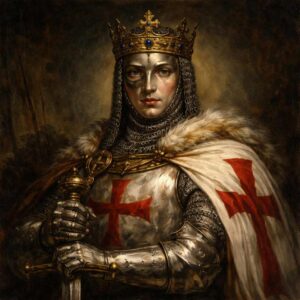
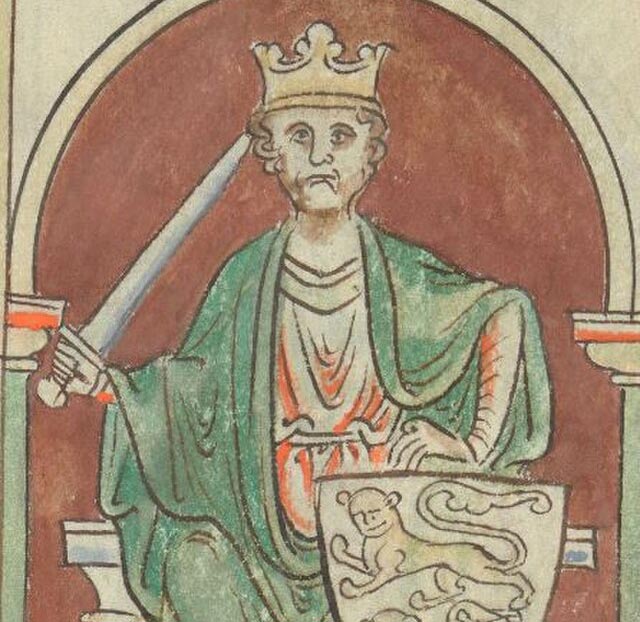
Prologue: Before the Lion
Before Richard ever drew a sword, the world he would inherit was a thicket of loyalties and rivalries stretching from northern England to the warm rivers of Aquitaine. His grandfather, Geoffrey of Anjou, had married the Empress Matilda, and from that marriage sprang the Angevin claim to England.
His father, Henry II (r. 1154–1189), built that claim into a sprawling federation—what later writers dubbed the Angevin Empire—binding England to Normandy, Anjou, Maine, Touraine, Brittany (by overlordship), and, through a dazzling marriage, Aquitaine.
That marriage was the axis of everything that followed. In 1152 Henry wed Eleanor of Aquitaine, the most powerful heiress in western Europe, newly divorced from the king of France and in command of lands from the Loire down to the Pyrenees.
Theirs was a union of prodigious talents and equal wills. Together they had sons who would spend their lives testing the limits of blood, territory, and patience: Henry the Young King, Richard, Geoffrey, and John.
Henry II’s reign brought legal reforms, sheriffs and circuits, scutage and writs—the mundane machinery that made a medieval state actually function. But it also produced civil war in miniature within the royal household. Eleanor refused to be a passive duchess; Richard would not be a second son content with scraps.
France’s king—first Louis VII, then his formidable son Philip Augustus—listened, smiled, and did what French kings did best: waited for Angevin brothers to quarrel and then nudged the fire.
Into this world of law, intrigue, and sharpened lances Richard was born.
Birth, Parents, and the Making of a Duke
Richard of Poitiers was born on September 8, 1157, at Beaumont Palace in Oxford—third surviving son of Henry II and Eleanor. If England gave him breath, Aquitaine gave him soul. He grew up in the south, in the courts of Poitiers and Bordeaux, a place that spoke in lyric poetry and counted honor in tournaments and chevauchées.
Tutors trained Richard in Latin and law, but music and verse touched him too. He learned to ride as though made for a saddle, to couch a lance with the easy arrogance of a prince, and to wield a sword with a control that would become his signature.
At age fourteen, Richard was betrothed to Aquitaine itself. In 1172, his father invested him as Duke of Aquitaine and Count of Poitou.
The gift was iron wrapped in velvet; Aquitaine was vast but unruly. Its barons guarded their independence as jealously as a miser guards coin. Richard’s early education therefore happened not in a schoolroom but before castle walls—Taillebourg, Castillon, Bouteville—as he crushed rebellions and taught the south that the young duke meant what he said.
He ruled hard, sometimes too hard, and his severity made enemies he would never entirely shake. But he gained what a medieval prince needed most: a reputation. Men who fought him learned he was brave to the point of recklessness and coldly methodical the moment the trumpets ceased.
The Rebellions Against Henry II
The Angevin brood did what ambitious princelings did in the twelfth century: they rebelled against their father. In 1173–1174, urged on by Eleanor and encouraged by King Louis VII, Henry the Young King rose against Henry II, and Richard and Geoffrey joined him.
The rebellion sprawled from Scotland to Aquitaine. It failed, but the peace left its scars. Eleanor was captured and spent years under watch. Richard, forgiven but hardly docile, returned south to do his father’s will in Aquitaine with renewed ferocity.
The uneasy truce did not last. Henry the Young King died in 1183, leaving the path to the Angevin inheritance narrowed. Richard, now the strongest son, refused to give up Aquitaine at his father’s command. There were skirmishes, reconciliations, betrayals.
Throughout, the young Philip II of France (Philip Augustus), who had come to the throne in 1180, smiled his fox’s smile and offered friendship to Richard. Philip’s friendship was never free; it was an investment designed to pry open the Angevin structure from within.
By 1188, two events fixed Richard’s course. The first was public: the fall of Jerusalem to Saladin in 1187, news that jolted Christendom. The second was private and deadly: the collapse of trust between father and son. In the heat of those days, Richard did something shocking—he did homage to Philip for his French lands and allied with him against Henry II.
In a grinding campaign across Anjou and Maine, the coalition wore the old king down. When Henry died in July 1189, defeated and betrayed, he left a crown that could not wait. Richard was now king of England, duke of Normandy, count of Anjou, and lord of Aquitaine—and he had a crusade to fight.
Coronation, Consolidation, and the Kingdom He Barely Saw
Richard was crowned at Westminster on September 3, 1189. The day was brilliant and troubled. Anti-Jewish violence erupted around the coronation and spread beyond London in the weeks that followed—an ugly stain on the opening of a chivalric reign.
Richard punished rioters, but his eyes were already on the horizon. He raised money as if time were a wolf at the door—selling offices, farming fines, and emptying the tallies—to fund the largest single project of his life: the Third Crusade.
To secure the realm in his absence, he named regents—most notably William Longchamp, bishop of Ely—and placed his brother John under strict limits. He settled with the powerful William Marshal. He forged truces with Scotland and with the counts who mattered in France.
England he treated like a treasure chest to be locked and left; Normandy and Aquitaine were the chessboard on which he planned to fight Philip after the crusade. For now, though, the cross called—and Richard answered with all the energy that made people call him Cœur de Lion, the Lionheart.
Why the Crusade? Zeal, Politics, and Opportunity
The fall of Jerusalem in 1187 shook the Christian world. Henry II and Philip had responded with a tax—the Saladin Tithe—to fund a recovery. Richard, by temperament a warrior and by culture a prince of Aquitaine steeped in crusading songs and legends, took the cross early.
There was genuine piety here: he endowed monasteries, took counsel with churchmen, and spoke with the effortless conviction of a man who thought God favored courage. There was also politics. The crusade offered a theater where Richard could outshine Philip, tie up troublesome vassals overseas, and return with a prestige that would make French claims waver.
In 1190, the two kings set out by different routes. Philip sailed for the Levant via Genoa; Richard moved through the Mediterranean, gathering momentum like a storm.
Sicily: A Lesson in Leverage
Richard reached Messina in September 1190. Sicily was in turmoil: King William II had died, Tancred had seized the throne, and Richard’s sister Joan, William’s widow, had been detained with her dowry withheld. Richard did what Richard did: he occupied Messina, forced negotiations, freed Joan, and wrung a settlement from Tancred.
He wintered there, the ships in harbor like a promise, and fell out with Philip over money and marriages. This was the pattern that would define their crusade: cooperation when necessary, rivalry at every turn.
Cyprus: A Kingdom Taken Mid-Voyage
In April 1191, storms scattered the fleet. Richard’s ships sought shelter on Cyprus, then under the rule of Isaac Komnenos, a Byzantine offshoot who fancied himself independent. Isaac made the mistake of molesting shipwrecked crusaders and insulting the English king.
Richard landed, defeated Isaac in brisk engagements, and took Cyprus in a matter of weeks. The island was a jewel: a supply base, a treasury, a strategic anchor for the whole crusading effort. Richard later sold or transferred its control—first to the Templars, then to Guy of Lusignan, the dispossessed king of Jerusalem—planting the seed of the Kingdom of Cyprus that would outlast the crusader states on the mainland.
On May 12, 1191, at Limassol, Richard married Berengaria of Navarre, brought out from the west by his mother Eleanor. It was a political match, amiable if not aflame, and the bride would spend much of her life apart from her husband. The marriage changed very little about what came next: war.
Acre: The Anvil of the Crusade
The great siege of Acre had begun in 1189, a brutal stalemate of trenches, towers, disease, and attrition. Philip arrived first; Richard reached the siege in June 1191. Even sick with fever, he threw himself into the work, directing engineers, sappers, and assaults with the precision that made his enemies careful. In July 1191, the city surrendered.
Inside Acre’s walls, months of hatred broke loose: arguments over spoils, banners torn down, personal slights tallied like blood-debts. Richard ripped down Leopold of Austria’s standard from the ramparts—an insult with a long, vengeful echo.
Then came one of the darkest moments of the crusade. Negotiations with Saladin over the release of prisoners stalled—hostages, money, and the True Cross were the moving parts—while the crusaders struggled to feed the city and push south.
In August, Richard ordered the execution of thousands of Muslim captives outside Acre’s walls (chroniclers usually say ~2,700). It was meant to break stalemate and to deny Saladin bargaining chips. It stained the campaign with a memory that no victory could entirely wash away.
Arsuf: The Lionheart’s Signature Battle
After Acre, Philip soon sailed home, leaving Richard as the western spearpoint. The army marched south along the coasttoward Jaffa, keeping the Mediterranean to their right so the fleet could resupply. Saladin, master of harassment, attacked the column continuously with horse archers and light cavalry, trying to draw the crusaders into a rash charge that would open their flanks.
Near Arsuf on September 7, 1191, Richard’s discipline held until the moment did not. The Hospitallers on the rear begged to charge; he told them to wait. When the pressure became a crush, Richard unleashed his heavy cavalry in a coordinated assault, wheeling the line like a door on a hinge.
The charge smashed Saladin’s forward elements and won a clear, clean field victory. It did not destroy Saladin’s army; very little could. But it re-established Latin morale, secured the coast to Jaffa, and announced that Richard was not just a siege captain—he was a battlefield commander whose timing could be lethal.
The March Inland and the Question of Jerusalem
With Jaffa secure, the road inland opened. Twice—over late 1191 and early 1192—Richard marched toward Jerusalem. Twice he turned back near Beit Nuba, within sight of the city’s walls. Why? Logistics, weather, and the cold clarity of strategy.
The supply lines were long; winter rains turned roads to glue; and Richard feared that even if he took Jerusalem he could not hold it, cut off from the coast by Saladin’s mobile army and counter-sieged by a foe who knew the terrain.
These withdrawals were not cowardice; they were judgment. Richard preferred to keep the coastal spine, secure Acre, Caesarea, Arsuf, Jaffa, and Ascalon, and shape a realm that could survive his departure. It was a strategic vision at odds with the crusading dream of pilgrims kneeling in the Holy Sepulchre—but it was the only plan that made military sense.
Jaffa Taken, Jaffa Saved, and the Treaty of Jaffa
In July 1192, Saladin struck Jaffa, took the city, and threatened to throw the crusaders back into the sea. Richard was aboard ship, preparing to leave, when news came.
He turned around, landed with a small force, and fought one of the most daring actions of his life—retaking Jaffa with a handful of knights and a wall of crossbowmen, whose bolts stitched the air and made Saladin’s horsemen think better of a close fight. The defense steadied the line and saved the campaign from dissolving into retreat.
Both commanders were spent. Saladin’s treasury and men were tired; Richard’s coalition frayed, and the storm brewing in Europe demanded his return. They began to negotiate. The terms—finalized in September 1192—are known as the Treaty of Jaffa: the crusaders would hold a coastal strip from Jaffa to Tyre; Ascalon’s walls would be dismantled; Muslim rule would hold Jerusalem; and Christian pilgrims would enjoy safe access to the Holy Places.
It was not the banner-on-the-dome victory preachers had promised, but it was peace, and it stabilized a frontier that could be defended.
Richard and Saladin: War with a Thread of Respect
Between charges and sieges, there ran a parallel story: letters, gifts, and courtesies exchanged between two men who understood each other’s craft. Tales grew in the telling—that Richard sent snow from the mountains for Saladin’s drinks; that Saladin sent horses when Richard lost a mount; that they spoke of a marriage alliance linking their houses.
Strip away the romance and you still find something solid: mutual respect. Each recognized in the other a rare professional—ruthless when necessary, restrained when wise. Their treaty was not just a truce; it was an agreement between peers.
The Homeward Road and the Lion in a Cage
Richard sailed from the Levant in October 1192 by a route that avoided French ports. Storms and enemies chased him into the Adriatic. Shipwrecked and disguised, he tried to slip overland through the Holy Roman Empire.
It went badly. Leopold V of Austria, nursing the insult of Acre, arrested him near Vienna in December 1192. Leopold soon handed him to Emperor Henry VI, who understood opportunity when it fell into his lap.
The ransom demanded was enormous—traditionally put at 150,000 marks, roughly two to three times the English Crown’s annual income. England and Normandy groaned under new levies; church plate was melted; Eleanor, the queen-mother, toured the realm like a general of finances, coaxing coin from abbots and sheriffs.
Meanwhile Philip II and John (Richard’s youngest brother) tried their luck—Philip in Normandy with siege and treaty, John with slander and letters. “Look to yourself; the devil is loose,” came the famous message when Richard’s release neared.
In February 1194, after negotiations and installments that strained everyone, Richard was freed. He crossed to England, staged a second coronation (to wash away the indignity of captivity), crushed John’s remaining allies, and, within weeks, sailed for Normandy. He did not intend to die as a captive king who let France peel his realm like fruit.
War with Philip and the Castle on the Seine
The last five years of Richard’s life were his most relentless. He fought Philip II across Normandy, Anjou, and Poitou with a strategic will sharpened by humiliation. He recovered ground, split alliances, ambushed sieges with sieges of his own.
He also built, because Richard was never only a destroyer. On a bluff above the Seine he raised Château Gaillard(1196–1198), a white fang of stone at Les Andelys, designed to lock the river and shield Rouen.
It was revolutionary in its tiered defenses and rounded towers—a fortress that seemed to grin at attackers. Philip called it the “fillette de Dieu”—“God’s little daughter”—and he was right to be wary; it threatened the artery by which France meant to bleed Normandy.
In these campaigns Richard showed the same traits as in the East: audacity, timing, and a keen eye for the economics of war. He rarely squandered men; he spent coin and stone to save blood. He meant to hold what his father had built and to die—as his enemies complained—not as a crusader-king, but as a Norman warlord defending his river.
Châlus: The Crossbow and the Last Forgiveness
In March 1199, news came that a peasant in the Limousin had uncovered treasure on the lands of Viscount Aimar of Limoges—gold and antiquities said to be ancient Roman. Richard claimed the find as overlord; the viscount balked. It was a small dispute with a king’s pride attached to it.
Richard went south, besieged the little fortress of Châlus-Chabrol, and personally directed the work as usual, walking the lines to mark where sappers should dig.
On March 26, he approached the walls to inspect a mining operation. A crossbowman—tradition names him Pierre Basile—took aim and shot him. The bolt struck near the shoulder, and though surgeons removed it, infection set in. Richard knew what that meant. He sent for Eleanor, who rode to him like a mother who had crossed a continent before and would cross it again for a son.
He put his affairs in order, naming John as heir (Geoffrey was dead; Arthur of Brittany, Geoffrey’s son, had a claim many knights favored, but Richard chose the devil he knew). He also sent for the archer.
The story that follows is half law court, half sermon. The prisoner was brought in trembling, expecting torture. Richard forgave him, gifted him coin, and ordered he be spared. It was a kingly moment, crafted for memory: the Lionheart mastering himself as he had so often mastered others.
After twelve days of fever and prayer, Richard died on April 6, 1199, in his early forties, in the arms of the mother who had once made him a duke and had never ceased to be his fiercest ally.
Legend says that after Richard died his mercenary captain Mercadier flayed or hanged the crossbowman anyway—proof that forgiveness from a king does not always outlive him. What is certain is that medieval Europe received the news as if a mountain had shifted. The greatest warrior of his age was gone, and the chessboard was suddenly Philip’s.
Richard’s heart was buried at Rouen; his entrails at Châlus; his body at Fontevraud Abbey, at the feet of Henry II. Even in death, the Angevin empire remained in parts.
Aftermath: The Crown to John, the Game to Philip
John took the crown in 1199. He also inherited the quarrel with Philip II and the discontent of lords who had learned to measure kings by the standard of Richard’s courage. John was clever, not brave; suspicious, not inspiring.
Within a few years, an accident and a crime—his seizure and probable murder of his nephew Arthur of Brittany—alienated Normandy and Brittany. Philip pressed his advantage. By 1204, Rouen fell; Normandy was lost. The Angevin Empire began to melt, its rivers flowing toward the French crown.
In 1215, English barons, tired of John’s exactions and failures, forced Magna Carta—a document no one could have imagined under Richard, because Richard took money and obedience with a smile and a sword.
It is tempting to imagine that had Richard lived, Philip would never have taken Normandy. Perhaps. Or perhaps even a lion would have found that law, patience, and the slow arithmetic of royal administration win in the end. Richard was light and heat; Philip II was weather—steady, implacable, and always there.
Legacy: The Lion’s Shadow
Richard’s legacy is a paradox: a king absent from England for most of his reign who nevertheless became England’smost celebrated warrior king. He spent perhaps six months in the country as an adult. He taxed the realm brutally to pay for crusade and war; he left no legitimate children.
And yet, the English ballad tradition—later Robin Hood stories—casts him as the good king whose reign is a golden backdrop to adventure. Why?
Because myths choose their subjects for shape, not spreadsheets. Richard offered a shape people could love: the knight-king whose bravery made enemies pause, whose courtesy to foes like Saladin made even defeat feel like part of a shared code, whose last act was forgiveness. He wrote with stone as well as steel—Château Gaillard still clings to its bluff like a memory of a clenched jaw.
He wrote with institutions, too: the idea that an English king must be more than an English administrator; he must be a player on the continental board.
On the Third Crusade, Richard was not a conqueror of Jerusalem; he was the architect of a sustainable frontier, one that saved lives and towns and gave pilgrims safe passage. In the West, he saved his family’s lands from the easy feast Philip imagined they would be after the captivity; he showed what a few years of unbroken will could accomplish. On his deathbed, he chose mercy, a virtue chroniclers love because it makes suffering make sense.
History, when it sobers, says this too: Richard’s gifts were martial. He governed by delegation, funded by exaction, and lived to fight. He was, to the end, a duke of Aquitaine in an English crown—musical, lavish, and dangerous. The realm that followed him needed different gifts; it got John instead, and learned the law’s way of coping with bad kings.
Walk the ruins of Château Gaillard at dusk, look out over the Seine bending like a blade, and you can still feel the force of him. Or stand on the beach near Arsuf and imagine the steady thunder of hooves held in check until a single command rolled down the line and turned a battered column into a hammer. Or kneel in Rouen and think of a heart buried in a city he defended like a home.
That is what Richard the Lionheart left behind: not a tidy ledger, but a set of scenes—Acre’s walls, Arsuf’s charge, Jaffa’s rescue, a quiet forgiveness at Châlus—that taught later centuries how to tell stories about courage. And sometimes, especially in hard times, a nation needs stories most of all.
Related on History Republic
- Saladin: The Sultan Who Reclaimed Jerusalem
- Baldwin IV of Jerusalem: The Leper King
- Edward The Black Prince
Go deeper in the History Republic app
Maps, timelines, and more stories from the same eras—built for readers who want the record, not the myth.
Further Reading
Affiliate links coming later.
- John Gillingham — Richard I
- Thomas Asbridge — Richard I: The Crusader King
- Steven Runciman — A History of the Crusades, Volume III
Books listed may earn a commission once our affiliate account is active; for now these are regular product links.