He was a traumatized child who watched his world collapse before he was old enough to understand it. He grew into a ruler who would either unify a fractured empire or burn it to the ground — and somehow, he managed to do both. Ivan IV of Russia is one of history’s most complicated figures. You’ve probably heard the name.
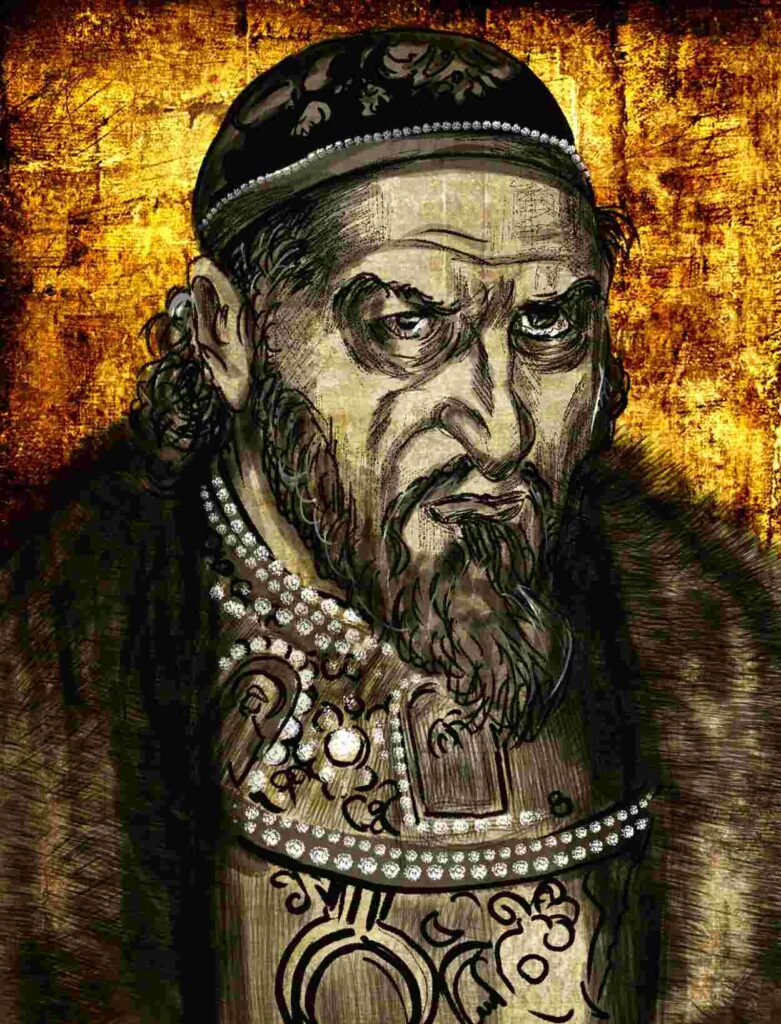
Maybe you’ve seen that iconic portrait: the long face, the intense stare, the beard that looks equal parts regal and unhinged. But the man behind the myth is far more layered than the cartoonish tyrant most people picture. He wasn’t just a sadistic lunatic stumbling through history.
He was a statesman, a reformer, a poet, a paranoid wreck, and a killer — often all in the same week. This is the story of how a traumatized orphan became the first Tsar of All Russia, and why, more than four centuries after his death, we’re still arguing about what to make of him.
What Does "Ivan the Terrible" Actually Mean?
Before anything else, let’s clear up one of the most persistent misconceptions about Ivan IV — because it changes everything. The Russian epithet Grozny, which we translate as “Terrible,” doesn’t carry the same meaning in modern English. It’s closer to “formidable,” “awe-inspiring,” or “fearsome” (Britannica, 2026). Think less “incompetent monster” and more “someone you genuinely do not want to cross.” That distinction matters more than it might seem. Ivan was terrifying, yes.
But he was also, at least for a time, genuinely effective. Reducing him to pure villainy misses the real story, which is that the same man who ordered mass executions also overhauled the Russian legal code and expanded the empire into Siberia. History is rarely clean like that. Ivan is maybe the messiest example of all.
A Childhood Built to Break a Person (1530–1547)
Ivan was born on August 25, 1530, just outside Moscow (Britannica, 2026). His father, Vasili III, died when Ivan was only three years old, leaving the boy as Grand Prince of Moscow — technically. In reality, power fell into the hands of his mother, Elena Glinskaya, and a rotating cast of scheming boyar families who treated the throne like a chess piece in their own private game. Then, when Ivan was just eight years old, his mother died too — almost certainly poisoned, though the boyars never admitted it (Britannica, 2026).
Left Alone in a Nest of Vipers
What followed were years of factional chaos, court intrigue, and a childhood no therapist would wish on anyone. The boyars fought endlessly over power and largely ignored the young prince, humiliating him, sometimes leaving him underfed, treating him like an inconvenient symbol rather than an actual child. Ivan later described this period in his letters to the defected Prince Andrei Kurbsky, railing against the boyars with extraordinary venom.
He wrote of the neglect, the disrespect, the way they grabbed power “like snatching something from fire” (Fennell, 1955). Scholars debate whether we can fully trust those letters — Edward Keenan famously argued they might be later fabrications — but even if Ivan’s specific words are contested, the emotional truth seems real enough (Keenan, cited in European Proceedings, 2020). A boy raised in that environment was always going to grow up with something to prove.
The First Tsar of All Russia
What Ivan proved, at sixteen, was that he was done being anyone’s puppet. In 1547, he had himself crowned not just Grand Prince but Tsar and Grand Prince of All Russia — the first Russian ruler to formally take that title (Britannica, 2026). The word Tsar came from the Latin Caesar, via Byzantine tradition, and it sent a message that was impossible to misread: Ivan wasn’t just another regional lord. He was the heir to Rome, to Byzantium, to God himself. He was the boss, and he intended everyone to know it.
Ivan the Reformer: The Years History Tends to Forget (1547–1560)
Here’s the part of Ivan’s story that gets left out of the popular imagination almost entirely — he was, for a time, genuinely good at his job. In the years following his coronation, Ivan surrounded himself with a group of capable advisors known informally as the “Chosen Council.” Together, they pushed through a remarkable slate of reforms that reshaped Russia from the ground up (de Madariaga, 2005; Britannica, 2026).
Legal and Administrative Reforms
A new law code — the Sudebnik of 1550 — modernized the Russian legal system in meaningful ways. Local governance was restructured to reduce the stranglehold of corrupt regional officials. The military was reorganized and professionalized. Ivan even convened a major church council, the Stoglav, to standardize religious practice across the realm. These weren’t cosmetic changes. They were structural reforms that laid the groundwork for a functioning centralized state.
Military Victories and Territorial Expansion
Ivan also fought wars — real ones, with real results. In 1552, he led Russian forces to capture Kazan, a major Tatar khanate to the east. He followed it up with the annexation of Astrakhan in 1556 (Platonov, 1974). These were significant victories that expanded Russian territory and opened up the vital Volga trade routes. Ivan had himself depicted in official iconography as a warrior-tsar, blessed by God, protector of the faithful. And for a brief window, you could almost believe the propaganda.
Anastasia: The Stabilizing Force
His first wife, Anastasia Romanovna, seems to have been a genuinely positive influence during this period. She was well-regarded at court and among the people, and by most accounts, Ivan actually loved her — or as close to love as a man like Ivan could manage. They had six children together, though most died young. While she lived, there was something like balance in Ivan’s reign. Then, in 1560, Anastasia died.
The Turning Point: Grief, Paranoia, and the Descent (1560–1565)
Historians and biographers have long pointed to Anastasia’s death as the hinge moment — the point where Ivan the reformer begins his transformation into Ivan the Terrible in the full modern sense (Tyler, Lockdown University). Whether her death genuinely broke something in him psychologically, or simply removed the last moderating influence on his behavior, the change after 1560 is dramatic and unmistakable.
Paranoia Takes Hold
Ivan became convinced — increasingly, obsessively — that the boyars had poisoned Anastasia, just as they had poisoned his mother years before. Modern scholars debate this endlessly. Was it paranoia? Possibly, though poisoning was far from rare in 16th-century Russian court politics.
Did he suffer from a diagnosable mental illness — bipolar disorder has been suggested, given his extreme swings between violent frenzy and profound religious penitence? Or were his actions better explained by political calculation and structural pressures? (Russiapedia/RT, 2013; de Madariaga, 2005). The answer is probably both — and we may never fully untangle the two.
The Kurbsky Letters: Ivan Argues With His Critics
By 1564, one of Ivan’s closest advisors, Prince Andrei Kurbsky, had seen enough. He fled to Lithuania and then wrote Ivan a letter accusing him of tyranny. Ivan wrote back — at length, with fury, and with the air of a man who genuinely could not fathom why anyone would want to leave his service. Thus began one of the most extraordinary epistolary exchanges in all of history (Fennell, 1955).
The letters are messy, passionate, and strange. Even with their authorship debated, they give us something rare: the texture of Ivan’s self-justification, his sense of divine mission, his barely-contained rage. Scholars in linguistics and cultural history have analyzed their rhetoric extensively, noting how Ivan constructed himself as both ruler and martyr in the same breath (European Proceedings, 2020).
The Oprichnina: Russia's First Reign of Terror (1565–1572)
In January 1565, Ivan pulled one of the most theatrical political stunts in Russian history — and he had a flair for the theatrical. He abruptly abandoned Moscow, retreated to a monastery outside the city, and sent back two letters.
One accused the boyars of treason and corruption. The other was addressed directly to the common people, telling them his quarrel was with the nobility — not with them. Then he waited.
Panic in the Capital
The city panicked. The boyars panicked harder. Delegations rushed out of Moscow to beg Ivan to return to the throne before everything fell apart. And Ivan came back — entirely on his own terms. Those terms included the creation of the oprichnina (Russiapedia/RT, 2013). The word comes from an old Russian term meaning “apart” or “separate,” and that’s essentially what it was.
A State Within a State
Ivan divided Russia into two zones. One was the regular state, the zemshchina, administered in the conventional way by the old institutions. The other was the oprichnina — Ivan’s personal domain, run by his personal army: black-robed horsemen called the oprichniki, who answered to no one but him.
The oprichniki are one of the most genuinely unsettling institutions in early modern history. They rode black horses, wore black clothing, and attached a dog’s head and a broom to their saddles — symbols of sniffing out treason and sweeping it away (de Madariaga, 2005). They were Ivan’s instrument of terror, and they used it freely: arrests, torture, executions, mass confiscations of land. The boyar class was decimated — not just politically, but physically.
What Was Ivan Actually Trying to Do?
Scholars still argue about the underlying logic of the oprichnina. Was it a coherent political strategy to break the old nobility and centralize state power? Or was it a chaotic, fear-driven purge that happened to have political side effects? (de Madariaga, 2005; Platonov, 1974). Most modern historians land somewhere in between.
What is clear is that after 1572 — when Ivan dissolved the oprichnina as suddenly as he’d created it — the boyar class was never quite the same political force again. Whether that outcome was worth the human cost is a question history has been asking ever since.
The Massacre of Novgorod: History's Most Contested Atrocity (1570)
If the oprichnina was Ivan’s system of terror, the Massacre of Novgorod was its single most infamous episode — and one of the most debated events of his entire reign.
What Happened in Novgorod
In the winter of 1569–1570, Ivan led his oprichniki to Novgorod — one of Russia’s oldest and most important trading cities. He had convinced himself that the city’s leaders were plotting to hand Novgorod over to Lithuania. What followed was weeks of systematic violence. Officials were tortured and executed. Monasteries were looted. Families were dragged into the streets and killed. The city was left hollowed out (Wikipedia: Massacre of Novgorod, 2024).
The Problem With the Death Tolls
Here’s where historians urge serious caution. Popular accounts throw around casualty numbers like 60,000 or even higher. Modern scholarly treatments are far more careful, noting that the sources are a mixture of hostile chronicles, likely exaggerated accounts, and later retellings that had every reason to mythologize the event (Russiapedia/RT, 2013; Wikipedia: Massacre of Novgorod, 2024).
What we can say with confidence: the massacre was devastating, it was deliberate, and it left a scar on Russian collective memory that has not fully healed in the centuries since. For Ivan, it was justified self-defense against treason. For the people of Novgorod, it was simply the end of their world.
The Livonian War: A Quarter Century of Costly Failure (1558–1583)
Running in parallel to all of this internal chaos was the Livonian War — a twenty-five-year conflict that Ivan had launched with genuine ambition and watched deteriorate into one of his reign’s defining disasters.
The Dream of Baltic Access
Ivan started the war in 1558 with a clear strategic goal: gain access to the Baltic Sea and the lucrative trade routes that came with it (Britannica, 2026; Platonov, 1974). The early years brought some success. But the war dragged on far longer than anyone anticipated, drawing in Sweden, Poland-Lithuania, and Denmark as the decades wore on.
The Cost of an Unwinnable War
By the time it ended in 1583, Russia had gained essentially nothing and lost significant territory. The economy had been severely strained. The population had been depleted by war, plague, and the years of the oprichnina. Ivan, who had started his reign expanding the empire eastward, ended it watching pieces of it slip away to the west. It remains one of the great strategic miscalculations of his reign — a war he chose, prolonged, and ultimately could not win.
The Murder of His Son: Ivan's Most Personal Tragedy (1581)
Of all the acts of violence associated with Ivan the Terrible, the one that history remembers most personally — the one that even seems to have broken Ivan himself — happened within his own family.
The Fatal Argument
In 1581, Ivan got into a violent argument with his son and heir, Ivan Ivanovich. In a fit of rage, he struck the young man with his iron-tipped staff. The blow was fatal (Britannica, 2026). Ivan had killed his own son. His heir. The future of his dynasty.
Grief Without Remedy
By all contemporary accounts, the grief that followed was immediate and overwhelming. Ivan wept, held the body, wailed through the night. But no amount of grief could undo the blow. What it left behind was a dynasty in crisis. Ivan’s only remaining son, Fyodor, was considered intellectually unfit to rule. The stage was set — though Ivan didn’t live to see it play out — for the catastrophic “Time of Troubles” that would follow his death: years of civil war, famine, foreign invasion, and dynastic collapse. Ivan died on March 28, 1584, by some accounts mid-game of chess (Britannica, 2026). He left behind a Russia that was dramatically transformed, and a successor crisis that would haunt the country for decades.
How History Has Judged Ivan: The Long Argument
Here’s where the story gets genuinely fascinating from a historical perspective — because how you judge Ivan depends almost entirely on when you’re doing the judging.
Early Modern Views: Pure Condemnation
For centuries after his death, foreign observers and many Russian accounts treated Ivan primarily as a tyrant. The oprichnina, the Novgorod massacre, the murder of his son — these were what defined him in the historical imagination.
The Soviet Rehabilitation
Then came Stalin. The Soviet dictator had a well-documented admiration for Ivan and actively promoted an interpretation of him as a “progressive” historical figure who had built the centralized Russian state through necessary, if brutal, means (de Madariaga, 2005; Perlego overview, 2024).
He commissioned Eisenstein’s famous film Ivan the Terrible to reinforce this image — though he was reportedly displeased when the second part made Ivan look too conflicted and morally troubled. Under Soviet historiography, Ivan’s violence wasn’t a flaw. It was a feature.
Modern Scholarship: Nuance Over Myth
Modern historians have largely dismantled that rehabilitation without swinging to simple condemnation. Isabel de Madariaga’s 2005 biography — still considered the most comprehensive English-language account — situates Ivan firmly within his historical context while refusing to minimize the terror (de Madariaga, 2005). Sergei Platonov’s older work provides a more traditional narrative framework (Platonov, 1974). Importantly, de Madariaga also compares Ivan to his contemporaries: Henry VIII in England, Philip II of Spain. Sixteenth-century rulers were not, as a rule, gentle people. Ivan’s violence was not uniquely extreme for the standards of his time — though its particular forms, especially the oprichnina, had no real parallel in Western Europe. Context matters, but it doesn’t excuse.
Ivan's Real Legacy: Builder and Destroyer in Equal Measure
So what does Ivan the Terrible actually leave behind? The answer is genuinely complicated — and that’s the point.
What He Built
On the achievement side: Ivan unified vast territories, formalized the title of Tsar, reformed the legal and administrative system, expanded Russia into Siberia and the Volga region, and established trade relationships with England and other Western powers (Britannica, 2026; de Madariaga, 2005).
His diplomatic correspondence with Queen Elizabeth I of England in the 1570s — preserved in English translation and studied by historians of early modern diplomacy — reveals a ruler who thought seriously about statecraft and international positioning, even as his domestic reign descended into terror (BYU EuroDocs, from Muscovy to Russia).
He was not stupid. He was not simply destructive. He was someone who built real things, and then in many cases burned them down himself.
What He Destroyed
On the catastrophe side: the oprichnina destabilized the Russian economy and wiped out a generation of the nobility. The Livonian War drained the country for twenty-five years and ended in failure. The murder of his son left Russia with an heir crisis that fed directly into the Time of Troubles. His campaigns of terror killed thousands — possibly tens of thousands — of people (de Madariaga, 2005; Platonov, 1974). The grozny — the formidable, the fearsome — built and burned in roughly equal measure.
Myths About Ivan the Terrible (And What the Evidence Actually Says)
Before we close, it’s worth spending a moment on a few myths that still circulate widely.
- Myth: “Terrible” means he was a monster or incompetent. In Russian, grozny means formidable or awe-inspiring. He was feared, not merely despised (Britannica, 2026).
- Myth: We know exactly how many people died in the Novgorod massacre. We don’t. The figures in popular accounts are estimates drawn from partisan sources, and modern historians treat them as approximations at best (Wikipedia: Massacre of Novgorod, 2024).
- Myth: Ivan’s reign was nothing but chaos and sadism. The reforms of his early reign were real and significant. The duality — reformer and tyrant — is exactly what makes him so historically interesting (de Madariaga, 2005; Britannica, 2026).
- Myth: The Kurbsky letters give us unfiltered access to Ivan’s mind. They’re political texts, constructed with rhetorical intent. Even if authentic, they’re not confessions — they’re arguments (European Proceedings, 2020; Fennell, 1955).
Final Thoughts: The Most Human Monster in History
Ivan the Terrible has been dead for over four hundred years. He is, in some sense, still arguing with us about who he was. He was a child abandoned by everyone who should have protected him, who grew into a man who protected no one.
He was a ruler of genuine vision who let paranoia devour that vision from the inside out. He was a builder who couldn’t stop breaking things — including, in the end, the dynasty he’d spent his life constructing. The grozny is, in the end, a genuinely tragic figure. Not because we should feel sorry for him — the victims of Novgorod, the families destroyed by the oprichnina, his own son: they are the ones who deserve our grief.
But because his story is the story of what happens when enormous capability and enormous damage get so completely tangled together in a single human being that you can never fully separate them. Russia’s history might have looked very different if Anastasia had lived. Or if the boyars had treated a three-year-old boy like a child rather than a pawn. We can’t know. What we have is the record he left: brutal, brilliant, contested, and impossible to look away from.
Sources: de Madariaga (2005), Platonov (1974), Fennell ed. (1955), Encyclopaedia Britannica (2026), European Proceedings of Social and Behavioural Sciences (2020), Tyler/Lockdown University, Russiapedia/RT (2013), BYU EuroDocs – From Muscovy to Russia 1440–1584, Wikipedia: Massacre of Novgorod (2024).
Related on History Republic
Go deeper in the History Republic app
Maps, timelines, and more stories from the same eras—built for readers who want the record, not the myth.
Further Reading
Affiliate links coming later.
- Isabel de Madariaga — Ivan the Terrible: First Tsar of Russia
- Maureen Perrie — The Cult of Ivan the Terrible in Stalin's Russia
- Simon Sebag Montefiore — The Romanovs: 1613–1918
Books listed may earn a commission once our affiliate account is active; for now these are regular product links.