The emperor was still alive when the wall gave way.
Constantine XI Palaiologos had been standing at the Kerkoporta gate for hours — armored, sword drawn, watching the fires on the horizon multiply. Around him, maybe seven thousand defenders held a perimeter designed for fifty thousand. The city at his back had not fallen in a thousand years. Twenty-three dynasties had tried. Persians, Arabs, Bulgars, Crusaders — all had broken against Constantinople’s walls and retreated into history’s footnotes.
Mehmed II was twenty-one years old and had been sultan for two years. His own court had told him this was impossible.
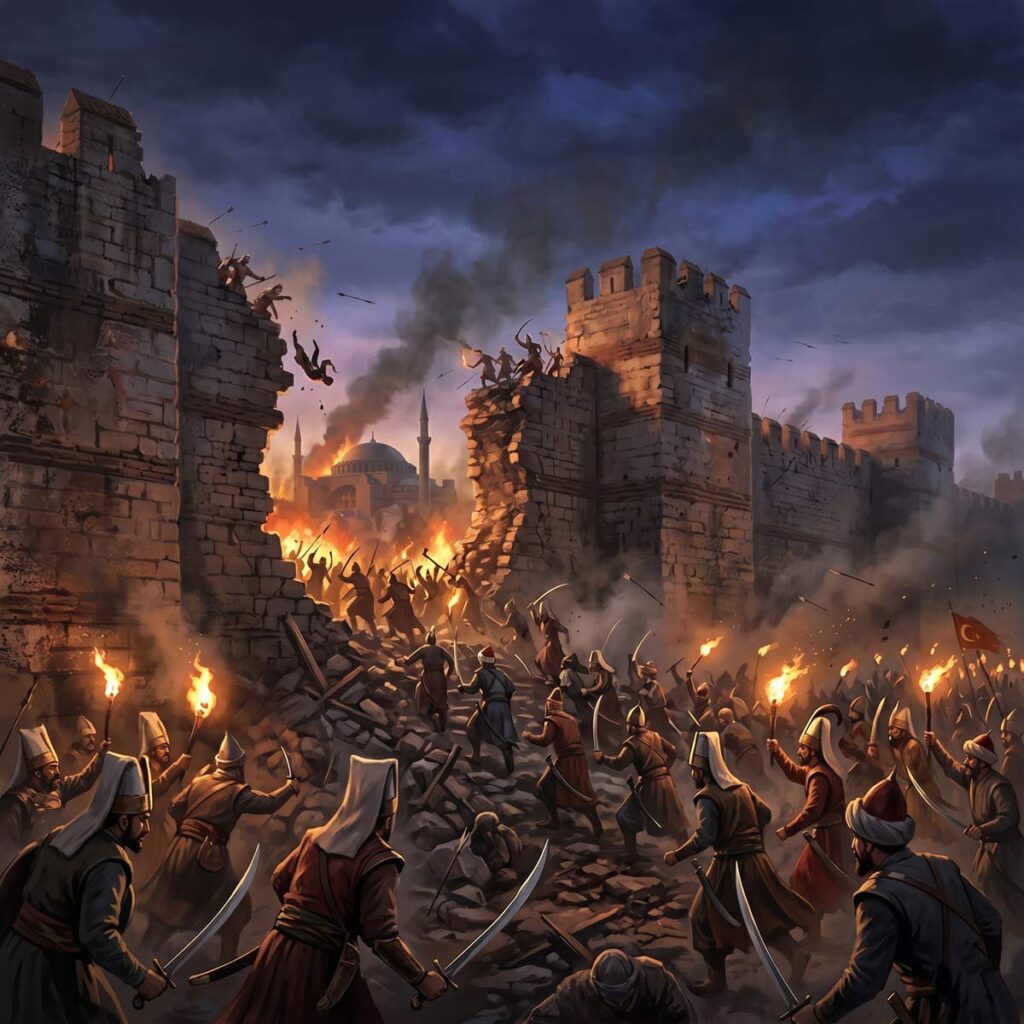
Somewhere in the predawn darkness of May 29, 1453, Constantine heard what every emperor before him had never heard: the sound of Ottoman soldiers pouring through a breach in the Theodosian Walls. Not scaling them. Not negotiating through them. Through them.
What happened in the next four hours did not just end a city. It ended a world.
Why Constantinople Was Supposed to Be Impregnable
To understand what Mehmed accomplished, you have to understand what Constantinople actually was — not as a geographic location, but as a political and psychological fact.
The city sat on a triangular peninsula at the mouth of the Bosphorus, where Europe met Asia and the Black Sea met the Mediterranean. Control Constantinople, and you controlled the trade routes that moved grain, silk, spice, and silver across three continents. The Byzantines had held this position since 330 AD, when Constantine the Great moved the Roman capital east and renamed the old Greek city of Byzantium after himself.
The Theodosian Walls — built in the early fifth century and reinforced across a thousand years of siege attempts — were an engineering achievement that no medieval army had breached from the land side. The outer wall stood nine meters high. Behind it rose an inner wall at twelve meters, with towers reaching twenty meters above the plain. Between them ran a terrace, and beyond the outer wall, a sixty-meter moat that could be flooded from the sea. Attackers who made it past the moat faced arrow fire from three separate defensive levels simultaneously.
Twenty-three sieges. Zero successful land assaults.
But Mehmed had studied what every previous attacker had done. More critically, he had studied what no one had done.
The Sultan Who Studied His Enemy's Weakness
Mehmed II was not simply a military commander. He spoke six languages, had read the campaigns of Alexander the Great in the original Greek, and had spent his teenage years consuming every account of Constantinople’s past defenses he could obtain. When his advisors told him the city was impregnable, he corrected them: the city was impregnable against the weapons that had existed before.
He commissioned something new.
Orban was a Hungarian engineer who had first approached the Byzantine court offering to build cannon. Constantine XI had no money — the treasury was nearly empty, the empire reduced to the city itself and a few fragments of territory. He turned Orban away. Mehmed hired him.
What Orban built was the largest cannon in the world. The Basilica, or Great Bombard, was approximately eight meters long. It fired stone balls weighing over 500 kilograms. It took sixty oxen to transport and a crew of two hundred men to operate. It could fire seven times a day. And it could do something no previous weapon had done: crack the Theodosian Walls.
Mehmed arrived before Constantinople on April 6, 1453, with an army historians estimate between 60,000 and 80,000 men — regular Janissaries, irregular troops, cavalry, and naval forces. He brought the Basilica and additional artillery batteries. He brought a fleet of over 100 ships to seal the city from the sea. He brought a logistics chain sophisticated enough to maintain a siege of any length.
Constantine had 7,000 defenders — a mix of Byzantine soldiers, Genoese mercenaries under Giovanni Giustiniani, and Venetian sailors. The disparity in numbers was total. The disparity in artillery was catastrophic.
The siege began.
Fifty-Three Days of Controlled Destruction
For the first weeks, the cannon did their work methodically. Every morning, Ottoman artillery battered sections of the Theodosian Walls. Every night, Byzantine defenders worked by torchlight to patch the damage with timber, rubble, and earth. The walls held — barely — because the defenders understood what Mehmed understood: a breach alone was not enough. He needed to break through faster than they could repair.
On April 12, the Basilica opened a significant section of the wall near the Lycus River valley, where the terrain dipped and the fortifications were at their weakest. Byzantine engineers filled the gap overnight. Mehmed’s artillery resumed in the morning.
This rhythm defined the siege. The Byzantines were not losing battles — they were simply running out of material, men, and time. Every repair was patched with whatever remained. Every sortie cost soldiers who could not be replaced. Every morning brought fresh Ottoman pressure.
The psychological dimension was equally calculated. Mehmed understood that Constantinople’s greatest asset was not its walls — it was the belief, shared across Christendom and across the Ottoman world, that the city could not fall. If he could shatter that belief, he would shatter resistance from within. He sent emissaries offering Constantine safe passage and the preservation of the city if he surrendered. Constantine refused each time, partly from pride, partly because he understood that a Byzantine emperor who surrendered the New Rome would be remembered as the man who ended Roman civilization.
He was right. He would be remembered that way regardless.
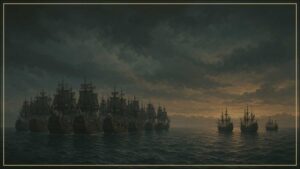
The critical blow came not from the walls but from the water. The Golden Horn, the harbor inlet that protected Constantinople’s northern flank, was sealed by a massive chain the Byzantines had stretched across its mouth. Mehmed’s fleet could not enter. On April 22, he solved this with a maneuver so audacious that contemporary sources described it in disbelief: he had his ships dragged overland.
Overnight, on greased timber rollers, Ottoman sailors moved approximately seventy ships from the Bosphorus across the hills north of the city and down into the Golden Horn, bypassing the chain entirely. Byzantine defenders woke on April 23 to find an enemy fleet inside their harbor. The northern walls were now exposed. Every defender who had been concentrated on the land walls now had to be stretched to cover a second front.
Seven thousand men covering what had required fifty thousand.
The Night the Wall Broke
By late May, the morale inside the city had reached a specific, quiet desperation — not panic, but the calm that settles on men who have stopped expecting rescue. A Venetian fleet that Constantine had been promised never arrived. The Pope’s pledges of Crusade support produced nothing of consequence. The Genoese colony at Galata, across the harbor, maintained its official neutrality and watched.
Constantine convened his commanders on May 28. He knew what the next morning would bring. Mehmed had been massing for a final assault for days. The emperor thanked every man individually, asked forgiveness for any offenses given, and distributed what remained of the treasury among the defenders. Byzantine officers embraced Ottoman-assigned enemies across twenty years of conflict. Giustiniani, the Genoese commander who had held the walls with exceptional discipline for seven weeks, stood at Constantine’s side.
That night, Mehmed addressed his army. He promised them three days of plunder under Islamic law — the standard terms for a city taken by force after refusing surrender. He told them Constantinople’s fall was not merely a military victory but the fulfillment of a prophecy attributed to the Prophet Muhammad. His soldiers believed him.
The assault began at approximately 1:30 AM on May 29.
Mehmed sent his irregular forces first — Bashi-bazouks, undisciplined shock troops used to exhaust defenders and identify weak points. They hit the walls in waves and broke against them. The Janissaries came behind, elite infantry who had trained since boyhood, and they found what the artillery had spent fifty-three days creating: a wall that could be defended by seven thousand men only if those seven thousand remained at full capacity.
They did not. In the chaos of the assault, Giustiniani was struck by a crossbow bolt — accounts differ on exactly where, but the wound was severe enough that he was carried from the walls. His departure, at the critical moment, fractured the Genoese defense. Men who had held because Giustiniani held began to falter.
And then the Kerkoporta.
The small gate in the Blachernae section of the wall — possibly left ajar during a sortie, possibly simply unguarded as defenders rushed toward the main breach — was found open by a group of Ottoman soldiers. Fifty men moved through it. Then more. They were inside the outer walls, behind the defenders still facing the main assault.
When Byzantine soldiers turned and saw Ottoman flags rising on the towers above them, the defense ended. Not because the walls had fallen — because the men holding them understood, in an instant, the finality of what had happened.
Constantine XI removed his imperial insignia, drew his sword, and walked into the breach. He was never seen again. Byzantine chroniclers would later write that he had fought until he fell and was buried under the bodies of his men. Ottoman records do not record his capture or execution — which suggests he died where he fought, anonymous in the chaos, the last Roman emperor buried under rubble.
By dawn, the city was inside.
What Fell With the Walls
The three days of plunder Mehmed had promised his army proceeded. Approximately 4,000 defenders and civilians were killed in the fighting and its immediate aftermath. Between 30,000 and 50,000 residents — scholars differ — were taken as slaves, the standard practice of the era for a conquered city. Byzantine nobles, clergy, and scholars who survived did so by fleeing to Venetian or Genoese ships in the harbor, or by purchasing their freedom through ransom.
Hagia Sophia — the Cathedral of Holy Wisdom, built by Justinian in the sixth century and for nine hundred years the largest Christian church in the world — was converted to a mosque within hours of the city’s fall. Mehmed prayed there before the day was out.
The Patriarch of Constantinople, Gregory III, had fled to Rome months before. The last patriarch to hold the title in the Byzantine tradition, Gennadios Scholarios, was appointed by Mehmed himself — the Ottoman sultan selecting the leader of the Orthodox Church in a deliberate signal that Constantinople, renamed Istanbul, would function as an imperial capital under new management, not as a ruin.
This is the detail that separates Mehmed from the conquerors who came before him. He did not want to destroy Constantinople. He wanted to inherit it. Within weeks, he was calling himself Kayser-i Rum — Caesar of Rome — claiming legitimate succession to the empire he had just ended. He imported Greek scholars. He maintained Byzantine administrative structures. He allowed the Orthodox Church to continue under his authority. He was twenty-one years old, and he understood that what he had taken was not just a city but a symbol — and that symbols, properly managed, were more valuable than ruins.
The Long Aftershock: What 1453 Remade
The fall of Constantinople sent shockwaves across a continent that had not yet learned to process catastrophic change. For the Latin West, it was a theological and psychological rupture — the New Rome, the city that had preserved Roman civilization and Christian orthodoxy for a thousand years, had fallen to an Islamic power. Pope Nicholas V called for Crusade. Nothing came of it.
What came instead were consequences no one in 1453 had anticipated.
The Byzantine scholars who fled — carrying manuscripts of Plato, Aristotle, Ptolemy, and Greek mathematicians — arrived primarily in Italy. Their knowledge fed directly into the Renaissance humanist project. The fall of Constantinople did not cause the Renaissance, but it accelerated the dissemination of classical Greek learning into a Western Europe already hungry for it. Works that had survived only in Byzantine libraries suddenly circulated in Florence, Venice, and Rome.
The Ottoman closure of key eastern trade routes — or more precisely, the increased tariffs and instability that came with Ottoman control of the Bosphorus — pushed Iberian sailors west and south in search of alternatives. The Portuguese intensification of Atlantic exploration in the 1450s and 1460s, and Columbus’s 1492 voyage, were not simply accidents of ambition. The economic logic of finding a route to Asia that bypassed Ottoman-controlled territory was explicit in the thinking of the era. Constantinople’s fall helped push Europe into the Atlantic Age.
The Ottoman Empire that Mehmed built on Constantinople’s bones became the longest-lived successor to the Roman imperial tradition — lasting until 1922, nearly five centuries. The city remained one of the world’s great capitals throughout that period. Istanbul today is home to over fifteen million people. Hagia Sophia, converted back to a mosque in 2020, still stands.
What This Still Asks Us to Consider
Empires end. That fact has never been particularly controversial. What 1453 forces on us is something sharper: the recognition that an institution can survive every attack it was designed to withstand, and still fall to something it never imagined.
The Theodosian Walls were built against armies that existed in the fifth century. They held against every army built on fifth-century principles. Mehmed didn’t attack the walls the old way. He attacked the assumption that the walls were permanent.
Every structure — political, military, cultural — is designed around a set of assumptions about what the threats will look like. When a new kind of threat appears, the structure doesn’t recognize it until it’s already inside.
Constantine XI died defending a city he had no realistic hope of saving. Whether that was nobility or delusion is a question the evidence refuses to settle cleanly. He had refused multiple opportunities to surrender and preserve his life. He had watched his empire contract for decades without being able to stop it. At the end, he did the only thing left available to him: he made the fall of his empire cost something.
That, too, is a kind of power.
Frequently Asked Questions
Why did Constantinople fall to the Ottomans in 1453?
Constantinople fell due to the combination of Mehmed II’s superior artillery — particularly the enormous Basilica cannon — a massive Ottoman force outnumbering the Byzantine defenders approximately ten to one, the isolation of the city after no promised Western reinforcements arrived, and the breach at the Kerkoporta gate during the final assault on May 29, 1453.
What happened to Emperor Constantine XI when Constantinople fell?
Constantine XI Palaiologos was never captured or executed — which strongly suggests he died fighting in the final breach. He reportedly removed his imperial regalia and charged into the battle after the walls were broken. Neither Byzantine nor Ottoman records document his body being identified. He is traditionally considered the last Roman emperor.
How did Mehmed II get his ships into the Golden Horn?
Mehmed had approximately seventy ships hauled overland on greased wooden rollers across the hills north of Constantinople, bypassing the chain the Byzantines had stretched across the harbor mouth. This extraordinary logistical maneuver, completed overnight on April 22-23, opened a second front on Constantinople’s northern walls and stretched the city’s already-depleted defenders beyond their capacity.
Did the fall of Constantinople cause the Age of Exploration?
Not directly, but it was a significant accelerant. Ottoman control of the Bosphorus and eastern trade routes increased tariff pressure and instability on the existing Asia trade, strengthening the economic case for finding Atlantic and southern sea routes to Asia. The Portuguese and Spanish exploration programs of the late 15th century were explicitly motivated in part by the need to bypass Ottoman-controlled territory. Columbus sailed in 1492 — thirty-nine years after Constantinople fell.
What did Mehmed II do with Constantinople after conquering it?
Rather than destroying the city, Mehmed worked to inherit it. He converted Hagia Sophia to a mosque and prayed there immediately, but he maintained the Orthodox Church under his authority, appointed a new Patriarch, preserved Byzantine administrative structures, imported Greek scholars, and claimed the title Kayser-i Rum (Caesar of Rome). He transformed Constantinople into the Ottoman capital, renaming it Istanbul, where it remained a world-class imperial city for nearly five more centuries.
How many people died when Constantinople fell?
Estimates vary. Approximately 4,000 defenders and civilians were killed during the assault and its immediate aftermath. Between 30,000 and 50,000 residents were taken captive and enslaved — the customary terms under Islamic law for a city that had refused surrender. Many survivors purchased their freedom through ransom or escaped on ships in the harbor.
Why didn’t Western Europe send help to Constantinople?
The short answer is that political fragmentation, religious division, and competing national interests made effective Crusade impossible by 1453. The Pope called for aid; Venice and Genoa calculated their own trade relationships with the Ottomans; the major European powers were fighting each other (the Hundred Years War had just ended in 1453). The promised Venetian fleet never arrived. The fall of Constantinople exposed the degree to which “Christendom” as a unified defensive bloc was more aspiration than reality.
Related Articles
- *The Fall of Rome: Why There Was No Single Moment — And Why That Makes It More Terrifying*
- *Peter the Great and Alexei: When Empire Demands the Destruction of Family*
- *Napoleon’s Hundred Days: What His Return from Exile Reveals About Power and Delusion*
Further Reading
- Roger Crowley, *1453: The Holy War for Constantinople and the Clash of Islam and the West* — The most gripping single-volume account of the siege, built on primary sources from both Ottoman and Byzantine sides. Essential.
- Steven Runciman, *The Fall of Constantinople 1453* — The authoritative scholarly treatment. Runciman interviewed the historical record with unusual precision; his reconstruction of the final night remains the standard reference.
- Judith Herrin, *Byzantium: The Surprising Life of a Medieval Empire* — A broader context for understanding what exactly ended in 1453 and why its survival for a thousand years was itself an extraordinary achievement.
Further Reading
This piece connects directly to our ongoing series on Empire & Collapse — the pattern of how great powers end, and what those endings reveal about how they were built. New episodes publish weekly.
Support Independent Historical Storytelling
History Republic exists to do something increasingly rare: treat history as a serious discipline and a living story, not a content commodity.
If this kind of work matters to you — rigorous, cinematic, built for people who want the real thing — consider becoming a member. You’re not buying access to information you can find elsewhere. You’re helping preserve a particular standard of historical storytelling in an era that mostly doesn’t bother.
The audience that keeps History Republic independent is the audience that makes work like this possible.
*Meta description: Mehmed II’s 1453 siege ended the Byzantine Empire after a thousand years. How a 21-year-old sultan did what 23 armies couldn’t — and what fell with Constantinople’s walls.*
Related on History Republic
- Mehmed The Conqueror
- The Fall of Rome : Why There Was No Single Moment — And Why That Makes It More Terrifying
- Vlad The Impaler: the Myth of Dracula
Go deeper in the History Republic app
Maps, timelines, and more stories from the same eras—built for readers who want the record, not the myth.
Further Reading
Product links are recommendations. Affiliate tagging is not active yet—no commission is earned on these clicks.