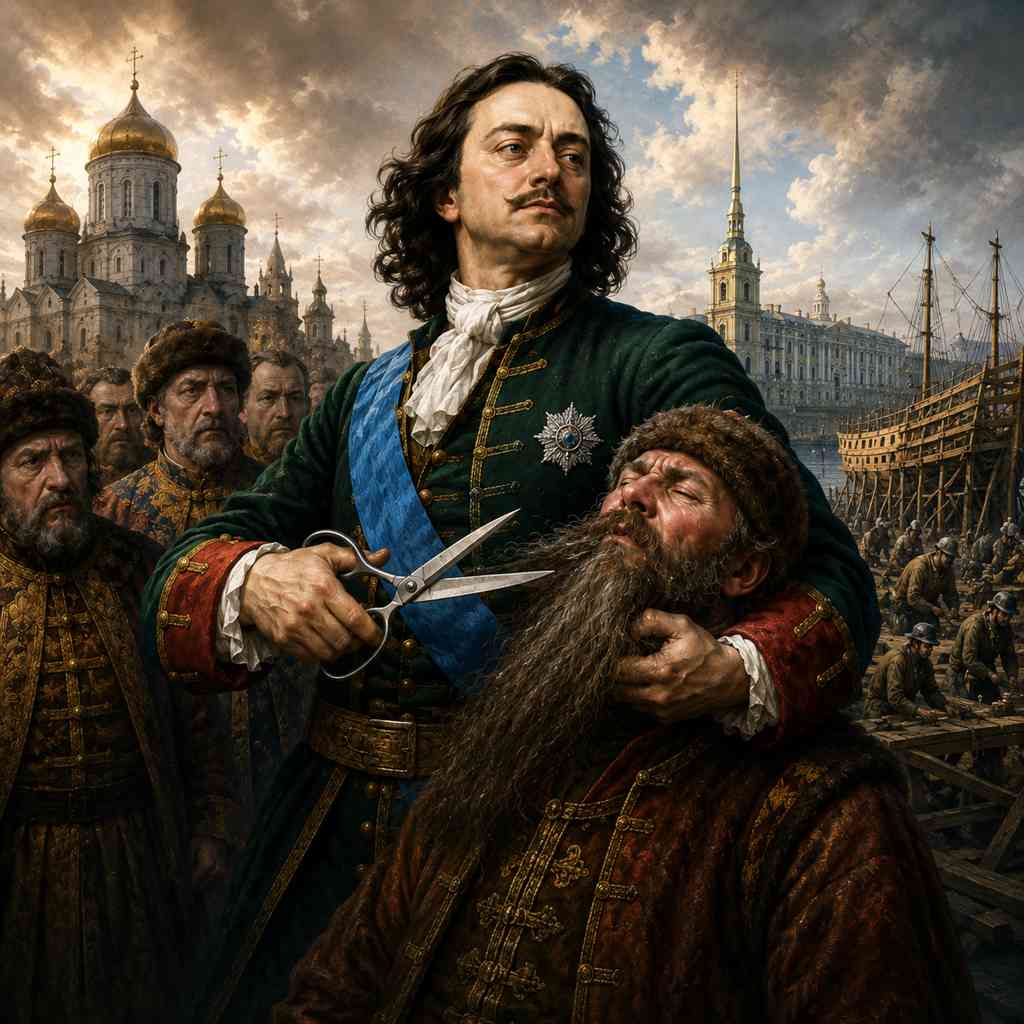
He grabbed a boyar by the beard and cut it off himself.
Not a servant. Not a barber. Peter Alexeyevich Romanov — Tsar of All Russia, standing nearly seven feet tall, thirty years old and already notorious — wielded the scissors personally. The boyar stood rigid with humiliation. His beard was not merely facial hair. It was his identity, his faith, his social rank made visible. In the Orthodox tradition, a beardless man bore a mark of dishonor. To cut it was to unmake him. And Peter cut it anyway, laughing.
Around him, the other boyars waited. They had arrived at court to celebrate the New Year — the year 7208, by the old Byzantine calendar Russia still kept. They had dressed in their long kaftan robes, the traditional garments of Muscovite nobility going back centuries. Peter’s scissors moved down the line. Beards fell. The room was silent except for the snip of blades and the tsar’s own voice, hard and cheerful, daring anyone to object.
No one did. Because every man in that room had heard what happened to those who refused Peter the Great. And none of them could yet see what he was actually building — or what it would cost to get there.
The Country Peter Inherited — and Why It Couldn't Survive Unchanged
Russia in 1682, when Peter first came to power as a child co-tsar alongside his half-brother Ivan V, sat on the edge of a world that was rapidly reorganizing itself. Western Europe had spent the previous century in a brutal process of transformation: the Scientific Revolution, the rise of professional standing armies, the development of centralized nation-states, naval empires, and fiscal-military machines of unprecedented efficiency. Sweden had built a war machine that had humiliated Denmark and dominated the Baltic. The Dutch had turned trade into a weapon of geopolitical power. England had executed a king, fought a civil war, and then engineered a constitutional revolution — all within living memory.
Russia, meanwhile, operated on a fundamentally medieval administrative model. The Orthodox Church held cultural authority that rivaled the tsar’s. The boyar aristocracy controlled regional power through hereditary precedent, not merit. The military relied on streltsy infantry units — musket-armed, but structured along lines inherited from the 16th century, loyal to their commanders rather than to a modern officer corps. Russia had no navy. No professional engineering corps. No reliable postal or administrative network. And when Peter’s government went to war — as it did catastrophically against Sweden in 1700 at the Battle of Narva, where Charles XII routed a Russian army three times the size of his own — these failures became impossible to ignore.
Peter had understood the depth of the problem years earlier. His famous grand tour of Western Europe from 1697 to 1698 — the Great Embassy — took him incognito through Prussia, the Dutch Republic, England, and the Habsburg domains. He worked in the shipyards at Zaandam under a false name. He studied artillery. He hired hundreds of European specialists to return with him. He came back not merely impressed by Western technology, but convinced at the cellular level that Russia faced a choice: transform or be consumed.
The beard-cutting was not theater. It was the opening salvo of a campaign to remake a civilization from the outside in.
Peter the Great's Brutal Modernization Begins: Tearing Down Before Building Up
The scale of what Peter attempted between 1698 and his death in 1725 has no real parallel in European history. He did not reform Russia. He assaulted it.
He abolished the old Julian-Byzantine calendar Russia had used since its conversion to Christianity and replaced it with the Julian calendar used by the West, moving the new year from September to January and resetting the year count to align with European norms. He replaced the traditional Cyrillic script used in printed books with a simplified civic script — the one still recognizable in modern Russian — to make secular printed material more accessible and to separate church publishing from state communication. He forced the nobility to adopt Western dress, levied a tax on those who refused to shave their beards, and established social events modeled on Western assemblies where men and women mixed publicly — a radical break from Muscovite tradition that had kept elite women largely in domestic seclusion.
Every one of these changes triggered resistance. The streltsy, the old military corps, mutinied in 1698 while Peter was still on his European tour. He returned early, personally supervised the interrogations, and executed over a thousand men. He suspended the position of Patriarch of the Russian Orthodox Church after the death of Patriarch Adrian in 1700 and did not appoint a successor for over two decades, placing the Church under a government-controlled body — the Holy Synod — that he established in 1721. The most powerful religious institution in Russia became a department of state.
He conscripted the nobility into lifetime state service — not as feudal obligation, but as salaried administrators and military officers ranked by a Table of Ranks he created in 1722, which organized 14 grades of civilian and military service. Birth no longer guaranteed position. Performance and service to the state determined advancement. A commoner could, in theory, rise. A prince who refused to serve could be stripped of status.
He built a new capital from nothing, on a swamp at the mouth of the Neva River that Russia had only just seized from Sweden. Saint Petersburg, founded in 1703, cost tens of thousands of conscripted laborers their lives in its construction. Peter demanded it anyway. He moved the capital there from Moscow in 1712. Moscow — old, Orthodox, Asiatic in its orientation — was no longer the center of Russia’s future. A city facing the Baltic Sea, designed by European architects, built to European proportions, would be.
The Great Northern War — Where Modernization Became Life or Death
The test that made all of this more than ambition was the Great Northern War against Sweden, fought from 1700 to 1721. Charles XII of Sweden was one of the most gifted battlefield commanders in European history, and the humiliation at Narva in 1700 — where his army of fewer than 9,000 men shattered a Russian force of perhaps 35,000 — could have ended Peter’s program before it properly began.
Peter drew a different conclusion. He rebuilt his army on an entirely new model. He introduced conscription to fill its ranks with trained soldiers rather than seasonal levies. He reorganized the officer structure to prioritize professional competence. He invested heavily in artillery — ironically some of the cannon he needed came from melting down church bells, a pointed choice that doubled as a statement about where sacred resources now belonged. He created Russia’s first true Baltic fleet, constructed at Voronezh on the Don River and later at new shipyards along the Baltic coast, and staffed it with European naval officers he recruited directly.
By 1709, the rebuilt Russian army met Charles XII at Poltava, in what is now Ukraine. Charles had led his Swedish forces deep into Russian territory in alliance with the Ukrainian Cossack hetman Ivan Mazepa, hoping to strike at Moscow. A brutal winter had already destroyed a significant portion of the Swedish force. Peter’s army — reorganized, re-equipped, fighting with field artillery at a level of sophistication the Swedes had not expected — destroyed what remained. Charles XII fled to the Ottoman Empire. The Swedish empire’s dominance of the Baltic ended permanently. Peter won control of the eastern Baltic coast, Livonia, Estonia, and Ingria.
The Treaty of Nystad in 1721 formalized the shift. Peter declared Russia an empire and assumed the title Emperor. The Tsardom of Muscovy was gone. The Russian Empire had arrived — a fact that every European court had to reckon with immediately.
The Turning Point Inside the Turning Point
There is a tendency to treat Peter’s modernization as a long arc of inevitable progress. It was not. The pivot within the pivot came in the years between Narva and Poltava — not on a battlefield, but in a decision Peter made about failure.
After Narva, a lesser ruler would have sued for terms. The Ottoman, Swedish, and Polish threats were simultaneous. The Cossack frontier remained volatile. Russia’s treasury was strained. Peter’s court contained powerful figures who believed Westernization was blasphemy and hubris, and who read the defeat at Narva as God’s judgment on a tsar who had mocked the Church and cut off beards.
Peter’s response to catastrophic military failure was to conscript 40,000 more men, melt church bells for cannon, and outlaw any public discussion of the defeat. He did not slow down. He accelerated. He treated Narva not as a refutation of his program but as evidence that it needed to go further, faster. That psychological decision — to interpret failure as an argument for more transformation rather than less — is the precise moment that made everything after Poltava possible.
Leaders who make that choice in the face of catastrophic failure are rare. The ones who do it at the scale of a civilization are almost singular.
What Peter's Modernization Actually Destroyed
The history of Peter the Great’s reforms tends toward the triumphalist — a backward country dragged into the modern world, emerging as a great power. That framing is real as far as it goes. But the costs of Peter’s program belong in any honest account.
Serfdom, which might have been reformed or eventually abolished in the 17th century as it was in Western Europe, Peter instead hardened into the foundation of his new state. The conscript army needed feeding. The new factories and shipyards needed labor. The expanding administrative apparatus needed taxable subjects who could not simply leave. Peter tied peasants more completely to the land, extended landlord authority over serfs, and made the serf population — roughly 90 percent of Russia’s people — the human fuel of modernization. The Russia that emerged as a European empire in 1721 was more Westernized at the top and more brutally unfree at the bottom than the Muscovite state Peter had inherited.
The Orthodox Church, stripped of its independent Patriarchate and absorbed into the state bureaucracy, lost the capacity to act as any kind of independent moral check on state power. The civic institution that might have moderated Russian autocracy became an instrument of it. That subordination of church to autocratic state would shape Russian political culture for the next two centuries.
And the new capital, Saint Petersburg — the shining symbol of Peter’s European ambitions — stood on a foundation of forced labor deaths. Contemporary estimates placed the mortality among construction conscripts in the tens of thousands, though precise figures are difficult to verify. The city that would produce Dostoevsky and Tchaikovsky and the Hermitage Museum was built on ground that cost an enormous human price.
The Russia That Survived Peter — and the Russia That Could Not
Peter died in February 1725 at age 52, likely from complications related to urinary tract issues and bladder inflammation — possibly made worse by his habit of wading into freezing water to help pull ships that had run aground. He died without naming a successor, which triggered a period of political instability — the Era of Palace Revolutions — during which the throne changed hands six times in 37 years.
But the transformation held. The army remained European in its structure. The Table of Ranks remained the governing principle of elite mobility. The Academy of Sciences Peter founded in 1724, days before his death, opened the following year and began producing Russian scholarship in earnest within a generation. Saint Petersburg remained the capital for nearly two centuries. The Baltic fleet gave Russia the geopolitical leverage to play a role in European affairs — participating in the War of Polish Succession, the Seven Years’ War, and ultimately the Napoleonic conflict — that no Muscovite tsar could have managed.
Catherine the Great, who ruled from 1762 to 1796, built on Petrine foundations to make Russia a genuine intellectual and cultural power within Europe. The Russia she presided over corresponded with Voltaire, hosted Diderot, collected European art at a scale that eventually became the Hermitage collection. None of that was thinkable without Peter.
The what-if question that hangs over all of this: without Peter’s forced modernization, does Russia become a target of Swedish, Ottoman, or eventually Prussian partition — the way Poland was partitioned in the 1770s, 1793, and 1795, divided between three powers because it lacked the internal cohesion and military force to resist? The historical record of that era suggests that states which could not modernize their fiscal-military systems were not preserved. They were absorbed.
Peter understood that. He may have understood little else about the human cost of what he was doing. But on that central strategic question, he read the situation with cold accuracy.
The Mirror That Peter Holds Up
Every generation produces leaders who claim they are forcing necessary transformation on a resistant people. Peter is the extreme case — the historical data point at the far end of the scale — and looking at him honestly requires holding two things simultaneously: he was right about the external threat, and he was brutal beyond what the threat required.
The hard question his reign asks is not whether modernization was necessary. It clearly was. The question is whether the method of top-down, coerced, identity-erasing transformation produces durable results or merely creates a country that wears Western clothes over an unchanged body. Russia’s subsequent history — the absolutism of Catherine, the reactive conservatism of Nicholas I, the revolutionary convulsions of 1917 — suggests that Peter solved the military-strategic problem and deferred every other one for later generations to absorb.
That pattern — authoritarian modernization that creates power without legitimacy, capability without consent — did not end with the 18th century. The 20th century ran the same experiment in several countries simultaneously. The results were similar: impressive military and industrial capacity built on a foundation that periodically cracked under the weight of everything that had been suppressed to build it.
Peter the Great’s brutal modernization is not a simple success story. It is the story of what happens when historical pressure becomes so extreme that a civilization must change or die — and the man who makes the change does not stop to ask whether his method of saving the country also damages it in ways that will take centuries to fully surface.
That is a question worth sitting with. Not because it has an easy answer, but because it does not.
If This Is the History You've Been Looking For
Readers who find themselves drawn to stories like this — the weight of real decisions, the human cost of historical forces, the complexity that never fits a summary — are exactly who History Republic exists for.
If you want to support independent historical storytelling that treats you as a serious reader, History Republic membership keeps this work alive. You are not subscribing to a newsletter. You are helping preserve serious historical storytelling in a shallow digital age.
Read Next on History Republic
- The Fall of Rome: Why There Was No Single Moment — And Why That Makes It More Terrifying
- Genghis Khan’s Intelligence Empire: The Spy Network That Conquered Half the World
- Constantinople 1453: How Mehmed II’s Siege Ended a 1,000-Year Empire in a Single Night
Recommended Reading
- Peter the Great: His Life and World by Robert K. Massie — the definitive English-language biography, exhaustively researched and compulsively readable. A genuine authority on the subject.
- The Romanovs: 1613–1918 by Simon Sebag Montefiore — places Peter within the full arc of the dynasty he transformed, with the same cinematic narrative drive that makes serious history accessible.
Watch on History Republic
Our YouTube channel covers the turning points that reshaped civilizations — including episodes on the military revolutions that made and broke empires in this era. Search History Republic on YouTube and subscribe so you never miss a new episode.
Frequently Asked Questions
What was Peter the Great’s brutal modernization actually trying to achieve?
Peter’s program aimed to transform Russia’s military, administrative, and cultural systems to match Western European standards — specifically to compete with Sweden, the Ottoman Empire, and other powers that were outpacing Russia in military technology and state organization.
Why did Peter the Great force nobles to shave their beards?
Peter mandated Western dress and shaved faces as visible markers of cultural alignment with Europe. The beard tax he imposed on those who refused was partly fiscal and partly a deliberate signal that Orthodox Muscovite identity no longer governed how the Russian elite presented itself to the world.
How did the Battle of Narva affect Peter the Great’s reforms?
The catastrophic Russian defeat at Narva in 1700 — where Charles XII routed a far larger Russian army — did not slow Peter’s modernization program. He responded by accelerating it: rebuilding the army along European lines, conscripting new forces, and investing heavily in artillery, which ultimately produced the victory at Poltava in 1709.
What happened to the Russian Orthodox Church under Peter the Great?
Peter abolished the position of Patriarch after the death of Patriarch Adrian in 1700 and replaced the Church’s independent leadership with a government-controlled body called the Holy Synod, established in 1721. The Church became, in structural terms, a department of the Russian state.
Did Peter the Great’s modernization help or hurt ordinary Russians?
Peter’s reforms dramatically strengthened Russia’s military and geopolitical position, but they hardened serfdom rather than loosening it. The vast majority of Russia’s population — the serf peasantry — bore the labor burden of modernization with no share in its benefits, and their legal condition under state authority became more restrictive during Peter’s reign.
Why did Peter the Great build Saint Petersburg instead of staying in Moscow?
Peter chose the newly captured Baltic coast for his new capital deliberately — to orient Russia geographically, symbolically, and architecturally toward Western Europe rather than toward Asia and the old Byzantine-Orthodox tradition that Moscow embodied. The city’s location on the Baltic gave Russia direct maritime access to European trade and diplomacy.
What was the Table of Ranks that Peter the Great created?
The Table of Ranks, established in 1722, organized Russian civil and military service into 14 grades. It replaced birth-based precedent with service-based advancement, theoretically allowing commoners to rise through merit. It remained the governing principle of Russian elite organization until the 1917 revolution.
How did Peter the Great’s reforms influence Russia after his death?
The institutional framework Peter built — the professional army, the imperial title, the Academy of Sciences, the Table of Ranks, the state-controlled Church — survived the instability of the Era of Palace Revolutions and provided the foundation on which Catherine the Great built Russia’s 18th-century intellectual and cultural prominence.
Related on History Republic
- Peter the Great and Alexei: When Empire Demands the Destruction of Family
- Ivan the Terrible and the Politics of Fear
- Genghis Khan's Intelligence Empire: The Spy Network That Conquered Half the World
Go deeper in the History Republic app
Maps, timelines, and more stories from the same eras—built for readers who want the record, not the myth.
Further Reading
Affiliate links coming later.
- Robert K. Massie — Peter the Great: His Life and World
- Lindsey Hughes — Russia in the Age of Peter the Great
- Simon Sebag Montefiore — The Romanovs: 1613–1918
Books listed may earn a commission once our affiliate account is active; for now these are regular product links.