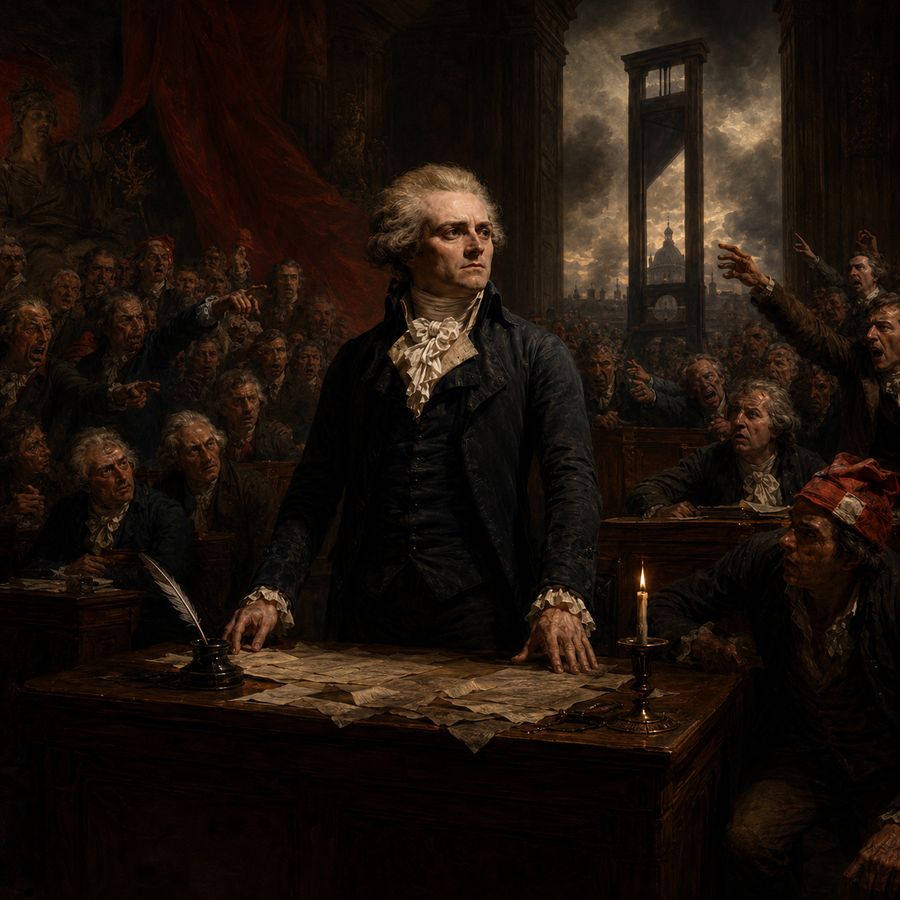
He had already signed hundreds of death warrants when he walked into the Committee of Public Safety on the morning of 9 Thermidor, Year II. Maximilien Robespierre — the Incorruptible, the Revolution’s high priest, the man who had sent former allies to the guillotine without blinking — stood before the men he had worked alongside for two years. He began to speak. And nobody would let him finish.
What happened next cost him his head. But the more disturbing question is not how Robespierre died. It is how a man who genuinely believed he was saving the Revolution became the single greatest argument against it.
The Man Who Believed He Was the Revolution
To understand the Reign of Terror, you have to understand what Maximilien Robespierre actually thought he was doing.
He was not, by most accounts, a sadist. Born in Arras in 1758, trained as a lawyer, elected to the Estates-General in 1789, Robespierre arrived in Paris as a provincial idealist with a copy of Rousseau in his coat and an almost pathological commitment to virtue. Early in his career, he publicly opposed the death penalty. He advocated for the rights of Jews and free people of color when such positions were politically costly. He earned his nickname — the Incorruptible — not as irony but as tribute.
The Revolution rewarded him with rising power. By 1793, he sat on the Committee of Public Safety, the twelve-man executive body that effectively governed France during the most violent phase of the Revolutionary Wars. France was under siege — literally. Britain, Austria, Prussia, Spain, and the Dutch Republic had all entered the war against the French Republic. Federalist revolts burned in Lyon and Vendée. Assassins moved through Paris. In July 1793, Charlotte Corday walked into Jean-Paul Marat’s medicinal bath and stabbed him to death.
The Republic was hemorrhaging from every direction. And Robespierre concluded — with complete sincerity — that the only way to save it was to become its executioner.
He articulated this logic directly, in a speech to the National Convention on February 5, 1794: “The mainspring of popular government in revolution is at once virtue and terror: virtue, without which terror is fatal; terror, without which virtue is impotent.”
Terror as state policy was not only a European story; in sixteenth-century Japan, Oda Nobunaga turned the burning of Mount Hiei into policy.
This was not the language of a tyrant rationalizing cruelty. It was the language of a true believer who had convinced himself that mass killing was a form of moral hygiene. That is what makes Robespierre genuinely terrifying — not his power, but his certainty.
How the Reign of Terror Began — and Why It Accelerated
The formal machinery of the Terror did not descend fully formed. It accumulated through crisis decisions that each made sense in isolation and together produced something monstrous.
The Revolutionary Tribunal established in March 1793 was meant to fast-track the prosecution of counter-revolutionaries. The Law of Suspects passed in September 1793 expanded the definition of “enemy” so broadly that almost anyone could qualify — former nobles, their relatives, merchants who charged too much, priests who refused to swear loyalty to the Republic. The Law of 22 Prairial, passed in June 1794, abolished the right of accused persons to call witnesses or present a defense. The only permitted verdict was acquittal or death.
The numbers that followed are not estimates pulled from the fog of history. Modern historians count roughly 17,000 people officially executed between September 1793 and July 1794 — by guillotine, firing squad, and mass drowning in the Loire River during the suppression of the Vendée revolt. Another 10,000 to 12,000 died in prison awaiting trial. In Nantes, the representative-on-mission Jean-Baptiste Carrier ordered prisoners loaded onto barges, floated into the river, and sunk. He called it “republican baptism.”
Robespierre did not personally order every execution. But he presided over the system that made all of them possible, and he defended it to the end.
The Terror targeted enemies of the Republic. Then it targeted potential enemies. Then it targeted the wrong kind of friends. Georges Danton — one of the Revolution’s most powerful voices, a man who had helped build the Republic alongside Robespierre — went to the guillotine in April 1794 after demanding that the Terror be wound down. The Hébertists, radical populists who thought the Committee had not gone far enough, followed weeks earlier. The Committee of Public Safety devoured its own coalition with mechanical efficiency.
By the summer of 1794, the pace was accelerating. June and July saw more executions than the entire preceding year. And Robespierre, increasingly isolated, increasingly paranoid, stopped naming his next targets clearly. He delivered a speech on 8 Thermidor in which he announced that there were traitors within the Convention and the Committee itself — but refused to say who they were.
That silence was his last mistake.
The Turning Point: One Day the Convention Refused to Listen
On 9 Thermidor, Year II — July 27, 1794 on the Gregorian calendar — Robespierre entered the National Convention to respond to attacks from men who had decided they would rather act than wait to be named. The previous day’s speech had terrified every deputy who could not be certain they were safe.
When Robespierre stood to speak, the shouting began. Deputies who had survived by staying quiet suddenly roared over him. “Down with the tyrant!” The president of the Convention rang his bell. The noise grew louder. Robespierre walked to the Montagnard benches — the radical faction that had been his base — and they did not rise. He turned to the center moderates. They did not speak. He tried again to address the assembly. Someone shouted that the blood of Danton was choking him.
He could not finish a sentence.
The Convention voted his arrest that afternoon. He was taken to the Luxembourg prison. That night, his supporters seized the Hôtel de Ville and freed him briefly — but the moment for resistance had passed. By the early hours of 10 Thermidor, National Guard troops loyal to the Convention surrounded the building. When they broke through the doors, Robespierre lay on the floor with a shattered jaw — whether from a pistol shot by a gendarme or a failed suicide attempt, historians still debate. He did not speak again.
On 10 Thermidor, he went to the guillotine. The crowd cheered. Saint-Just — his closest intellectual ally, the “Angel of Death” who had authored some of the Terror’s most chilling justifications — went with him. So did nineteen others.
The system Robespierre had built killed Robespierre.
What Fell With Robespierre — and What Survived
The immediate aftermath of Thermidor moved fast. The Committee of Public Safety lost its centralized authority within weeks. The Revolutionary Tribunal was reorganized and its pace of executions slowed dramatically. Many of the surviving Terrorists found themselves on trial, and in some cases on the scaffold. The Law of 22 Prairial was repealed. Political prisoners by the thousands walked out of French jails.
The “Thermidorian Reaction” — the period following Robespierre’s fall — brought something resembling relief to Paris. But it did not bring stability. The winter of 1794–95 saw the worst famine Paris had experienced in decades. The radical popular movements that the Terror had simultaneously championed and suppressed lost their final foothold. Power drifted toward the propertied classes. By 1795, a new constitution concentrated executive authority in a five-man Directory that most of its own architects privately considered unworkable.
The Republic lurched forward. It never found solid footing.
What the Terror did not destroy, it delegitimized. The idealism of 1789 — the Declaration of the Rights of Man and Citizen, the radical proposition that a nation could govern itself through reason and virtue — had been routed through four years of war and internal violence and emerged on the other side as something France could no longer entirely believe in. Robespierre had tried to force the Revolution to live up to its own principles through coercion. He proved, with his own death, that coercion cannot manufacture virtue.
The Directory governed France from 1795 to 1799, when a coup on 18 Brumaire ended it. The man who engineered that coup — a thirty-year-old Corsican general named Napoleon Bonaparte — had spent the Terror years navigating carefully. He survived. He noticed what had destroyed Robespierre. And he built his own authoritarian consolidation on a different model: not ideological purity enforced by the guillotine, but military prestige and institutional control.
The French Revolution did not end on the day Robespierre died. But the version of it that believed a pure republic could be willed into existence through systematic killing — that version died with him.
Why Revolutions Devour Their Own Architects
The pattern Robespierre embodied is not unique to France. It appears with enough regularity across historical contexts that it demands analysis, not just documentation.
Revolutions require architects — people who define the enemy, articulate the vision, and organize the violence necessary to break the old order. Those same qualities become liabilities once the old order is broken. The revolutionary vanguard, trained to identify enemies, does not stop when external threats diminish. It turns inward, because that is the reflex it has developed. The criteria for ideological purity tighten. The circle of the acceptable shrinks.
Robespierre understood power in terms of virtue and vice, patriots and traitors. He had no framework for loyal opposition, for the legitimacy of political disagreement within the republic he had helped create. When allies like Danton argued for moderation, Robespierre heard treason — because his entire worldview left no room for the category of “friend who disagrees.” In that framework, the only defense against accusation was to accuse first.
This is the structural trap that catches revolutionary architects. The tool they built to destroy the old order is still running when they need to govern. And governance requires tolerance for ambiguity that revolution cannot afford.
Saint-Just — who at twenty-six was among the youngest and most ideologically ruthless members of the Committee — expressed it with chilling clarity: “The Republic consists in the extermination of everything that opposes it.” He meant it as a rallying cry. He died not understanding it was also a self-description.
The Thermidorian deputies who brought Robespierre down were not idealists. Many of them had blood on their own hands from the Terror’s earlier phases and were acting out of self-preservation, not principle. That matters. The end of the Reign of Terror was not a moral awakening. It was a survival calculation made by frightened men who finally outnumbered the man who frightened them.
Revolutions, in this light, do not devour their architects because of irony or fate. They devour them because the logic of revolutionary purification, once activated, cannot distinguish between external enemies and internal ones. The architect eventually becomes indistinguishable from what he set out to destroy.
The Modern Lens
The Reign of Terror has been used as political ammunition for two centuries — by conservatives arguing against revolution, by liberals warning about ideological absolutism, by authoritarians deflecting criticism of their own violence. None of those uses quite captures what the historical record actually shows.
What the record shows is a specific failure mode of political certainty. Robespierre did not become monstrous because he stopped believing in the Revolution. He became monstrous because he never stopped. He could not separate the project from himself, could not imagine the Republic surviving a version of events in which he was wrong about something important.
That failure is not exclusively revolutionary. It appears in rulers, institutions, and movements across every era when the people in charge decide that their vision of the good is so important that the methods used to achieve it are beyond question.
The French Revolution produced, within a decade, both the Declaration of the Rights of Man and the guillotine at full industrial capacity. That tension — between the highest stated ideals and the violence deployed to protect them — sits at the center of modern political history.
Robespierre stands at that intersection, permanently. He is neither a monster nor a martyr. He is a warning about what happens when a person decides they have become the embodiment of a cause, rather than its servant.
Frequently Asked Questions
What caused the Reign of Terror in the French Revolution?
The Reign of Terror emerged from a convergence of external military threats — France was at war with most of Europe — and internal revolts against the Republic. The Committee of Public Safety, led in part by Robespierre, responded by constructing a legal apparatus that enabled mass executions of anyone deemed a counter-revolutionary threat. Crisis conditions enabled ideological extremism, and each expansion of the Terror’s scope became self-justifying.
How many people died during the Reign of Terror?
Modern historians count roughly 17,000 officially executed between September 1793 and July 1794, with an additional 10,000 to 12,000 dying in prison. Deaths from military suppression of the Vendée revolt bring total estimates of the broader revolutionary violence significantly higher, though figures vary by how historians define the period and scope.
Why did Robespierre order the execution of Danton?
Robespierre concluded that Danton’s calls for moderation — for slowing the pace of executions and negotiating peace with France’s enemies — represented a threat to the Republic’s survival. Within Robespierre’s ideological framework, anyone who argued against the Terror was either a traitor or a dupe of traitors. Danton went to the guillotine in April 1794, reportedly shouting that he had preceded Robespierre but that Robespierre would follow.
What ended the Reign of Terror?
The coup of 9 Thermidor, Year II (July 27, 1794) ended the Terror’s most intense phase. Deputies within the National Convention, fearing they would be among Robespierre’s next targets, organized his arrest. He was executed the following day. The Committee of Public Safety lost its centralized power in the weeks that followed, and the Revolutionary Tribunal’s pace slowed dramatically.
Was Robespierre a dictator?
Robespierre never held formal dictatorial power — he was one member of a twelve-man committee. But he exercised outsized ideological authority and became the public face of the Terror’s most extreme phase. His power was real but informal, rooted in his moral prestige within the movement rather than a formal office. The Terror was a collective project, not a personal dictatorship, even if Robespierre drove its ideological engine.
What happened to France after Robespierre’s death?
The Thermidorian Reaction loosened the Terror’s apparatus, freed thousands of political prisoners, and shifted power toward moderates. The Directory governed from 1795 to 1799, a period marked by political instability and continued war. Napoleon Bonaparte’s coup of 18 Brumaire in November 1799 ended the Directory and established the Consulate, beginning his rise to imperial power.
Why do revolutions often turn on their own leaders?
The logic of revolutionary purification — identifying and eliminating enemies of the cause — does not switch off cleanly. Once a movement builds institutional machinery for enforcing ideological conformity, that machinery requires enemies to justify its existence. When external enemies are neutralized or contained, internal disagreement becomes the target. Leaders who helped construct that machinery find themselves unable to turn it off, and eventually unable to escape it.
Was the Reign of Terror a betrayal of the French Revolution’s ideals?
Robespierre did not think so, and neither did Saint-Just. They argued that temporary violence was necessary to permanently secure liberty. Whether that represents a betrayal or a tragic extension of revolutionary logic remains one of the most contested questions in modern historiography. The answer depends significantly on whether you believe the ideals of 1789 were achievable through any means available to France in 1793–94.
Read Next
- Constantinople 1453: How Mehmed II’s Siege Ended a 1,000-Year Empire in a Single Night — Another civilization-altering turning point, told through the final hours of an empire that believed it could survive anything.
- Peter the Great’s Brutal Modernization: How Russia Was Dragged Into the 18th Century — The costs of forcing a nation to transform, and what it takes — and destroys — to build a new order from the ruins of the old.
- Genghis Khan’s Intelligence Empire: The Spy Network That Conquered Half the World — Power built not through ideology but through information, and what it reveals about how empires actually function.
Books Worth Reading
A Place of Greater Safety by Hilary Mantel — A novel, yes, but Mantel’s command of the psychological reality of Robespierre, Danton, and Desmoulins is more penetrating than most academic treatments. If you want to understand what it felt like inside the Revolution, this is the book.
The Terror: The Merciless War for Freedom in Revolutionary France by David Andress — A rigorous, readable account of the Terror’s mechanics and human costs, grounded in primary sources and free of the romantic myths that have accumulated around the period from both left and right.
Watch on History Republic
Our YouTube episode on turning points in military and political history covers how a single decision — or a single moment of silence in a room full of frightened men — changes the trajectory of nations. The Reign of Terror is exactly that kind of story.
If This Is the History You've Been Looking For
History Republic exists for people who want more than a summary. If you have spent years frustrated by history content that skims the surface — that tells you what happened without ever asking why it had to happen, or what it cost the people living through it — this is where you belong.
You are helping preserve serious historical storytelling in a shallow digital age. If that matters to you, consider supporting History Republic through a membership. Every member makes the next piece of work possible.
Related on History Republic
- Napoleon’s Hundred Days: What His Return from Exile Reveals About Power and Delusion
- Ivan the Terrible and the Politics of Fear
- Joan of Arc
Go deeper in the History Republic app
Maps, timelines, and more stories from the same eras—built for readers who want the record, not the myth.
Further Reading
Product links are recommendations. Affiliate tagging is not active yet—no commission is earned on these clicks.