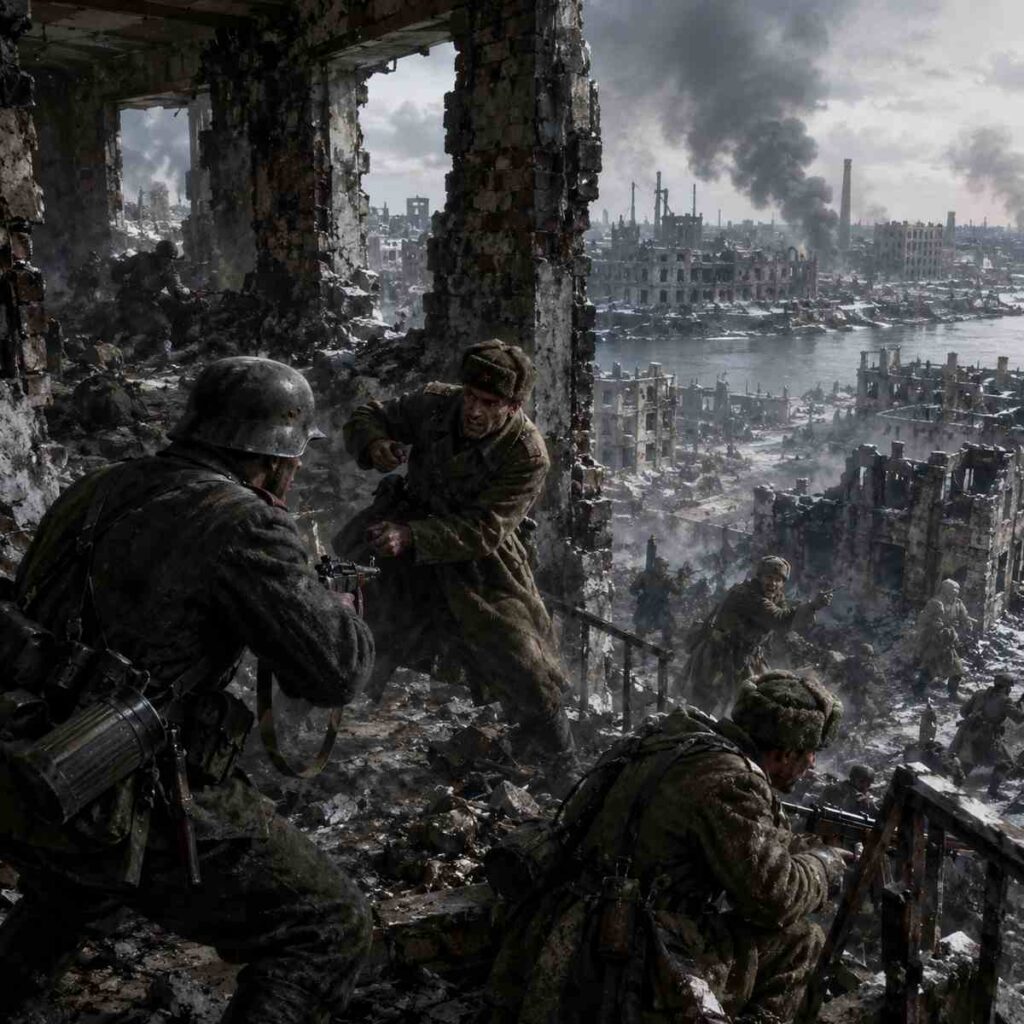
The German officer had a map, a radio, and orders to take the grain elevator by nightfall. What he did not have was a clear line of sight past the next pile of rubble, or any reliable intelligence on what waited behind the collapsed factory wall thirty meters ahead. His unit had controlled that block two days ago. Then the Soviets tunneled through a basement and retook it in the dark. Now the map was useless. Every building was a separate war.
This was Stalingrad in the autumn of 1942 — a city where front lines measured in meters, where a staircase was a strategic objective, where the safest place to stand was so close to the enemy that artillery could not fire without killing both sides. A place the Germans had expected to take in ten days. A place that would consume the Sixth Army entire, break the Wehrmacht’s strategic spine, and deliver the moment the entire war pivoted.
Six months of urban combat at Stalingrad changed the Second World War not because of its body count — though that count was catastrophic — but because of what it proved about industrial will, psychological endurance, and the strategic logic of cities. Understanding why Stalingrad mattered means understanding what Germany expected, what the Soviet Union risked, and why the name of a single city on the Volga still echoes in every serious conversation about modern warfare.
Why Stalingrad Was Not Just Another City
The city bore Stalin’s name. That made it symbolic. But German planners targeted it for reasons that had nothing to do with propaganda and everything to do with logistics.
Stalingrad sat on the west bank of the Volga River, the Soviet Union’s primary north-south artery. Capture the city, and Germany could sever the flow of Caucasian oil northward to Moscow and to Soviet industry. Hold the riverbank, and Axis forces could pivot south into the oil fields themselves — the fuel that fed Soviet tanks, aircraft, and factories. Without Caspian oil, the Soviet war machine would begin to starve.
The 1942 German summer offensive, Case Blue, was built around this logic. Army Group South split into two: Army Group A driving toward the Caucasus oil fields, Army Group B moving east along the steppe toward the Volga. The Sixth Army, under Field Marshal Friedrich Paulus — one of the most professionally capable formations in the German military — would secure Stalingrad as the operation’s anchor.
Germany had reason to expect speed. The summer of 1941 had seen breathtaking advances. Soviet formations had collapsed, encircled, surrendered in the hundreds of thousands. The Wehrmacht’s combined arms tactics, honed over three years of European warfare, had produced something the world had never seen at that scale — a military machine capable of thinking and moving faster than its enemies could respond. German confidence in 1942 was not delusion. It was the product of genuine, documented success.
What that confidence did not account for was a city designed for exactly the kind of fight Germany could not afford.
The Logic of Ruined Ground: How Urban Combat Erased German Advantages
The Wehrmacht’s great strength was maneuver. Open ground let German commanders encircle, envelop, and destroy Soviet formations before they could react. Tanks, motorized infantry, close air support, and artillery worked together in a rolling devastation that paralyzed Soviet command structures and crushed morale.
Stalingrad eliminated every one of those advantages simultaneously.
The Luftwaffe had pounded the city throughout August 1942, creating exactly the urban environment that would become Germany’s grave. Collapsed buildings produced rubble fields that immobilized armor. Twisted factory floors became labyrinthine fortresses. Apartments became sniper nests. Cellars became Soviet arteries — soldiers tunneled between positions, appearing behind German lines in the dark, attacking and dissolving back into the wreckage before a coordinated response could arrive.
Soviet General Vasily Chuikov, commanding the 62nd Army, understood the geometry of the situation with cold clarity. He ordered his men to press so close to the Germans that Luftwaffe pilots could not bomb Soviet positions without hitting their own. He called it “hugging” — a tactical embrace that turned Germany’s air superiority into a liability. The closer the Soviets stayed to German units, the more the most powerful weapon in the German arsenal was neutralized.
The fighting that resulted became known to Soviet soldiers as the Rattenkrieg — the War of Rats. Room by room, floor by floor, crater by crater. Men fought with entrenching tools and knives when ammunition ran low. A single building — the Lazur Chemical Plant, the Red October factory complex, the grain elevator — could consume entire battalions across days of continuous fighting. The grain elevator alone changed hands more than a dozen times.
Meanwhile, the Volga remained open. Soviet reinforcements crossed the river under artillery fire and air attack, fed into a burning city, and held. The crossing was brutal. Units arrived at the west bank already depleted by enemy fire. Some formations numbered only a few hundred men by the time they reached the fight. They held anyway.
The Turning Point: Operation Uranus and the Trap That Shut
By November 1942, the strategic picture had shifted in ways that Paulus and Hitler both failed to read accurately.
The Sixth Army had advanced deep into Stalingrad. German soldiers occupied perhaps 90 percent of the city’s rubble. But occupying ruined ground is not the same as controlling it — the 62nd Army still held a strip along the Volga, still crossed troops and supplies, still fought. And the flanks of the Sixth Army, stretching far to the north and south along the Don River, were held by Romanian, Hungarian, and Italian armies — Germany’s allies, but not Germany’s Sixth Army. Lightly equipped, thinly stretched, facing a Soviet front that had been quietly, methodically reinforced since September.
Soviet General Georgy Zhukov and the Stavka — the Soviet High Command — had been planning since the early autumn. The operation was called Uranus. Its objective was not to relieve Stalingrad from the front. It was to go around it entirely.
On November 19, 1942, Soviet armored formations struck the Romanian Third Army north of Stalingrad. On November 20, a second thrust hit Romanian formations to the south. Both flanks shattered. Within four days, the two Soviet pincers met at Kalach-on-Don, and the Sixth Army — close to 300,000 men — was encircled inside the Stalingrad pocket.
The trap closed in ninety-six hours.
Hitler refused to authorize a breakout. He ordered Paulus to hold, promised an air supply operation that Luftwaffe commanders privately knew was impossible, and told the Sixth Army it stood as a “fortress.” Hermann Goering’s guarantee that the Luftwaffe could deliver 500 tons of supplies per day to the pocket was fantasy. On most days, far less than 100 tons arrived. The men inside Stalingrad burned furniture for warmth and killed their horses for food while German transport aircraft flew into Soviet anti-aircraft fire and froze on the runway at forward airstrips.
A relief operation — Winter Storm — fought its way to within forty miles of the pocket in December before Soviet counter-attacks drove it back. Paulus never moved to meet it. The window closed.
By January 1943, men inside the pocket were dying from cold, starvation, and the steady grinding of Soviet forces attacking from every direction. On February 2, 1943, the last German forces in Stalingrad surrendered. Paulus, who had been promoted to Field Marshal by Hitler two days earlier — no German Field Marshal had ever surrendered — walked into Soviet captivity.
Consequences: The Immediate Reckoning
The numbers from Stalingrad resist easy comprehension.
The Sixth Army, which had entered the battle as one of the most powerful ground formations in the world, ceased to exist as a fighting force. Of the approximately 300,000 men encircled, fewer than 100,000 survived to surrender. The rest died in combat, from the cold, from starvation, or from disease. Of the survivors who entered Soviet prisoner of war camps, fewer than 6,000 ever saw Germany again. Most died in captivity.
Soviet losses were comparable in scale. The Red Army suffered enormous casualties defending the city, crossing the Volga, and executing the encirclement. Estimates of total Soviet military dead in the Stalingrad campaign range broadly, but the city itself was virtually annihilated — a pre-war population of roughly 400,000 was reduced to rubble and ruins, with civilian casualties woven into the catastrophe at every level.
For Germany, the immediate consequences extended far beyond the arithmetic of dead and captured. The Army Group A forces that had advanced into the Caucasus now faced the risk of their own encirclement and retreated rapidly. Romania, Hungary, and Italy — each of which had lost entire armies in the collapse of the Stalingrad flanks — began to reassess what German alliance actually meant for them. Spain, Turkey, and other neutral states that had been watching the conflict’s balance recalibrated their positions.
The myth of German invincibility, which had been the Wehrmacht’s most powerful strategic weapon since 1939, broke at Stalingrad. An army that could be encircled, starved, and destroyed could be beaten. The Soviet Union had done it. The question the rest of the world now asked was not whether Germany could be defeated, but when.
Long-Term Impact: What Stalingrad Rewrote
The strategic consequences of Stalingrad shaped the final thirty months of the European war in ways that reached into the Cold War and beyond.
The Eastern Front never recovered its pre-Stalingrad character. Before November 1942, Germany had held strategic initiative — choosing where and when to strike, forcing the Soviets to react. After Stalingrad, that initiative shifted permanently to the Soviet Union. At Kursk in the summer of 1943, Germany attempted a final strategic offensive in the east and failed. From that point forward, the Wehrmacht fought a rearguard action across two thousand miles of front, retreating until Soviet forces reached Berlin in April 1945.
Soviet operational art — the doctrine of deep battle, the coordinated use of armor, infantry, artillery, and deception at operational scale — had been theorized since the 1930s but proved at Stalingrad. The encirclement of the Sixth Army was not luck. It was the product of systematic planning, careful logistics, and operational security so complete that German intelligence failed to detect the buildup of over a million Soviet troops on those Romanian-held flanks. Soviet generals who survived Stalingrad — Zhukov, Rokossovsky, Vasilevsky — carried those lessons forward and applied them at every subsequent major operation.
The battle also changed the political reality inside the Soviet Union. Stalin, who had micro-managed disastrously in 1941, allowed his generals greater operational latitude after Stalingrad. The relationship between Soviet political authority and military command — always tense, always dangerous — shifted in ways that made the Red Army measurably more effective.
For Germany, Stalingrad accelerated the erosion of trust between Hitler and his General Staff. Senior officers who counseled strategic withdrawal or questioned Fuhrer decisions faced dismissal, humiliation, or worse. The Wehrmacht became increasingly an instrument of Hitler’s will rather than professional military judgment — with consequences for every campaign that followed.
The battle’s influence on urban warfare doctrine persisted into every conflict that followed. Korea, Vietnam, Fallujah, Grozny, Mosul — every major urban battle of the second half of the twentieth century and the beginning of the twenty-first was analyzed against the Stalingrad template. How does a technologically superior force fight an enemy determined to negate that advantage through close combat and rubble? Stalingrad was the foundational answer — and the answer was that the city wins, and whoever refuses to be driven out of it wins with it.
What Stalingrad Still Reveals
There is a temptation, when examining Stalingrad, to reach for a clean lesson. The danger of overextension. The hubris of certainty. The importance of protecting flanks. Those observations are accurate. They are also incomplete.
What Stalingrad actually demonstrated — the deeper thing — is that industrial societies fighting for survival produce a kind of combat motivation that tactical excellence cannot solve. The Soviet soldiers who held the west bank of the Volga through the autumn of 1942, crossing under fire, living in cellars, fighting over single rooms, were not better trained than their German opponents. In many cases they were less experienced. But they were fighting inside a political and psychological framework — the defense of the Motherland, the knowledge that there was nowhere left to retreat — that German tactical doctrine had no answer for.
Chuikov understood that if he gave ground, his army would cease to exist. The Volga was at his back. So he chose the fight that erased German advantages rather than the fight Germany wanted. That choice — strategic, psychological, and deeply human — is why Stalingrad lasted six months instead of ten days.
Great military outcomes almost never hinge purely on weapons, numbers, or technology. They hinge on who understands the nature of the specific fight they are in, and who adapts first. Paulus, trained for maneuver warfare, commanded a maneuver army inside a city that made maneuver impossible. Chuikov, commanding an army of survivors, built a doctrine from necessity and held.
The soldiers who crossed the Volga in November 1942, knowing the odds, knowing the cold was coming, knowing what waited on the other bank — their story deserves more than a paragraph in a broad history of the war. It deserves the kind of attention that honors what they actually faced.
Frequently Asked Questions About the Battle of Stalingrad
Why was the Battle of Stalingrad so important to World War 2?
Stalingrad destroyed Germany’s Sixth Army, ended German strategic initiative on the Eastern Front, and demonstrated that the Wehrmacht could be encircled and defeated at operational scale. The Soviet victory shifted the war’s balance permanently.
How long did the Battle of Stalingrad last?
The Battle of Stalingrad lasted approximately six months, from August 1942 through February 2, 1943, when the last German forces in the pocket surrendered.
How many soldiers died at Stalingrad?
Total casualties across both sides exceeded one million. The German Sixth Army lost roughly 300,000 men encircled, with fewer than 6,000 survivors eventually returning to Germany after Soviet captivity. Soviet military and civilian losses were also catastrophic and comparable in scale.
Why did Hitler refuse to let the Sixth Army retreat from Stalingrad?
Hitler viewed Stalingrad as a symbol — the city bore Stalin’s name — and believed holding it was a matter of prestige and strategic necessity. He also trusted Goering’s promises of aerial resupply, which proved completely inadequate. Authorizing a breakout would have acknowledged a strategic failure Hitler refused to accept.
What was Operation Uranus in the Battle of Stalingrad?
Operation Uranus was the Soviet encirclement operation launched on November 19, 1942. Soviet forces struck the weakly held Romanian flanks north and south of Stalingrad and linked up behind the German Sixth Army within four days, trapping 300,000 men inside the Stalingrad pocket.
Why did Germany lose the Battle of Stalingrad?
Germany lost at Stalingrad because of overextended supply lines, the strategic vulnerability of its Romanian-held flanks, Hitler’s refusal to authorize withdrawal, the impossibility of aerial resupply at required levels, and Soviet operational planning that had correctly identified and targeted Germany’s weakest points.
What tactics did the Soviets use in urban combat at Stalingrad?
Soviet General Chuikov developed the tactic of “hugging” — pressing so close to German positions that Luftwaffe air support could not be used without hitting German troops. Soviet forces also used tunnel systems, night attacks, and small-unit infiltration to negate German combined-arms advantages.
How did the Battle of Stalingrad affect the rest of World War 2?
Stalingrad gave the Soviet Union permanent strategic initiative on the Eastern Front. It destroyed German credibility with Axis allies, accelerated political fractures inside the German High Command, and proved Soviet operational doctrine capable of defeating the Wehrmacht at scale. Every subsequent major operation until Berlin reflected the Stalingrad template.
Continue Reading
If the Battle of Stalingrad resonates, these pieces explore the same territory of power, military decision-making, and civilizational collision:
- Constantinople 1453: How Mehmed II’s Siege Ended a 1,000-Year Empire in a Single Night — the strategic logic of assault, and what happens when defenders run out of room to retreat.
- Peter the Great’s Brutal Modernization: How Russia Was Dragged Into the 18th Century — the Russian state’s relationship with survival and forced transformation, seen from its beginning.
Recommended Reading
Two books earn their place on this subject:
Antony Beevor’s *Stalingrad* remains the definitive English-language account of the battle. Beevor worked from Soviet and German archives that were inaccessible for decades. The human detail is extraordinary. If you read one book on the Eastern Front, this is the one.
David Glantz and Jonathan House’s *When Titans Clashed: How the Red Army Stopped Hitler* provides the operational and strategic context that puts Stalingrad inside the full arc of the Eastern Front. Glantz spent decades translating Soviet military scholarship into English. The result is irreplaceable for anyone who wants to understand how the Red Army actually fought.
Watch on History Republic
Our YouTube deep dive on the fall of Constantinople covers similar terrain — the moment a superior force meets the one fight it cannot win through conventional means, and what that reveals about the human psychology of last stands. Watch it to understand the pattern that appears across centuries of military history.
Support History Republic
History Republic exists for the reader who is done with shallow content — the person who wants the full story, told with the seriousness it deserves, by people who care whether they get it right.
If that is you, becoming a History Republic member is the most direct way to keep this kind of storytelling alive. You are helping preserve serious historical storytelling in a shallow digital age. If this is the kind of history you have been looking for, History Republic is built for you.
Related on History Republic
- The Battle of Cannae: Why Rome’s Greatest Defeat Is Still Studied Today
- The July Crisis of 1914
- Ivan the Terrible and the Politics of Fear
Go deeper in the History Republic app
Maps, timelines, and more stories from the same eras—built for readers who want the record, not the myth.
Further Reading
Product links are recommendations. Affiliate tagging is not active yet—no commission is earned on these clicks.