The archduke was already dying when his car took the wrong turn.
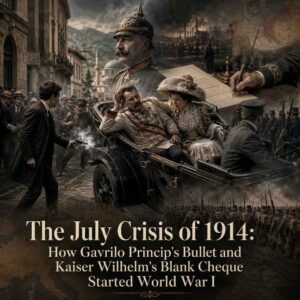
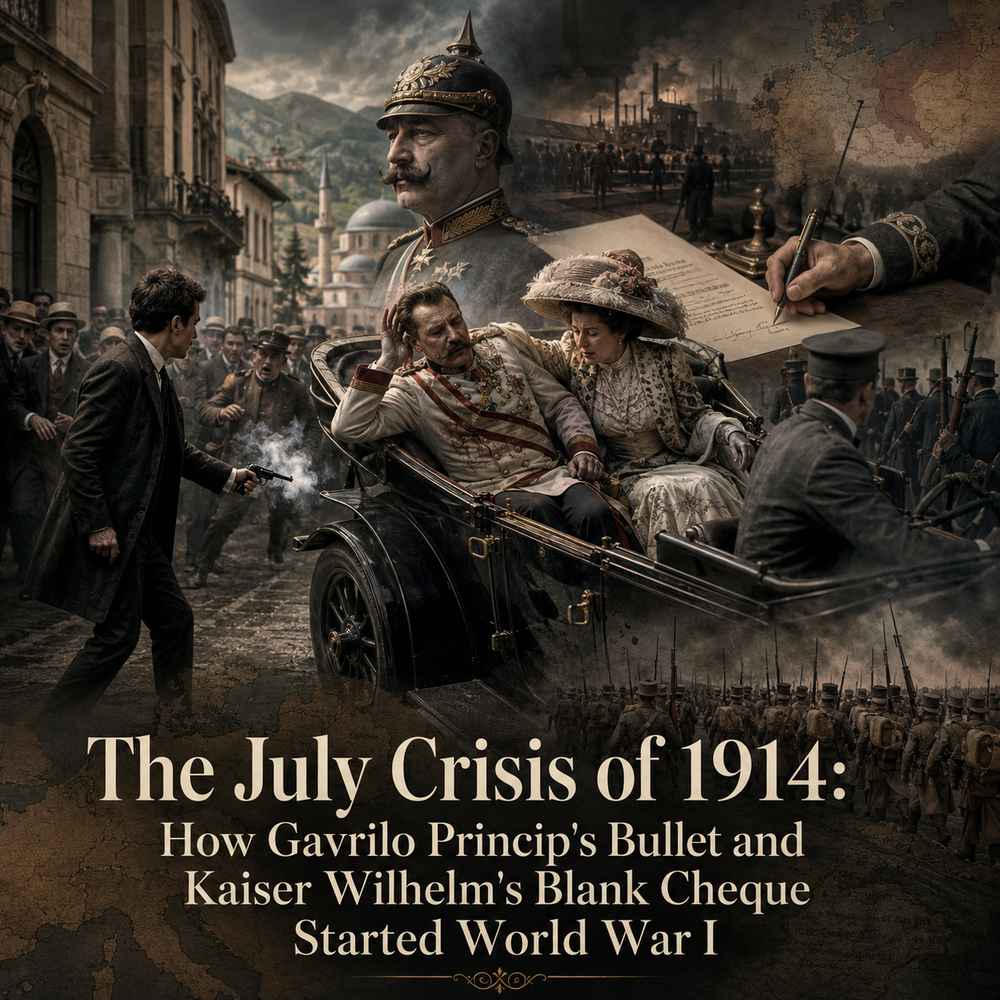
Franz Ferdinand sat upright in the back seat, blood soaking through his dress uniform, his wife Sophie slumped against him. The motorcade had been heading away from Sarajevo — away from Gavrilo Princip, away from the Black Hand conspirators who had already failed once that morning. The first assassin had thrown his bomb and missed. Franz Ferdinand had survived. The plot had collapsed.
Then the lead driver made a wrong turn.
He stopped to correct course on Franz Josef Street, directly in front of Schiller’s Delicatessen, where Gavrilo Princip stood on the pavement eating a sandwich, having already abandoned the mission as a failure. The car stalled less than five feet away. Princip drew his FN Model 1910 pistol. He fired twice.
Neither shot was aimed with any particular precision. One bullet entered Sophie’s abdomen. The other struck Franz Ferdinand in the jugular vein. Within the hour, both were dead.
In that wrong turn — that banal, accidental ten-second correction — lay the spark that would kill seventeen million people.
But the spark was not the fire. The July Crisis of 1914 that followed the assassination is the story of how the most powerful men in Europe chose war when they could have chosen otherwise — and how a single unconditional promise from Kaiser Wilhelm II to Austria-Hungary turned a regional murder into a civilizational catastrophe.
Why June 28, 1914 Was Already a Powder Keg
To understand the July Crisis, you have to understand that Europe in 1914 was not peaceful. It was merely stable — in the way a locked vault is stable. Every major power had been building toward something for thirty years.
Germany had emerged from the Franco-Prussian War of 1870 as a unified, industrially dominant force that terrified its neighbors. France had never recovered its pride from that defeat and had been quietly rearming. Russia was modernizing its army with French loans and increasingly viewed the Balkans as essential to its sphere of influence. Austria-Hungary, the creaking multiethnic empire, saw Serbian nationalism as an existential threat — a virus that could infect its own restless southern Slavic populations and tear the empire apart from within.
The alliance system that had developed to manage these tensions had instead calcified them. The Triple Alliance — Germany, Austria-Hungary, Italy — faced the Triple Entente of France, Russia, and Britain. Every major power had mobilization plans so precise, so scripted, that initiating them was nearly irreversible. Germany’s Schlieffen Plan required attacking France immediately through Belgium the moment war with Russia began, because fighting a two-front war simultaneously was considered unwinnable. Russian mobilization required days, and once started was nearly impossible to stop. Every military clock was synchronized to every other military clock.
Franz Ferdinand, ironically, was one of the men most likely to have managed this tension. He was not a militarist. He believed Austria-Hungary’s obsession with Serbia was strategically reckless. His death removed one of the few moderating voices at the top of the Habsburg hierarchy.
The men who replaced him in influence were not moderate.
The Blank Cheque: Kaiser Wilhelm's Fatal Promise
Austria-Hungary’s chief of staff, Franz Conrad von Hötzendorf, had been pushing for a war against Serbia for years. Foreign Minister Leopold von Berchtold wanted the same. They understood that moving militarily against Serbia risked drawing in Russia, which had positioned itself as the protector of Slavic nations. Moving against Russia without knowing Germany’s position was suicidal.
So they asked.
On July 5 and 6, 1914 — just days after the assassination — Austrian emissaries met with Kaiser Wilhelm II and Chancellor Theobald von Bethmann Hollweg in Potsdam. The Austrians wanted to know: if Austria attacked Serbia and Russia intervened, would Germany stand with them?
Wilhelm said yes. Unconditionally.
He told the Austrians they could “rely on Germany’s full support” regardless of what followed. Bethmann Hollweg confirmed it in writing the next day. This became known as the “blank cheque” — an unconditional guarantee of German military backing for whatever Austria chose to do.
Historians have argued for over a century about what Wilhelm intended. Some believe he expected Russia to back down, as it had during the Bosnian Crisis of 1908. Some believe he was recklessly indifferent to consequences. Some argue he actively wanted a European war before Russia’s military modernization made Germany’s window of relative superiority close permanently.
What is not disputed is what the blank cheque accomplished. It removed the one constraint that might have forced Austria into diplomacy. Before July 5, Austrian leaders knew a Serbian war risked European escalation they couldn’t manage alone. After July 5, that risk was Germany’s problem. Austria could move.
And move they did.
The Ultimatum That Was Designed to Be Rejected
Austria-Hungary spent three weeks drafting what it would send to Serbia. The document they produced on July 23 was not a serious diplomatic communication. It was a trap.
The ultimatum demanded that Serbia suppress all anti-Austrian publications and organizations, dismiss all officers Austria deemed hostile, and — most critically — allow Austro-Hungarian officials to participate directly in Serbia’s investigation of the assassination. That last demand was a deliberate violation of Serbian sovereignty so extreme that even Kaiser Wilhelm, when he read it, called it “a great moral victory for Vienna.” He thought Serbia would accept.
Serbia accepted every demand except the one requiring Austro-Hungarian participation in the investigation. That single exception — legally and diplomatically reasonable by any measure — was sufficient.
Austria-Hungary declared it unsatisfactory. On July 28, 1914, exactly one month after the assassination, Austria-Hungary declared war on Serbia.
The Austro-Hungarian military attaché in Belgrade, observing the Serbian response before the declaration, had sent a telegram to Vienna stating that there was no reason for war — that Serbia had capitulated on all essential points. The telegram was ignored.
The decision had already been made.
The Mobilizations That Could Not Be Stopped
What happened next was the machinery of European military planning grinding into motion with the cold indifference of a mechanism.
Russia began partial mobilization on July 25, before war was even declared. Tsar Nicholas II and Kaiser Wilhelm — cousins, linked by blood and by a frantic exchange of telegrams they signed “Nicky” and “Willy” — tried desperately in private to manage the situation. Wilhelm begged Nicholas to delay full mobilization. Nicholas begged Wilhelm to restrain Austria. Both men were already losing control of their own governments.
The Russian military command informed Nicholas that partial mobilization was technically impossible — the plans existed only for full mobilization, and initiating partial measures would create logistical chaos that would cripple any subsequent full mobilization. Nicholas had to choose between full mobilization or none.
He chose full mobilization on July 30.
Germany responded with an ultimatum to Russia: halt mobilization within twelve hours. Russia did not respond. Germany declared war on Russia on August 1.
France, bound by treaty to Russia, was next. Germany demanded French neutrality and the surrender of French border fortresses as “guarantee.” France refused. Germany declared war on France on August 3.
The Schlieffen Plan activated. German forces moved toward Belgium. Britain, which had treaty obligations to protect Belgian neutrality, issued its own ultimatum. Germany did not halt. Britain declared war on Germany on August 4.
In thirty-seven days, a wrong turn on a Sarajevo street had become the First World War.
The Immediate Human Arithmetic
The speed of the collapse was staggering. Within weeks of the final declarations, millions of men were mobilizing across a continent that had not seen a major European war in nearly fifty years. Most expected it to be over by Christmas.
Franz Ferdinand and Sophie, for whom this war was nominally being fought, had been buried at Artstetten Castle in Austria. No major European royal attended the funeral. The slight was deliberate — they had never fully been accepted at court, in part because Sophie was considered insufficiently aristocratic for an heir to the Austro-Hungarian throne. In death as in life, they were marginal to the empire they had served.
Gavrilo Princip was twenty years old. Austro-Hungarian law prevented him from being executed — he was a minor. He was sentenced to twenty years in prison and placed in Theresienstadt fortress, where he contracted tuberculosis. He died in April 1918, seven months before the war he had started ended. He was twenty-three.
The Serbian government, which Austria had suspected of masterminding the assassination, appears to have had advance intelligence of the plot and failed to act decisively on it — whether from incompetence or tacit tolerance remains debated. Serbia was invaded anyway. By the end of 1915, the entire Serbian army had been forced into a retreat across the Albanian mountains in winter. Of the roughly 400,000 who began that retreat, perhaps 150,000 survived to reach the Adriatic coast.
What the July Crisis Actually Decided
The July Crisis of 1914 is often taught as though war was inevitable — as though the alliance systems, the arms race, the imperial rivalries, and the nationalist tensions made 1914 inevitable. That framing is dangerously wrong.
War in 1914 was a choice. Multiple times, it could have been stopped.
Austria could have accepted Serbia’s response to the ultimatum. It chose not to. Germany could have refused the blank cheque or conditioned it on genuine diplomatic effort. It did not. Russia could have delayed mobilization to allow diplomacy more time. It judged the risk too high. Germany could have ignored the Schlieffen Plan’s rigid timelines. Its military command considered that impossible. Britain could have remained neutral — and nearly did, until Belgium was invaded.
At every juncture, the men making decisions chose escalation over resolution. Some feared appearing weak. Some calculated that war was coming eventually and preferred it now while conditions were favorable. Some simply failed to grasp what modern industrial warfare would actually mean.
None of them knew. None of them had any reference point for what a war between industrialized powers with machine guns, artillery, barbed wire, and mass conscript armies would produce. The last major European conflict, the Franco-Prussian War, had lasted months. They thought in those terms.
What they produced instead was four years of industrialized slaughter. Approximately seventeen million dead. The dissolution of four empires — the German, Austro-Hungarian, Ottoman, and Russian. The redrawing of the entire map of Europe and the Middle East. And, perhaps most consequentially, the conditions — economic devastation, territorial resentment, political humiliation — that would produce Adolf Hitler, the Nazi Party, and a second world war that killed more than twice as many people.
The July Crisis didn’t just start World War I. It started the century.
What This Moment Still Reveals
There is a persistent modern temptation to view the July Crisis as a lesson about alliance systems, or arms races, or the dangers of military planning that outpaces political judgment. All of those lessons are real.
But the deeper lesson is psychological.
Every major decision-maker in July 1914 was operating under the conviction that the other side would blink first — or that if they didn’t, the war would be manageable, short, and worth it. Kaiser Wilhelm genuinely believed Russia would back down as it had in 1908. Austrian leaders genuinely believed a quick war with Serbia would stabilize the empire rather than accelerate its disintegration. German military planners genuinely believed the Schlieffen Plan would produce a six-week victory in the west.
Every one of these calculations was catastrophically wrong. Not because the men were stupid — many were highly intelligent, deeply experienced, surrounded by advisors. They were wrong because they were reasoning from analogies that no longer held, in a world that had changed beneath their assumptions.
This is what military power unmoored from strategic wisdom actually looks like. Not incompetence. Not malice. Precision in the wrong direction.
The blank cheque that Kaiser Wilhelm signed on July 5, 1914, took less than thirty minutes to issue and required no army, no mobilization, no public announcement. It was a private conversation followed by a short written confirmation.
It killed seventeen million people.
Frequently Asked Questions
What was the July Crisis of 1914?
The July Crisis of 1914 was the five-week diplomatic and military collapse that followed the assassination of Archduke Franz Ferdinand on June 28, 1914, culminating in declarations of war between the major European powers and the beginning of World War I.
What was the blank cheque in World War I and why did it matter?
The blank cheque was an unconditional guarantee of German military support issued to Austria-Hungary by Kaiser Wilhelm II and Chancellor Bethmann Hollweg on July 5–6, 1914. It mattered because it removed the one constraint that might have forced Austria-Hungary into diplomatic restraint — the fear of facing Russia without German backing — effectively enabling the escalation to a continental war.
Did Gavrilo Princip intend to start World War I?
No. Princip was a Bosnian Serb nationalist motivated by resentment of Austro-Hungarian rule over Bosnia. His intent was political assassination, not continental war. He later stated that had he known what his actions would produce, he would not have pulled the trigger — though historians treat such retrospective statements with appropriate skepticism.
Could World War I have been prevented after the assassination?
Yes. Historians broadly agree that war was not inevitable after Franz Ferdinand’s assassination. Multiple decision points — Austria’s response to Serbia’s ultimatum, Germany’s unconditional support, Russia’s mobilization timeline, Germany’s invasion of Belgium — each represented a moment where different choices could have contained the crisis. The July Crisis was a failure of political will and strategic imagination, not an unstoppable mechanism.
Why did Britain enter World War I?
Britain entered World War I primarily because Germany’s execution of the Schlieffen Plan required invading neutral Belgium, violating the 1839 Treaty of London that Britain had guaranteed. The strategic reality was also significant: a German-dominated continental Europe would have been an unacceptable threat to British power and trade, but the Belgian invasion gave the political justification and public support for intervention.
What was the Schlieffen Plan and why did it make World War I inevitable once it began?
The Schlieffen Plan was Germany’s military strategy for a two-front war against France and Russia simultaneously. It required immediately attacking France through Belgium the moment war with Russia began — on a rigid timetable — before turning east. Once Germany declared war on Russia and activated the plan, war with France and the invasion of Belgium became automatic. The plan’s inflexibility converted a war with Russia into a world war within 72 hours.
What happened to Serbia during World War I?
Serbia was invaded by Austria-Hungary in 1914 but repelled the initial assaults. After Bulgaria joined the Central Powers in 1915, a combined Austro-Hungarian, German, and Bulgarian offensive overwhelmed Serbian forces. The Serbian army conducted a catastrophic winter retreat across Albania to the Adriatic coast, losing roughly half its men to cold, starvation, and combat. The reconstituted Serbian army later fought on the Salonika Front until the war’s end.
Continue Reading
If this piece resonated with you, these are worth your time:
- *Robespierre and the Reign of Terror: Why Revolutions Devour Their Own Architects* — another examination of how political extremism produces outcomes that destroy its own architects
- *Peter the Great’s Brutal Modernization: How Russia Was Dragged Into the 18th Century* — the long arc of Russian strategic ambition that made 1914’s mobilization decisions psychologically comprehensible
- *Stalingrad: Why Six Months of Urban Combat Changed the Second World War Forever* — the direct consequence of the July Crisis, two decades downstream
Books Worth Reading
The Sleepwalkers: How Europe Went to War in 1914 by Christopher Clark remains the definitive modern account of the July Crisis. Clark’s careful reconstruction of each decision-maker’s perspective dismantles the comfortable mythology that Germany alone bears responsibility, without absolving anyone. Essential reading for understanding how intelligent people walked into catastrophe.
The Guns of August by Barbara Tuchman is older but never loses its power. Tuchman reconstructs the opening weeks of the war with the precision of a military historian and the narrative drive of a novelist. John F. Kennedy reportedly read it during the Cuban Missile Crisis as a warning about how great powers stumble into wars they didn’t intend.
On YouTube
Our full exploration of Stalingrad — the war this crisis ultimately produced — is available on the History Republic YouTube channel. The six-month siege that broke the German war machine is, in many ways, the final reckoning for the decisions made in those thirty-seven days of July 1914.
A Note on Why This Work Matters
History Republic exists because serious historical storytelling — grounded in evidence, told with the craft it deserves, free from the shallow summaries that dominate online content — is worth preserving and building.
If you’ve read this far, you already understand what we’re trying to build.
Members make this work sustainable. They allow us to go deeper, produce more, and maintain the standard this history demands. If you want to be part of that — not as a consumer, but as a genuine supporter of independent historical storytelling in an age that badly needs it — the membership link is below.
You are helping preserve serious historical storytelling in a shallow digital age. That matters more than the algorithm will ever measure.