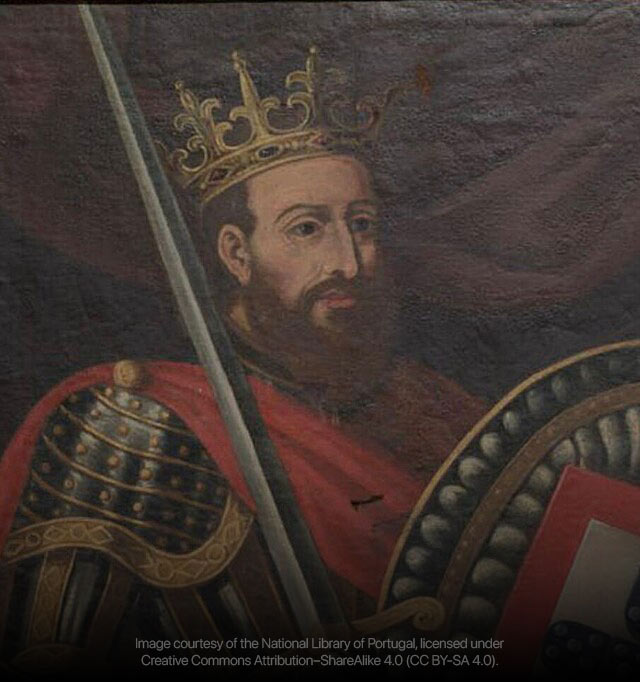
History sometimes hinges on a stubborn child. Afonso Henriques—later Afonso I, founder and first king of Portugal—grew up on a contested frontier where loyalties twisted like the rivers that cut through the north.
Before he was “the Conqueror,” he was a boy watching nobles bargain, bishops bless, and soldiers bleed for a strip of land that was not quite independent and not quite ruled. He would change that.
Over a long, hard life (ending in 1185), Afonso transformed the County of Portugal into a kingdom that the neighbors had to acknowledge and that Rome would finally bless. This is the long arc of how he did it—by sword, by charter, by treaty, and by patience.
Before Afonso I of Portugal: a frontier looking for a future
In the late 11th and early 12th centuries, the western edge of the Iberian Peninsula was a patchwork of ambitions. The Christian kingdoms of León-Castile and Galicia pressed south; Islamic power—first Almoravid and later Almohad—held the great cities and rich plains farther down. The “County of Portugal” (then essentially the Minho–Douro zone and the old County of Coimbra) was not yet a country.
It was a marcher fief granted in 1095 to a Burgundian knight, Henry of Burgundy, by his father-in-law Alfonso VI of León-Castile, with the task of defending and developing a volatile frontier. Henry married Teresa, Alfonso VI’s illegitimate daughter, and together they governed this liminal space until Henry’s death in 1112, when Teresa ruled alone as regent for their young son, Afonso.
Two dynamics shaped this borderland. First, Reconquista warfare ebbed and flowed with raids, sieges, and seasonal campaigns; towns could change hands, and castles were everything. Second, the county’s elites learned to play a double game—courting León-Castile to the east while nurturing their own identity and interests to the west.
By the time Afonso was born (likely 1109–1111, with Guimarães as the traditional birthplace), the idea of a “Portugal” distinct from Galicia and León was no longer just a whisper. It had patrons, monasteries, and a rising class of nobles who wanted a prince of their own.
Birth, parents, and early days
Afonso entered this world as Afonso Henriques, son of Henry, Count of Portugal, and Teresa of León. Henry’s death left Teresa in a difficult position: still ambitious, closely tied to Galician magnates (especially the powerful Trava clan), and unwilling to yield power when her son came of age.
The boy’s education, in the rough school of border politics, mixed piety and pragmatism—monasteries like Santa Cruz of Coimbra helped shape him, but it was the armored nobility of the Minho and Douro who would carry him to power.
The coalition that formed around Afonso as a teenager was, at once, a patriotic movement and a practical alliance: nobles wary of Galician dominance, bishops anxious to consolidate ecclesiastical influence, townsmen hoping for charters, and veterans who wanted campaigns that profited Portugal rather than Galicia.
The break came at Guimarães on 24 June 1128, at the celebrated Battle of São Mamede. Afonso’s supporters defeated forces loyal to his mother Teresa and her Galician ally Fernão Peres de Trava. In the aftermath, Afonso took control of the county; soon he would style himself “Prince of Portugal” (princeps), signaling a step between count and king and a claim to autonomous direction.
Later chroniclers cast São Mamede as the true birthday of the nation; modern historians see it as the moment Afonso secured the political room he needed to pursue independence.
From Count to Contender
Between 1128 and 1139, Afonso worked to harden the county into a proto-kingdom. He courted the clergy—especially João Peculiar, the shrewd archbishop of Braga—and bound key nobles by patronage and opportunity.
He issued and confirmed forais (municipal charters) to fortify the county’s urban spine, encouraged settlement south of the Mondego, and kept a sharp eye on his cousin and rival to the east, Alfonso VII of León-Castile, who styled himself “Emperor.”
Diplomacy alternated with saber-rattling. In 1137, at Tuy, Afonso temporarily recognized his cousin’s suzerainty in a tactical pause; within two years, events would render that accommodation moot.
Ourique (1139): battle, banner, and the birth of a title
The turning point—historically solid yet wrapped in legend—came at the Battle of Ourique on 25 July 1139. Portuguese forces under Afonso met and defeated an Almoravid army somewhere in the broad region traditionally called “Ourique.” The precise location and scale are debated; the famed vision of Christ promising victory (the “Miracle of Ourique”) is a later, patriotic embroidery. What matters for the political story is what followed: Afonso began using the royal title.
Whether he “acclaimed” himself king on the battlefield or consolidated the title shortly thereafter, he had crossed a psychological and diplomatic line. From count and prince, he became Afonso, King of the Portuguese—with or without his cousin’s blessing.
The new title brought new war. Afonso’s assertion of kingship strained relations with León-Castile and led to the face-saving tourney (or encounter) at Arcos de Valdevez in 1141—a curious near-battle that, by chivalric contests and negotiation, helped de-escalate a direct clash while preserving Afonso’s practical control at home.
Whatever Valdevez’s precise military meaning, its political outcome was clear: both sides were ready for diplomacy.
1143: Zamora and a new place in Iberia
In October 1143, Afonso and Alfonso VII met at the Cathedral of Zamora under the watchful eye of the papal legate Cardinal Guido de Vico. The encounter—often called the Treaty of Zamora—did not, in the surviving documents, read like a formal, legal recognition on parchment in the modern sense; but it did normalize a reality.
Afonso would continue to style himself king and act as one; Alfonso VII would deal with him as such even as he maintained imperial pretensions; and Rome, crucially, took note. The Archbishop of Braga and Afonso’s circle understood the next step: if León-Castile would not give full, explicit recognition, perhaps Rome would—if properly courted.
Afonso wasted little time. In December 1143, he addressed a letter of “oblation” to Pope Innocent II, offering Portugal as a censual fief of St. Peter and promising an annual tribute (famously, four ounces of gold) in exchange for papal protection—placing Portugal under the Pope’s shield rather than León’s shadow.
The papacy replied warmly yet cautiously in 1144. It would take decades and more victories for Rome to seal the matter—decades Afonso meant to fill with conquest and consolidation.
The meaning of Zarzamora is often simplified. This meeting was a diplomatic conference more than a modern treaty. It did not produce a surviving document explicitly stating “Portugal is independent.” But it did reset relations: Afonso’s royal usage became routine; the papacy’s involvement widened; and the fragile peace allowed both rulers to fight on other fronts.
In that sense, Zamora was the political hinge that led, via decades of campaigning and petitioning, to Rome’s Manifestis Probatum in 1179.
1147: Santarém by stealth, Lisbon by siege
The dazzling year of 1147 showed Afonso at his most audacious and opportunistic.
First, in March, he took Santarém in a brilliantly executed night assault, riding from Coimbra with a picked force of about 250 knights, scaling the walls by surprise, and seizing the city before the garrison could react. Santarém controlled the Tagus approaches; its capture pushed Portugal’s frontier south in one stroke.
Then came Lisbon. That summer a large fleet of northern European crusaders, bound for the Holy Land as part of the Second Crusade, stopped at Porto. Afonso negotiated an alliance: if the crusaders helped him take Lisbon from the Almoravids, they could share in plunder and privileges—and many would be invited to settle afterward.
The siege lasted from July to October 1147 and ended in surrender and storm. It was the only major Christian victory of the Second Crusade, and it changed Portugal forever: Lisbon became a key royal center and, in time, the kingdom’s beating heart. Some crusaders stayed; others sailed on or returned north; but the demographic and strategic fabric of Portugal had been rewoven.
Lisbon’s fall set off a chain of coastal and riverine operations that secured the lower Tagus and encouraged settlement. With Santarém and Lisbon in hand, Afonso could argue—credibly—to both neighbors and Rome that his kingship was not mere bravado. He had made a kingdom on the ground.
Afonso’s Reconquista: method in the momentum
Afonso was no mere raider. The pattern of his campaigns reveals a strategic sensibility:
- Take river gates first (Mondego, then Tagus) to open corridors for trade and troop movement.
- Work with whoever can help—local nobles, monastic orders, and, when opportunity knocks, foreign crusaders.
- Plant institutions behind the spears: charters for towns, endowments for monasteries (especially Cistercians), episcopal support for the spiritual and administrative glue a new realm needs.
- Keep pressure flexible—move south when the Almoravids (and later Almohads) are vulnerable; maneuver diplomatically when León-Castile presses from the east.
By the 1150s–1160s, this method had produced a state with durable bones: fortified towns, a chain of castles, and a political class tied to the fortunes of a Portuguese crown rather than to Galician patrons.
Consolidating a kingdom: charters, church, and coin
Conquest impresses; consolidation convinces. Afonso’s statecraft mattered as much as his sieges.
- Forais (municipal charters): Afonso confirmed and granted charters to towns across the realm, fixing rights and obligations, anchoring settlers (many from the north) in reclaimed lands, and creating a class of townsmen with a stake in royal order.
- Monastic partnerships: Endowments to Santa Cruz (Coimbra) and Cistercian houses secured literate administrators, colonists for frontier lands, and moral capital. Monks drained marshes, planted vines, copied charters, and legitimized royal policy in homilies and chronicles.
- Episcopal diplomacy: By supporting the see of Braga and other bishoprics, Afonso made bishops co-authors of Portugal’s independence case—to León’s annoyance, but to Rome’s ears.
- Royal court and coin: As his domain expanded, Afonso’s court issued diplomas and minted coinage—the symbols and substance of sovereignty—while his officials negotiated borders, truces, and marriage alliances to stabilize gains.
All of this meant that when Afonso called himself “king,” he could point to more than a title. He could point to an apparatus.
Rome decides: Manifestis Probatum (1179)
Diplomacy, like siegecraft, rewards persistence. For years after 1143, Afonso and his clergy maintained steady contact with the papacy, emphasizing two points: (1) Portugal’s utility in the struggle against Islam, where Afonso’s armies had delivered real gains; and (2) Portugal’s direct vassalage to St. Peter, which delicately sidestepped León-Castile’s claims of overlordship.
At last, in 1179, Pope Alexander III issued the papal bull Manifestis Probatum, which formally recognized Portugal as a kingdom and Afonso as its king, taking the realm under St. Peter’s protection.
The bull praised Afonso’s services to the Church against “the enemies of the Christian name,” affirmed the kingdom’s dignity, and blessed its conquests where no other Christian prince had prior claim—an elegant way of ratifying Portugal’s southward expansion without provoking its Christian neighbors. This was the definitive international recognition Afonso had sought for decades.
With Manifestis Probatum, Afonso’s project was complete in principle and in law: a sovereign Portugal, sanctified by Rome, real on the map, and hard to undo.
How long he reigned, how he died—and what remained
Afonso used the royal title from 1139 and reigned until his death on 6 December 1185, a span of forty-six years as king (longer if you count his rule as count since 1112). In the end, the warrior who had spent a lifetime in the saddle died an old man in Coimbra, and was buried at Santa Cruz, the monastery that had helped imagine his kingdom before it fully existed.
What remained?
- Territory transformed: Under Afonso, Portugal pushed decisively beyond the Mondego, fixed itself on the Tagus, and planted institutions to hold what armies took. Santarém and Lisbon were the big prizes; countless lesser towns and castles were the connective tissue.
- A recognized crown: Zamora normalized; Manifestis Probatum legalized—Portugal was now a fact in Christendom.
- A political culture: Nobles tied to the Portuguese court; bishops and abbots who thought in Portuguese terms; towns whose charters bound them to a Portuguese king.
- A model for successors: Afonso’s son Sancho I inherited not a brave dream but a functioning state with room to grow.
The man in the middle of the myth
Later centuries wrapped Afonso in legends—the shining vision before Ourique, the solemn Cortes of Lamego supposedly confirming the new crown, the perfect chivalric founder. Much of that is literary embroidery; the paperwork is thin.
But the substance holds: Afonso was ferociously pragmatic. He made friends of monks and mariners; he used foreign crusaders when useful and let them settle when wise; he balanced force and form, understanding that charters and bulls could be as decisive as battering rams.
He was also a frontier prince of his time: sometimes ruthless, often opportunistic, always alive to the winds of Iberian politics. León-Castile could be a threat one year and a partner the next; Rome could be a distant arbiter and a vital ally, depending on the letter you sent and the victories you could boast.
Aftermath: a kingdom that could outlive its founder
When Afonso I died in Coimbra in 1185, Portugal did not pause to ask whether it would continue—it simply did. The crown passed to his son Sancho I without a civil war or a regency crisis, which in the brutal arithmetic of the Middle Ages already counted as proof that Afonso had built more than a personality cult.
The institutions he had hammered together—royal chancery, episcopal alliances, a network of chartered towns, a nobility tied to the court’s fortunes—held their shape with a new king’s seal at the bottom instead of the old one.
Sancho inherited not just a title but a program. He pushed Afonso’s settlement drive deeper into contested lands, multiplying forais (municipal charters) to attract colonists, regularize taxes, and fix obligations that made frontier towns resilient.
If Afonso’s reign had been about breaking open the gates (Santarém, Lisbon), Sancho’s early years were about filling the corridors behind those gates: repopulating abandoned hamlets, strengthening castles, and stitching together river valleys with markets and parish churches so that armies didn’t have to take the same ground twice.
Militarily, the Reconquista rhythm continued. With the help of crusader contingents stopping in Iberia, Sancho struck south: the capture of Silves (1189) briefly announced a Portuguese presence in the Algarve before the Almohad counterattack (1191) forced withdrawals and taught the hard lesson that keeping the south would demand more than one lucky campaign.
Even in setback, the pattern Afonso set endured—use the sea, court foreign allies when they can be useful, and leave behind garrisons and charters wherever flags are planted.
Diplomatically, Afonso’s late triumph in Rome paid ongoing dividends. Because Manifestis Probatum (1179) had already placed Portugal under papal protection and recognized its king, Sancho dealt with León and Castile as a peer, not a vassal jockeying for air.
There were border squabbles—there always are on living frontiers—but the axis of Portuguese foreign policy no longer revolved around pleading for acknowledgment. The kingdom existed in law and in habit, which meant treaties could be argued line by line instead of fought city by city.
Inside the realm, the founder’s equilibrium—crown, church, towns, and nobles keeping one another in productive tension—continued to evolve. Monastic communities (especially the Cistercians) expanded their role in clearing land, managing estates, and training the literate staff the crown needed; bishops pressed their privileges while anchoring royal claims; towns grew in wealth and stubbornness.
The Portuguese court learned the steady work of a settled kingdom: minting coin with reliable weight, recording land grants so they would not be litigated to death, marrying daughters and sons across borders, and refining the paper instruments that bind a people as securely as stone walls.
In that sense, the truest measure of Afonso’s legacy lay not in the next victory but in the next generation’s boredom with asking first principles. By the time Sancho I was an old man, the question was no longer “Is Portugal real?” but “How far can Portugal reach, and who pays for it?” That shift—from existential doubt to strategic calculation—is the quiet revolution Afonso left behind.
There were, of course, growing pains after the founder’s generation: inheritances that sparked family quarrels, church–crown spats over jurisdiction and property, and the grinding costs of southern campaigns that sometimes outpaced the treasury. But those were problems inside a functioning frame.
The country weathered them because the frame held: a kingship recognized abroad and rooted at home, a habit of municipal self-government that kept frontiers sticky with loyalty, and a clergy invested in the success of a realm they had helped to imagine.
So the aftermath of 1185 is not a dramatic epilogue; it is the beginning of normalcy. The county’s son had given Portugal two gifts that outlived him: shape and momentum. Shape meant institutions that let the kingdom behave like a kingdom even when a particular campaign failed or a particular noble sulked. Momentum meant that, when the chance came again to push south—to the Alentejo and, in time, the Algarve—the machine Afonso built could try, fail, regroup, and try again.
Conclusion
Afonso Henriques matters because he proved a political thesis: that a marcher county on a contested coast could become a kingdom if it married military momentum to institutional muscle and international recognition.
He understood that independence is not a single proclamation; it is a chain—of battles won, towns settled, bishops convinced, treaties negotiated, and, finally, a papal seal pressed into wax.
In the story of medieval Europe, where many bold ventures fell back into their neighbors, Afonso’s Portugal stuck. It did so because he built something that could live without him: a network of towns, a cadre of nobles and clergy invested in Portuguese success, and a legal-diplomatic scaffolding that locked his borders into the Christendom of his day.
When he died in 1185, the county’s son had left a kingdom behind.
That is how medieval projects become modern countries: not with a single shout on a battlefield, but with a thousand administrative breaths that go on being taken after the shouting stops.