When Terror Becomes Policy
The Order That Changed Everything
The boyar arrived at the monastery before dawn. He had been summoned by personal order of the Tsar — and in 1565, a personal summons from Ivan IV meant one of two things: favour or death. There was no way to know which until you were standing in front of him.
Ivan Vasilyevich, first Tsar of All Russia, had just done something no Russian ruler had ever attempted. He had abandoned Moscow. He had written letters denouncing his own nobility as traitors and his clergy as cowards. And then he had waited — knowing exactly what would happen next.
The people panicked. The boyars capitulated. Within weeks, Ivan had returned to Moscow with something no Russian ruler had possessed before: absolute, unchallengeable authority over life and death. He hadn’t seized it by force. He had manufactured consent through fear so total that his subjects handed it to him voluntarily.
This is the story of how Ivan the Terrible turned terror into a governing philosophy — and why the system he built would eventually consume everything, including the heir he had spent a lifetime preparing.
The World That Made Ivan
To understand Ivan the Terrible’s psychology of power, you have to understand the world that shaped him. When his father Vasily III died in 1533, Ivan was three years old. When his mother Elena Glinskaya died — almost certainly poisoned — five years later, he was eight. The child who would become Russia’s most feared ruler spent his formative years watching the great boyar families of Moscow circle him like wolves.
They weren’t subtle about it. Court factions seized regents, arrested rivals, and paraded their power in front of the young Grand Prince. Ivan later wrote that he and his younger brother Yuri were treated as servants — underfed, poorly clothed, used as political props when convenient and ignored when not. Whether this account was entirely accurate or partly self-serving propaganda matters less than what it produced: a ruler with a profound, consuming conviction that power was something that had to be seized and defended with absolute ruthlessness, because the moment you relaxed, your enemies would destroy you.
Ivan was crowned Tsar — a title deliberately chosen to echo the Roman Caesar and Byzantine Emperor — in 1547, at the age of sixteen. For the first decade of his reign, he governed with surprising competence. He reformed the legal code, reorganised the military, expanded Russia’s borders, and introduced the first Russian printing press. The early Ivan was not the terror he would become. He was something more dangerous: a man of genuine capability who had convinced himself that the source of all his troubles was the treachery of those around him.
That conviction would not stay theoretical for long.
The Architecture of Paranoia
The shift began with the Livonian War. In 1558, Ivan launched a campaign to secure Baltic coastline and access to Western trade — a strategically sound ambition that quickly became a military catastrophe. Early gains dissolved into grinding stalemate, then reversal. As losses mounted, Ivan’s search for explanation turned inward: not towards strategic reassessment, but towards betrayal.
In 1564, his most trusted military commander, Prince Andrei Kurbsky, defected to Lithuania. He then did something unprecedented: from exile, he wrote directly to Ivan, accusing him of tyranny, paranoia, and the murder of innocent nobles. Ivan wrote back. The exchange — known today as the Kurbsky-Ivan Correspondence — is one of the most extraordinary documents in Russian history. In it, Ivan articulates what he genuinely believed: that a tsar’s authority was absolute and divinely ordained, that any resistance to that authority was not political disagreement but spiritual treason, and that the appropriate response to treason was annihilation.
This wasn’t performance. This was Ivan’s actual governing philosophy, now hardened by years of real and imagined betrayal into something systematic. What came next would give it institutional form.
The Oprichnina: Terror as a System
In December 1564, Ivan disappeared from Moscow. He retreated to Alexandrov Sloboda, a fortified estate 65 miles away, and sent two letters back to the capital. The first accused his boyars and church officials of sabotage and corruption. The second — addressed directly to the common people of Moscow — told them he held no anger toward them specifically.
It was a masterstroke of psychological manipulation. The city erupted. Crowds demanded the boyars go to Ivan and beg him to return. The nobility, terrified of popular revolt and their own vulnerability without a tsar, had no choice. They sent delegations pleading for his return on any terms he named.
Ivan named his terms. He would return — but he would divide Russia in two. One portion, the Zemshchina, would be governed by the boyar council as before. The other, the Oprichnina, would be his personal domain, subject to his rule alone, answerable to no law or tradition. And to administer the Oprichnina, he created Russia’s first political secret police: the Oprichniki.
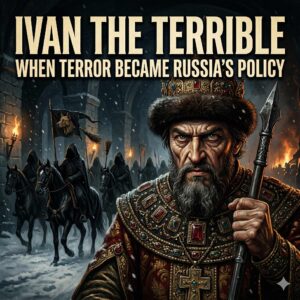
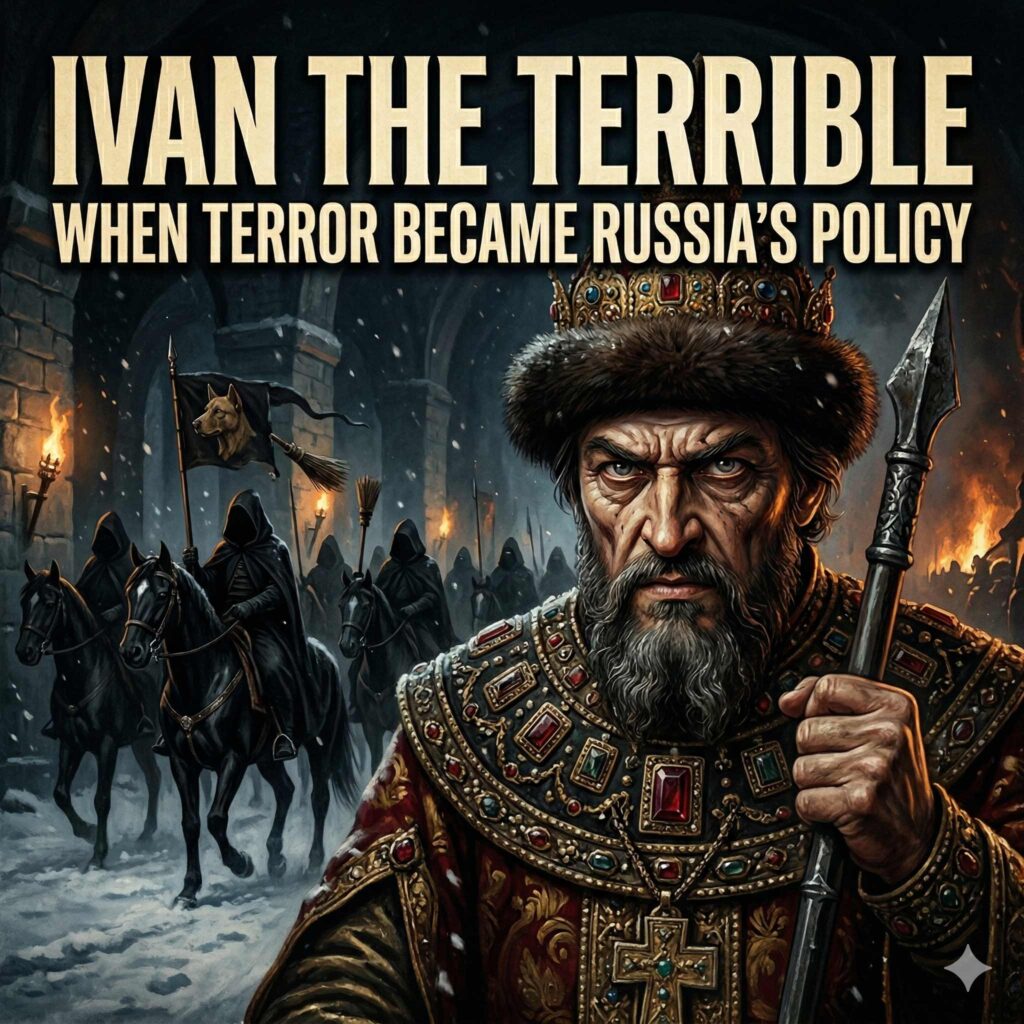
The Oprichniki dressed in black, rode black horses, and carried a dog’s head and a broom at their saddle — symbols that they were the Tsar’s hounds, sworn to sniff out treason and sweep it away. In practice, they were given extraordinary powers to arrest, torture, execute, and confiscate property with no judicial oversight and no accountability. Within months, the terror had a face — and it was organised.
The Massacre of Novgorod: Terror at Industrial Scale
If there was a single moment when Ivan’s politics of fear revealed their full catastrophic potential, it was the winter of 1569 to 1570.
Ivan received — or manufactured; historians still debate the origin — reports that Novgorod, Russia’s second city and oldest trading republic, was plotting to defect to Lithuania. He needed no more. In December 1569, he led the Oprichniki north in a march that had more in common with a medieval annihilation campaign than a judicial investigation.
What followed at Novgorod lasted approximately five weeks. Contemporary accounts describe systematic mass executions: residents bound and thrown into the Volkhov River through holes in the ice, families executed together, property stripped and burned. The numbers in historical sources vary wildly — from several thousand to tens of thousands — and should be treated with appropriate uncertainty. What is not in dispute is the scale of destruction or the deliberate, methodical nature of it. This was not battlefield killing. It was the organised application of state violence against a civilian population.
Ivan did not commit this atrocity despite his governing philosophy. He committed it because of it. In his framework, the threat of treason — real or imagined — justified any response. Mercy was weakness. Hesitation was an invitation. The only language power respected was the threat of absolute consequence.
The Novgorod massacre was not an aberration. It was Ivan’s political theory applied at scale.
The System That Devoured Its Creator
The immediate consequences of the Oprichnina years were devastating. Russia’s military capacity was severely degraded — the Oprichniki, whatever their terror value, were not disciplined soldiers. In 1571, a Crimean Tatar force under Devlet I Giray raided as far as Moscow itself, burning the city’s outer districts while Ivan fled. The following year, a larger Russian army finally repelled the Tatars at the Battle of Molodi — but the military incompetence the Oprichnina had introduced into command structures was visible throughout.
Economically, the terror had emptied whole regions. Estates confiscated from executed nobles fell fallow. Peasants fled or died. The agricultural base that supported military campaigns contracted at precisely the moment the Livonian War demanded maximum resource extraction.
In 1572, Ivan abolished the Oprichnina. The word itself was banned — it became forbidden to even speak it. Historians have debated why: military necessity, fear of a coup by his own Oprichniki, or simply a recognition that the system had outlived its strategic purpose. But he did not abandon the methods. The executions continued. The paranoia deepened.
The Murder of His Son
In November 1581, Ivan struck his pregnant daughter-in-law during an argument — sources differ on the pretext. His son, Tsarevich Ivan, confronted his father. The confrontation escalated. Ivan IV struck his heir with an iron-tipped staff, hitting him in the temple. The Tsarevich died of his wound four days later.
Ivan was reportedly inconsolable. He had destroyed his own succession with his own hands — the logical terminus of a governing philosophy that recognised no limits on the sovereign’s rage. The son he had groomed to continue his project was gone. The Russia he left behind would fracture into the catastrophic period known as the Time of Troubles within twenty years of his own death.
The Long Shadow: What Ivan Built That Survived Him
Ivan the Terrible died in 1584, leaving behind a Russia that was simultaneously more centralised and more unstable than the one he had inherited. The contradiction was not accidental — it was structural.
On one side of the ledger, Ivan’s legacy is genuinely significant. He completed the transformation of Russia from a collection of principalities into a unified state with a single sovereign authority. He expanded Russia’s territory dramatically — the conquest of Kazan and Astrakhan in the 1550s opened the Volga corridor and began Russia’s eastward expansion that would eventually reach the Pacific. He established institutions — the Zemsky Sobor, the reformed legal code, the standardised military — that formed the administrative skeleton of the Russian state for generations.
On the other side: the systematic destruction of the boyar class, while it concentrated power in the Tsar’s hands, also eliminated the experienced administrative layer that the state needed to function. The Oprichnina had not just killed individuals; it had killed institutional competence. When Ivan died and left a mentally incapable heir, Feodor I, there was no functioning class of administrators capable of managing the crisis. The result was the Time of Troubles — a decade of civil war, famine, foreign invasion, and dynastic collapse that came within a breath of erasing the Russian state entirely.
The deeper legacy is more troubling still. Ivan established, with terrifying clarity, a template for Russian autocracy that would echo through the centuries: the idea that the state’s survival justifies any action against any person, that loyalty is presumed insufficient until proven through suffering, and that the correct response to a threat — real or imagined — is overwhelming, theatrical violence designed to make the cost of opposition unthinkable.
You can trace a direct line of institutional DNA from the Oprichniki to the Okhrana to the NKVD. The specific crimes differ. The underlying logic does not.
What Ivan the Terrible Actually Teaches Us
The history of Ivan the Terrible is not primarily a story about a madman. That framing is too comfortable — it allows us to file him under aberration and move on. The more unsettling truth is that Ivan was a rational actor operating within a coherent, internally consistent political framework.
His framework had one foundational assumption: that power is inherently unstable, that enemies are always present, and that pre-emptive violence is the only reliable stabiliser. Once you accept that premise, the Oprichnina follows logically. The massacre of Novgorod follows logically. Even the murder of his own son — in the heat of rage, without premeditation — follows from a lifetime spent treating all challenges to his authority as existential.
The question Ivan’s life forces us to ask is not whether extreme measures can consolidate power. They can, in the short term. The question is what kind of system those measures build — and whether that system can survive the moment it needs to function without terror.
Ivan’s answer was: it cannot. The Oprichnina destroyed the very administrative class needed to run the state he was trying to protect. The fear that held the system together also hollowed out everything inside it.
That dynamic — where the tools used to secure power ultimately undermine the capacity to exercise it — is not unique to sixteenth-century Russia. It appears, with remarkable consistency, whenever governing by fear replaces governing by institution. Ivan the Terrible did not invent this problem. He gave it one of its most complete historical demonstrations.
This Is the History Worth Understanding
If you’ve read this far, you’re not here for a surface-level summary. You’re here because you believe history — told properly, with honesty about its complexity and its darkness — is one of the most useful lenses we have for understanding the world.
That’s what History Republic is built to provide. Not sensationalism. Not Wikipedia summaries. Serious historical storytelling for people who take it seriously.
If that’s the kind of history you’ve been looking for, consider becoming a member. Members get deeper access — extended analysis, member-only breakdowns, and the knowledge that they’re part of keeping this work alive.
Continue the Story
Related Articles:
→ Peter the Great and Alexei: When Empire Demands the Destruction of Family
→ Robespierre and the Reign of Terror: Why Revolutions Devour Their Own Architects
→ Napoleon’s Hundred Days: What His Return from Exile Reveals About Power and Delusion
Recommended Reading:
→ Ivan the Terrible by Henri Troyat — The definitive biography; rigorous, readable, and unsparing.
→ The Formation of Muscovy 1304–1613 by Robert O. Crummey — Essential context for understanding the world Ivan inherited and destroyed.
Watch on History Republic:
→ Ivan the Terrible: How Fear Became a Governing Strategy [YouTube Episode — Psychology of Power Series]
Frequently Asked Questions
Why was Ivan IV called ‘the Terrible’?
The English translation is misleading. The Russian word ‘Grozny’ carries connotations of awe-inspiring, formidable, and dread-inducing — closer to ‘the Fearsome’ or ‘the Thunderous’ than simply ‘Terrible.’ The title was originally a mark of power, not pure condemnation. Over time, given the content of his reign, the English ‘Terrible’ stuck for good reason.
What was the Oprichnina and why did Ivan create it?
The Oprichnina (1565–1572) was Ivan’s personal domain — carved out of Russia and governed by him alone, outside the traditional legal and noble structures. The Oprichniki were its enforcers: a political secret police with absolute powers of arrest, torture, execution, and property seizure. Ivan created it after his forced ‘departure’ from Moscow in 1564, which was a calculated political manoeuvre that extracted total submission from the boyar class in exchange for his return. It was not madness. It was a system.
How many people died during Ivan the Terrible’s reign of terror?
Reliable figures are difficult to establish — sixteenth-century Russian recordkeeping was inconsistent, and later sources had political motivations on both sides. Estimates for the Novgorod massacre alone range from 2,000 to 60,000, with most modern historians settling on figures in the low thousands. Across the Oprichnina period as a whole, several thousand executions are documented. The broader devastation — displacement, famine, economic collapse — affected hundreds of thousands more.
Did Ivan the Terrible really kill his own son?
Yes, with strong probability. The most reliable account comes from the Papal legate Antonio Possevino, who was in Moscow at the time. Ivan struck Tsarevich Ivan during an argument — the exact cause is debated — with an iron-tipped staff. The blow to the temple was fatal; the Tsarevich died four days later. Ivan reportedly spent days in grief-stricken fasting and prayer. The killing was almost certainly unintentional in the sense of unpremeditated, but it was the direct product of a lifelong pattern of violent rage.
Why is Ivan the Terrible important to Russian history?
Ivan was the first ruler to formally take the title of Tsar, completing Russia’s self-definition as the successor to Byzantium and Rome. He unified Russia’s territory, reformed its legal and military institutions, and launched the eastward expansion that would eventually make Russia the world’s largest state. He also established the template for Russian autocracy — absolute, centralised, and enforced through fear — that shaped the country’s political culture for centuries. His reign is both foundational and catastrophic: the same figure built the state and came close to destroying it.
What happened to Russia after Ivan the Terrible died?
Ivan died in 1584, leaving the throne to his son Feodor I, who was pious and gentle but mentally incapable of governing. Real power passed to Feodor’s brother-in-law Boris Godunov. When Feodor died childless in 1598, the Rurik dynasty — which had ruled Russia since the ninth century — ended. What followed was the Time of Troubles: fifteen years of civil war, famine, foreign invasion by Poland and Sweden, and a succession of rival claimants. Russia came extraordinarily close to complete political collapse. It was rescued, ultimately, by the election of Mikhail Romanov in 1613 — founding a dynasty that would rule until 1917.
How does Ivan the Terrible’s use of terror compare to later Russian rulers?
The structural parallels are striking enough that historians take them seriously. Ivan’s Oprichniki — a personal security force operating outside normal law, used to terrorise potential rivals and extract loyalty through fear — prefigured the Tsar’s secret police (the Okhrana), Stalin’s NKVD, and the broader pattern of Russian political repression. The specific ideological justifications differ across centuries. The underlying logic — that the state’s survival justifies unlimited violence against those deemed threats — is remarkably consistent. Ivan did not create that logic. But he gave it its most complete early institutional form.