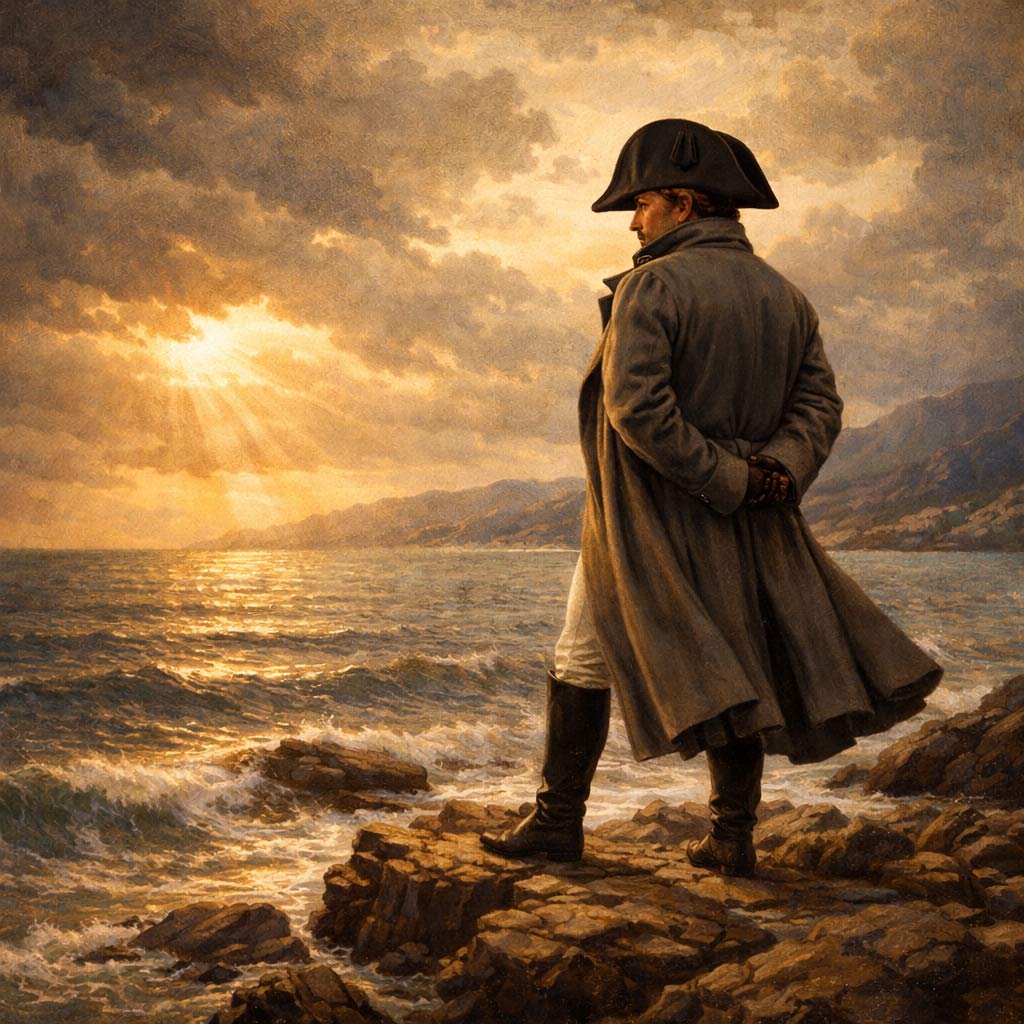
Seven nations had already decided it wouldn’t matter.
Before Napoleon Bonaparte set foot back on French soil in March 1815, the most powerful military coalition in European history had begun organizing against him. The ink on his exile agreement had barely dried. He had been stripped of his throne, stripped of his empire, and handed the island of Elba like a man given a toy to keep him quiet. The Congress of Vienna was dismantling everything he had built — redrawing maps, restoring kings, erasing the Napoleonic order as though it had been a stain rather than a transformation.
He returned anyway.
One thousand soldiers. No artillery. A gamble so outrageous that even his most devoted marshals considered it suicide. He landed at Golfe-Juan on March 1, 1815, and began a march north through the Alps that would pass into history not as a military campaign but as something stranger: a demonstration of what happens when a man mistakes legend for power — and what happens when a nation, briefly, agrees with him.
The Hundred Days did not end at Waterloo. They ended the moment Napoleon confused the emperor he had been with the emperor he still thought he was.
The Man Who Refused to Stay Exiled
Napoleon’s Hundred Days: the return from Elba to Waterloo
To understand the Hundred Days, you have to understand what Elba was supposed to be.
The Treaty of Fontainebleau in April 1814 was, by the standards of European diplomacy, extraordinarily generous. Napoleon had lost. His armies were exhausted, his marshals mutinous, Paris itself under Allied occupation. The victors — Austria, Prussia, Russia, Britain — could have imprisoned him, tried him, or executed him. Instead they gave him a small Mediterranean island, a court, a personal guard of six hundred men, and sovereignty over a population of twelve thousand.
It was, in every practical sense, a gilded cage. But it was a cage Napoleon wore like a crown.
He governed Elba with the same obsessive energy he had once applied to France — reorganizing iron mines, building roads, reforming schools. He received visitors. He gathered intelligence. He watched.
What he saw disturbed him. The restored Bourbon monarchy under Louis XVIII was deeply unpopular. French officers who had fought under the tricolor were being passed over for royalist nobles who had spent the war years in comfortable exile. Veterans were bitter. The agricultural south was restless. The army — his army — was humiliated.
Napoleon did not decide to return because he was bored, or reckless, or mad. He decided to return because he read the intelligence correctly and drew the wrong conclusion from it.
He saw that France was unhappy with the Bourbons. He did not see — could not see, perhaps refused to see — that unhappy with the Bourbons did not necessarily mean ready for another decade of war.
The March North: When Legend Moved Faster Than Armies
Napoleon’s return from Elba 1815 — the march through the Alps
On March 7, 1815, the advance guard of the 5th Infantry Regiment blocked the road at Laffrey, south of Grenoble. Their orders were clear: stop the exile, by force if necessary.
Napoleon dismounted. He walked forward alone, in his grey overcoat, and opened his coat to the soldiers facing him. Every surviving account agrees on one thing, whatever the exact words: he told them to fire if they wished.
They did not fire. They joined him.
By the time he reached Grenoble, the city’s garrison had gone over to his side. By Lyon, Marshal Ney — who had promised Louis XVIII he would bring Napoleon back in an iron cage — rode to Napoleon’s side instead. By March 20, Louis XVIII had fled Paris in the middle of the night, and Napoleon walked into the Tuileries Palace without a shot fired.
It was one of the most astonishing acts of individual charisma in the history of modern warfare. It was also, in retrospect, a warning sign Napoleon catastrophically misread.
The soldiers who joined him at Laffrey were not joining a cause. They were responding to a symbol. The veterans who cheered him through the Alps were expressing loyalty to a memory — to the man who had given them glory, identity, and victory — not necessarily to another war they might not survive.
Napoleon felt the crowds and heard them as mandate. He was not wrong that they loved him. He was wrong about what that love was willing to bear.
The Coalition That Was Already Moving
Seventh Coalition 1815 — European powers against Napoleon
The news of Napoleon’s landing reached Vienna on March 7, the same day his soldiers refused to fire on him at Laffrey. The reaction was immediate.
The Congress of Vienna had been deadlocked for months over territorial disputes. Those disputes did not disappear. They were simply set aside. Britain, Austria, Prussia, Russia, and eventually the Netherlands, Spain, and Portugal declared Napoleon an outlaw — not just an enemy, but a criminal against the peace of Europe. Each major power committed to fielding 150,000 troops.
The combined Allied force eventually committed exceeded 800,000 men across multiple theaters. Napoleon’s total available force, drawing on a France that had already been bled white by twenty years of war, was a fraction of that.
He needed a quick, decisive victory to fracture the coalition before it could concentrate. He knew it. Every strategic decision he made in June 1815 was driven by this calculation — hit Wellington and Blücher before they could unite, knock one out, offer terms, split the alliance diplomatically.
The plan was not delusional. It had a logic. What was delusional was the assumption that France would sustain the mobilization it required — and that the coalition’s political will would fracture after a single battlefield defeat, the way it sometimes had in previous decades.
The Europe of 1815 was not the Europe of 1805. The powers had learned, expensively, that negotiating with Napoleon from weakness led to more war. They had decided, quietly, that this time there was no acceptable outcome other than his permanent removal.
Napoleon’s operational thinking was sound. His strategic reading of the political situation was a decade out of date.
Waterloo: The Last Gamble
Battle of Waterloo June 18 1815 — Napoleon’s final defeat
On June 18, 1815, Napoleon’s army moved against the Duke of Wellington’s Anglo-Allied force near the village of Waterloo in present-day Belgium. Two days earlier, he had beaten the Prussians at Ligny — not destroyed them, but pushed them back. The window was narrow. The margin was thin. It required everything to go right.
It did not.
Napoleon delayed the opening attack until the ground dried. The delay was four to five hours. Wellington used every minute of it to stabilize his defensive position on the ridge at Mont-Saint-Jean. The Prussians, who should have been retreating east, were instead regrouping north, moving toward Wellington’s flank.
The assault on the Hougoumont farmhouse, intended as a diversion, drew in far more French troops than planned. Ney’s cavalry charges against Wellington’s squares were devastating — to the cavalry. The Imperial Guard, the instrument Napoleon had held in reserve across two decades of warfare, went forward in the late afternoon and broke against concentrated Allied musket fire.
It was the first time the Guard had ever been repulsed. The psychological effect on the French army was immediate and catastrophic. Men who had charged forward convinced they were winning suddenly saw the unthinkable: the Guard, in retreat.
“The Guard retreats — all is lost!” The cry moved through the French lines faster than any cavalry charge. The army dissolved.
Napoleon had come within hours of breaking Wellington’s line. The math had been close. But close, in the final campaign of the Napoleonic Wars, was the same as nothing.
What the Hundred Days Cost
Aftermath of Waterloo 1815 — Napoleon’s second abdication
Napoleon abdicated for the second time on June 22, 1815, four days after Waterloo.
This time there was no Elba. No gilded island. No personal guard or iron mines or visitors to receive. The Allied powers debated briefly — Saint Helena, a volcanic rock in the South Atlantic, forty-seven miles long and ten miles wide, accessible only by sea, at the midpoint between Africa and South America.
He would live there for six years. He dictated his memoirs, constructed his legend, and died in 1821 — likely from stomach cancer, possibly accelerated by the damp climate of the island, possibly, as later analysis of his hair would suggest, by arsenic poisoning from the wallpaper dye in his damp lodgings.
The immediate consequences of the Hundred Days extended far beyond Napoleon himself. France was occupied by Allied forces. The war indemnity imposed was 700 million francs — crushing for a country already financially depleted. The final settlement of the Congress of Vienna, when it resumed, was in many ways shaped by the paranoia the Hundred Days had provoked: the Concert of Europe, the Holy Alliance, the architecture of conservative stability that would define European diplomacy for the next generation.
Marshal Ney, who had broken his oath to Louis XVIII and rejoined Napoleon, was tried for treason and executed by firing squad in December 1815. He reportedly refused a blindfold and gave the order to fire himself.
The Hundred Days killed, by conservative estimate, over sixty thousand men at Waterloo and in the associated campaigns. It set back the liberal constitutional reforms Napoleon had half-promised upon his return. It handed the reactionary powers of Europe a generation of political justification for suppressing revolutionary movements.
The Seduction of the Legend — And What It Obscures
Napoleon’s legacy — power, delusion, and myth
The Hundred Days is sometimes narrated as tragedy: the great man making one last heroic attempt, undone by fate or treachery or the bad luck of muddy ground at Waterloo.
This reading is seductive. It is also, largely, a story Napoleon told about himself on Saint Helena, and that sympathetic biographers repeated for decades afterward.
The harder reading is this: Napoleon returned because he could not accept that history had moved past him. He had built an identity so thoroughly fused with power, victory, and conquest that exile — even comfortable exile — was psychologically intolerable. He was not fifty years old. He was not sick. He was simply a man who had defined himself entirely through the exercise of dominion, and found that without it, he could not locate himself at all.
The soldiers who joined him at Laffrey gave him what he needed to believe: that the world still organized itself around his presence. They were right, briefly. And then they weren’t.
There is something instructive in the gap between what Napoleon saw — genuine popular love, genuine military loyalty, a genuine weakness in the Bourbon restoration — and what he failed to see: that the coalition he faced had already learned the lesson he had spent twenty years teaching. That decisive, coordinated force, applied without negotiation, was the only language power respected.
He had built a world that thought in those terms. And that world had turned those terms against him.
The Hundred Days is not a story about what Napoleon almost did. It is a story about what happens when a man’s model of the world stops updating — when past victories become the lens through which present reality is misread.
Why This Still Matters
The failure mode Napoleon exhibited in 1815 is not unique to emperors.
Every institution, every leader, every movement that has ever risen to dominance carries within it the same risk: that the patterns which generated success will be mistaken for permanent laws rather than context-dependent strategies. That the world which rewarded a particular approach will be assumed to remain the world indefinitely.
Napoleon at Elba was not unintelligent. He was not misinformed. He was trapped by the very quality that had made him extraordinary: an absolute confidence in his own model of reality, built from a record of being right so often that the possibility of structural obsolescence became genuinely unthinkable.
The most dangerous delusion is not the obviously wrong belief. It is the belief that was right for so long, in so many circumstances, that questioning it feels like weakness.
Frequently Asked Questions
Why did Napoleon return from Elba in 1815?
Napoleon returned from Elba primarily because he read legitimate intelligence suggesting the Bourbon restoration was deeply unpopular — French veterans were sidelined, royalist nobles were favored, and the army was demoralized. He concluded the conditions were right for his return to power. What he misjudged was whether popular dissatisfaction with the Bourbons translated into appetite for another major war, and whether the Allied coalition would fracture under military pressure the way it sometimes had in earlier years.
Could Napoleon have won at Waterloo?
Napoleon came closer to winning at Waterloo than the clean narrative of Allied triumph suggests. His assault nearly broke Wellington’s center, and had the Imperial Guard’s attack succeeded, the battle might have turned. The key factors that sealed his defeat were the delay of several hours in the morning attack — which gave Wellington time to solidify his position — and the Prussian arrival on his right flank earlier than anticipated. The margin was real, but the structural problem remained: even a victory at Waterloo would have required a second campaign against overwhelming Coalition forces.
What happened to Napoleon after the Hundred Days?
Napoleon surrendered to the British and was exiled to Saint Helena, a remote volcanic island in the South Atlantic. He lived there under close British supervision until his death in May 1821. The official cause of death was stomach cancer, though subsequent analysis of his preserved hair detected elevated arsenic levels — likely from arsenic-based green pigment in his damp-walled lodgings rather than deliberate poisoning, though debate continues.
How long did the Hundred Days actually last?
Despite the name, the Hundred Days lasted approximately 111 days — from Napoleon’s landing at Golfe-Juan on March 1, 1815, to his second abdication on June 22, 1815, four days after Waterloo. The term “Hundred Days” was first used by the prefect of Paris in a speech welcoming Louis XVIII back to the capital, referring to the period the king had been absent from Paris.
What were the long-term consequences of the Hundred Days for France?
The Hundred Days resulted in significant punishment for France. Allied armies occupied French territory. France was required to pay a war indemnity of 700 million francs. The final settlement of the Congress of Vienna, shaped partly by the alarm the return had caused, entrenched conservative, anti-revolutionary principles across European diplomacy for a generation. Internally, France endured a period known as the White Terror, during which royalist mobs targeted Bonapartists and Protestants in the south, and prominent figures who had supported Napoleon — including Marshal Ney — were tried and executed.
Why did Napoleon’s marshals initially refuse to support his return, then join him?
Many of Napoleon’s marshals had accepted positions under the Bourbon restoration and had sworn oaths of loyalty to Louis XVIII. Marshal Ney’s case is the most dramatic: he publicly promised to bring Napoleon back in an iron cage, then rode to join him at Auxerre. The explanation is partly the overwhelming personal magnetism of the encounter, partly genuine military loyalty that had never fully transferred to the Bourbons, and partly the calculation — reasonable at the time — that Napoleon’s return might succeed. After Waterloo, marshals like Ney paid for that calculation with their lives.
How did the Hundred Days change the Congress of Vienna’s outcome?
The Congress of Vienna had been deadlocked over competing territorial claims when news of Napoleon’s landing broke. The crisis had the paradoxical effect of temporarily uniting the powers. When negotiations resumed after Waterloo, the final settlement was shaped by the determination to prevent any future Napoleonic-style disruption — leading to the Concert of Europe framework, in which the great powers committed to collective intervention against revolutionary threats to the established order. This architecture defined European diplomacy until the Crimean War.
Related Articles You Might Enjoy
- *The Rubicon: What Caesar Knew, What He Risked, and Why He Did It Anyway* — another examination of the moment a commander chooses irreversible action over caution, and what that choice reveals about the psychology of power.
- *The Battle of Cannae: Why Rome’s Greatest Defeat Is Still Studied Today* — on the battle where everything went right for one commander and catastrophically wrong for the other, and the strategic lessons embedded in that afternoon.
- *Alexander the Great: The 3 Strategic Decisions That Built an Empire* — how Alexander translated early victories into a model of conquest, and where the model eventually reached its limits.
Further Reading
Napoleon: A Life by Andrew Roberts (Penguin, 2014) remains the most readable single-volume biography in English — rigorous, pro-Napoleon in its sympathies but honest about the failures, and particularly good on the Hundred Days as the culmination of a life-long pattern rather than an isolated episode.
The Hundred Days by Antony Brett-James is a narrower, older work that assembles firsthand accounts from officers and soldiers on both sides. What it lacks in synthesis it compensates for with immediacy — the experience of Waterloo at ground level, not from the commanding heights of strategic analysis.
Watch on History Republic
Our deep-dive YouTube series on the military campaigns of the Napoleonic era explores the strategic decisions — and strategic failures — that defined the era. If you want to understand not just what Napoleon did but how he thought, the series builds the analytical frame this article only begins.
A Note to History Republic Readers
The Hundred Days is exactly the kind of story that gets flattened in popular retelling — reduced to a romantic comeback attempt, a near-miss, a tragic ending. What it actually is, examined seriously, is one of history’s most instructive case studies in how power distorts perception: how the experience of being right, repeatedly, at enormous scale, can make a man structurally incapable of updating his model of the world.
That kind of serious historical analysis — the kind that treats the past as a source of genuine insight rather than entertainment — is what History Republic exists to produce. If you believe independent historical storytelling matters in a media environment that rewards speed over depth and spectacle over substance, consider supporting the work directly through membership.
You are helping preserve serious historical storytelling in a shallow digital age. That is worth something. If it matters to you, you can make it sustainable.