A World Before Saladin
The first Crusade did not simply conquer a city; it cleaved a world. In 1099, after a grinding march from Europe to the Levant, Crusader armies stormed Jerusalem and carved out fragile principalities from Antioch to the Judean hills.
The assault ended in fire and blood—chroniclers on both sides recorded a massacre that haunted memory for generations. For Muslim observers, the loss of al-Quds was not just a military setback; it was a wound in the body of the faith, a sign that the political house of Islam had drifted into disrepair.
Fragmentation ruled. The once-mighty Seljuk sultanate had fractured into regional atabegates. Sunni and Shiʿi polities competed for legitimacy: to the west, the Fatimid caliphate clung to Cairo; to the north, ambitious Turkmen warlords guarded their towns and quarrelled with their cousins; to the east, the Abbasid caliphate in Baghdad possessed spiritual prestige but scant power.
Into this messy geometry rode the Crusader states—Jerusalem, Tripoli, Antioch, Edessa(which soon fell to Zengi)—buoyed by the sea lanes of Genoa, Pisa, and Venice and protected by quick stonework: castles like Krak des Chevaliers and Belvoir sprouted across ridges and passes. The map looked fixed. It was not.
Two men began to change the tempo. First Imad al-Din Zengi, and after him his son Nūr al-Dīn, welded northern Syria into a hard core of resistance. They reformed armies, built madrasas, preached jihād as a disciplined project rather than a slogan.
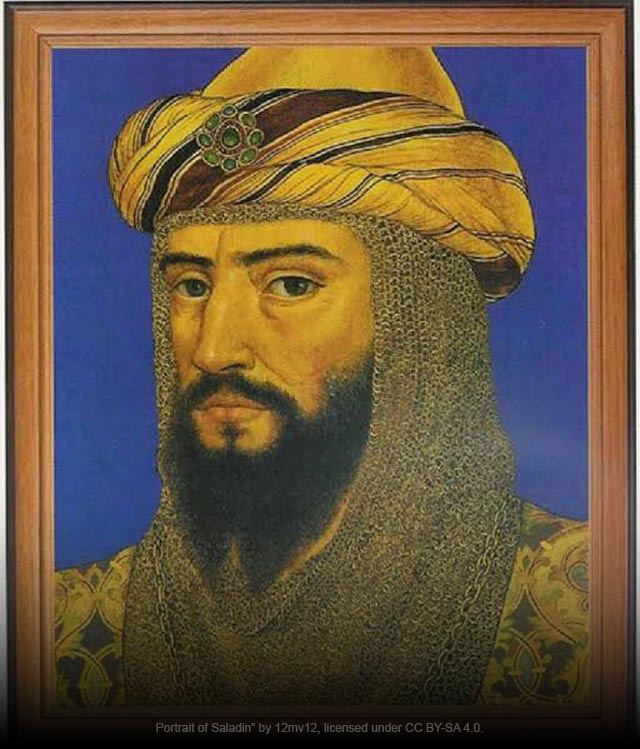
Yet even Nūr al-Dīn, formidable as he was, needed someone who could reach beyond Aleppo and Damascus, someone who could weld Syria’s zeal to Egypt’s wealth. That task would fall—by a string of accidents, loyalties, and talents—to a soft-spoken Kurdish officer whose name would become a byword for both steel and restraint: Ṣalāḥ ad-Dīn Yūsuf ibn Ayyūb—Saladin.
Birth and Early Days
Saladin was born 1137/38 in Tikrit, on the Tigris, into a respected Kurdish family. His father, Najm al-Dīn Ayyūb, and his uncle, Shīrkūh, served as officers under Zengid command. The boy grew amid the bustle of garrisons and the talk of campaigns, but his education turned inward before it turned outward.
Tutors taught him the Qurʾān, hadith, and the law of the Shāfiʿī school; he learned Arabic prose and poetry, the manners of chancery letters, and the rhythms of courtly virtue: sobriety, generosity, restraint. He loved horses and polo, and like many young men of his class he trained with the bow and practiced furūsiyya—the Islamic art of horsemanship and arms. Friends remembered his piety and modest tastes; he preferred scholars’ company to singers and wine.
The decisive pivot of his youth was not a classroom but a patron. Saladin entered the orbit of Nūr al-Dīn, ruler of Aleppo and Damascus, a prince who fused asceticism with statecraft.
Nūr al-Dīn had a larger plan: to bring Egypt under Sunni rule and use its wealth to finish the struggle against the Crusader states. He sent his sword—Shīrkūh—to seize Cairo. Saladin, still in his late twenties, went along as part of his uncle’s staff.
Egypt: Vizier, Reformer, Founder
Egypt in the 1160s was a chessboard on fire. The Fatimid caliphate—Shiʿi in confession and increasingly fragile in politics—was squeezed between Crusader pressure from the Levant and Zengid ambitions from Syria.
Shīrkūh fought, maneuvered, and in 1169 died at the height of success, leaving his nephew in an improbable position: Saladin was named the vizier of Egypt, commander of a Shiʿi government in the name of a Sunni master.
He set to work. Saladin purged rivals, rebuilt the army with loyal Syrian and Kurdish cadres, and replaced Fatimid officials with men tied to him and to Nūr al-Dīn.
In 1171, with the Fatimid caliph al-ʿĀḍid on his deathbed and Cairo’s factions exhausted, Saladin ended the centuries-old Fatimid line by having the Friday khutba proclaimed in the name of the Abbasid caliph at Baghdad. The act did more than realign a pulpit. It signaled that Egypt had returned to Sunni allegiance and that a new political house was being built.
Formally, Saladin remained Nūr al-Dīn’s lieutenant. In practice, he had taken possession of the Nile’s granaries and workshops. He fortified Cairo, began work on the wall circuit that would define the city for centuries, founded madrasas and hospitals, and cultivated the image of a ruler whose justice was as notable as his zeal.
When Nūr al-Dīn died in 1174, leaving a young son and a realm held together by loyalty to his person, a vacuum opened across Syria. Saladin moved to fill it—not by a single coup, but by a steady march of letters, sieges, and oaths.
Uniting Egypt and Syria
In the years after 1174, Saladin crossed from Egypt into Syria, presented himself as the defender of Nūr al-Dīn’s legacy, and sought recognition—sometimes coaxing, sometimes compelling—from cities and atabegs who had no wish to kneel.
Damascus yielded first, a prize won more by diplomacy than by steel; it became his favored residence. Homs, Hama, and Aleppo were harder. He faced the proud Zengid princes and wary local elites, fought skirmishes, arranged marriages, and swapped fortresses like beads until the pattern formed to his liking.
By 1183 he had taken Aleppo; by 1186 he had forced Mosul to accept his suzerainty. The line from Cairo to the Euphrates now ran through one man’s chancery: the Ayyūbid dynasty—named for his father—stood on its own feet.
All the while, Saladin probed the Crusader states, testing castles, raiding fields, and seeking the moment when force would bring not a border skirmish but a decision. He had enemies within the Latin ranks—the bold and reckless Reynald of Châtillon, lord of Kerak, who made a career of shattering truces and plundering caravans, even threatening to launch ships against the holy cities of Arabia.
Saladin swore publicly that if God ever delivered Reynald into his hands, no ransom would save him. The pledge was not theatre. It was a marker of the sultan’s view that order—not mere victory—was at stake.
Montgisard: Saladin and King Baldwin the Leper (1177)
In the middle of Saladin’s careful climb—after he had secured Cairo and before he had fully drawn Syria under his banner—came the day that nearly broke his legend. The year was 1177. Word in the Latin kingdom was that the young King Baldwin IV—the “leper king,” scarcely seventeen and already marked by a disease that would stiffen his joints and numb his hands—was weak, his barons divided, his armies thin.
Sensing an opening, Saladin crossed the Sinai with a large, mobile host, leaving heavy siege engines behind to move fast. He slipped past Ascalon, where Baldwin was watching with a small force, and pushed deep into the lowlands around Ramla and Lydda, confident he could plunder the countryside and force a later, easier submission from Jerusalem.
What Saladin did not expect was nerve. Baldwin refused to sit behind walls. He scraped together a tiny field army—royal knights, household troops, local levies—and then drew in the Templar garrison from Gaza under Grand Master Odo of St. Amand.
Chroniclers imagined the teenager’s hands lashed to his saddle so he could keep his sword steady; whether the detail is literal or legend, it captures the mood: a boy-king too stubborn to let his body choose the day’s terms. The Franks marched hard across the heat-shimmering plain to cut Saladin’s line of march near a low rise called Montgisard (east of Ramla).
Saladin’s army, stretched out in columns and scattered by foraging, turned to form—and then the thing that cannot be measured on a map happened. The Franks hit first. Baldwin rode forward beneath the True Cross, the Templars drove into the Muslim van, and a surprise shock rippled down Saladin’s array before his lieutenants could dress the lines. What began as a rearguard check became a rolling rout. Dust rose in sheets. Standards wavered and fell. Units that had been confident seconds before now saw only an enemy banner erupting out of the glare and the flash of mail and lance-head.
Saladin fought to rally the center, then realized the only way to save anything was to save himself. He broke contact with a small guard and rode for Egypt, harried by Frankish pursuers, abandoning baggage and prestige across the flats. Later writers exaggerate numbers; what matters is how the sultan himself would remember it: Montgisard was a wound.
The victory did not give Baldwin the strength to invade Egypt or reverse the strategic balance; his disease would not let him hold the field for long, and his kingdom remained brittle. But for a season the aura of inevitability around Saladin burned away.
He took the lesson. The next time he came in strength he would not dash past strongholds and let his line string out on open roads. He would neutralize forward threats first, choose the ground, and make the Franks march thirsty to meet him. And indeed, the pendulum swung back quickly: in 1179, Saladin shattered a Frankish force at Marj ʿAyyūn and then, with system and siegecraft, tore down the new fortress at Jacob’s Ford (Chastellet) on the upper Jordan—an outpost that menaced Damascus itself.
From that summer on, he pressed the coast and the Jordan crossings like a vise. Montgisard had taught him what carelessness cost; Hattin would show what patience could win.
The Road to Hattin
By 1187, the pieces aligned. Saladin declared a broad jihād, calling contingents from across Egypt, Syria, and the Jazīra. The Latin kingdom of Jerusalem, strained by faction and overconfidence, chose to field a relief army rather than wait behind walls.
The immediate spark came from the east side of the Jordan: Tiberias was threatened, and the Crusader host, under King Guy of Lusignan, marched out in summer heat to lift the pressure.
Saladin’s plan was simple and merciless: control water, exhaust the enemy, force battle on his ground. He occupied the wells and springs, posted cavalry screens to harry marches, and drew the Frankish force away from the lakeshore into a treeless waste.
On July 4, 1187, near a pair of extinct volcano cones known as the Horns of Hattin, the armies finally locked. Saladin’s archers and light cavalry encircled the Crusaders, showering them with arrows, driving them into tighter formation as thirst and heat gnawed at discipline.
Chroniclers on both sides speak of smoke and burning brush—whether to torment eyes and lungs or to signal and confuse, it added misery to exhaustion.
When the enemy line buckled, Saladin drove wedges between its segments. The True Cross, the kingdom’s most sacred relic, was captured; command structure splintered. King Guy was taken alive. Reynald of Châtillon was led before Saladin.
The sultan offered the king water; Guy drank and passed the cup to Reynald. Saladin is said to have remarked that he had not offered Reynald protection by this gesture; moments later he struck the lord of Kerak with his sword and had him executed. It was vengeance, yes, but also the closing of a moral account: Reynolds’ serial violations of truces had, in Saladin’s view, put him beyond the law of ransom.
The field was annihilation. The bulk of the Latin kingdom’s fighting strength lay dead, captive, or scattered. And Saladin did not stop to count trophies. He sent columns outward like a tide.
The Taking of Jerusalem
The weeks after Hattin were a chain of falling stones. Acre, Nablus, Jaffa, Ascalon, Gaza—town after town opened its gates or yielded after brief sieges. Only Tyre, under the fierce and skillful Conrad of Montferrat, held out. Saladin turned inland. The prize of prizes—Jerusalem—awaited.
He invested the city in late September 1187. Defenders led by Balian of Ibelin bargained and fought, hoping for relief that could not come. Saladin’s engineers pressed saps and towers; his men assaulted the walls.
Realizing their position was untenable, the defenders negotiated terms. On October 2, 1187, Jerusalem surrendered. There was no repetition of 1099. Ransoms were set; the poor were granted mercy in numbers; holy places were respected; churches retained sanctuary with a few exceptions later adjusted by diplomacy; Jews, long exiled by Crusader rule, were allowed to return and resettle.
The Dome of the Rock and al-Aqṣā were cleansed and restored as mosques. The city changed hands with a sobriety that astonished Latin and Muslim chroniclers alike.
To the Muslim world, this was redemption: not only a victory but a victory done rightly, with restraint that proved the conqueror’s claims to justice.
To the Christian West, it was an alarm bell. Kings who had scuffled with each other now looked east with a single purpose. A new wave was building: the Third Crusade.
The Lion and the Sultan
The Third Crusade gathered three titans: Frederick Barbarossa of the Holy Roman Empire (who tragically drowned en route), Philip II of France, and Richard I of England—the Lionheart—a commander whose tactical nerve matched Saladin’s patience.
The immediate battleground was the coast. In 1189, Latin forces and Italian fleets converged on Acre; Saladin encircled the besiegers while trying to keep the sea lifeline cut. It became a grinding war of trenches and towers, of disease and countermines.
In 1191, after Philip and Richard arrived, Acre finally fell. What followed was one of the grim episodes that marked the Crusade’s seesaw of honor and brutality: negotiations over prisoners collapsed, and Richard ordered the mass execution of thousands of Muslim captives outside the city. Saladin could not prevent it; he would avenge it the only way available—by renewing the war with renewed discipline.
Richard moved down the coast. At Arsuf in September 1191, Saladin’s horse archers and light cavalry harassed the Frankish march with skill, but the Lionheart kept his lines cool until the decisive moment, then counterattacked and won the field—a rare clear Latin victory against Saladin in the open. Still, it was no rolling conquest.
The English king could beat the sultan’s field forces and take coastal towns, but the interior—Jerusalem—sat at the end of long supply lines, defended by depth and a vigilant opponent who denied a quick knock-out.
Between battles, the two men negotiated. Their envoys swapped letters, medical gifts, horses, fruit. Legends blossomed: that Saladin sent Richard a fresh mount when his horse was killed; that Richard sent Saladin snow from the mountains for cooling drinks; that they discussed marrying Richard’s sister to Saladin’s brother and creating a shared kingdom at Jerusalem.
The sources disagree on how far such ideas traveled beyond courtesy, but the tone of their exchanges left a mark: even when the war sharpened, respect ran like a bright thread through the fabric of rivalry.
Richard advanced inland and then fell back, the cost-benefit of a siege of Jerusalem never quite balancing. In 1192, Saladin struck Jaffa, retaking the city in a sudden blow; Richard scrambled ashore and counterattacked with a handful of knights and crossbowmen in a daring defense that recaptured the town and embarrassed the besiegers. Both leaders were near the end of their resources.
Each needed to go home to unruly barons and rival kings. In September 1192, they agreed to the Treaty of Jaffa: the Crusaders would keep a coastal strip from Jaffa to Tyre; Muslim rule would hold Jerusalem; pilgrims—unarmed—would be allowed to visit the holy places.
It was not the crusading dream of Christendom, nor the total expulsion some of Saladin’s supporters imagined, but it was peace, the kind of peace that true strategists craft when they know what they can hold and what they should not try to grasp.
Death in Damascus
Exhaustion is one of history’s truest forces. After years of campaigning, of winter marches and summer sieges, Saladin’s body began to fail. He returned to Damascus and fell ill. On March 4, 1193, the sultan died, surrounded by family and jurists reciting scripture.
Stories of his modesty at death became part of his legend. Chroniclers claimed that the man who had commanded an empire left so little in personal wealth that his officials had to borrow to pay for his funeral shroud.
Whether that’s literally precise or pious embroidery, it reflects a truth about his image and, to a great degree, his practice: Saladin had spent freely on endowments, schools, hospitals, and stipends; he had cultivated the reputation of a ruler whose generosity was not a pose.
Aftermath: A House Divided
Saladin left sons and brothers to rule the lands he had stitched together. But, as with many empires built by a single compelling personality, the seams began to pull. His eldest son al-Afdal held Damascus; another, al-ʿAzīz, took Egypt; his brother al-ʿĀdil (a formidable statesman) eventually outmaneuvered the nephews and reunited much of the realm under his own authority.
This Ayyūbid world endured—with quarrels and partitions—into the thirteenth century, until a new kind of soldier rose from within their guard: the Mamlūks, military slaves who would overthrow Ayyūbid princes in Egypt and carry the sword of Islam against Mongols and Crusaders alike.
Yet even as political control shifted, Saladin’s settlement held in essentials. Jerusalem remained under Muslim rule. The coast flickered between powers, but the strategic center of the Levant no longer belonged to a European crown. The frontiers had changed—and with them the confidence of the societies that lived on either side of those lines.
Legacy: Steel and Mercy
It is easy to mistake Saladin for a set of numbers—dates, battles, treaties. His true legacy lies in the balance he sustained between force and restraint. He was a war leader of unusual patience, content to grind down enemies with attrition when flashing a sword would have pleased a crowd; he was also capable of ferocity when order demanded it, as Reynald learned.
He built a dynasty not by trampling every rival at once but by absorbing opponents when it suited him, practicing the politics of incorporation rather than annihilation. He made Egypt and Syria speak to each other again, the Nile’s silver poured into the armories of Aleppo and Damascus. He put the holy city back into the orbit of Islam and did it with a choreography that convinced friend and foe that justice, not just victory, had returned.
In the Islamic world, Saladin became the exemplar of the just sultan: pious, charitable, defender of the faith. In the LatinWest, he became—curiously and tellingly—an icon of chivalry: the honorable enemy whose courtesy and discipline made him a mirror for knights to measure themselves against.
That double image has its distortions; no medieval ruler was a plaster saint. But it springs from the record of a life in which character and strategy pulled in the same direction.
Stand, for a moment, on the ramparts of Jerusalem and watch a winter sun slide down the stones of al-Aqṣā. The city has changed hands many times; its walls have learned every language that armies speak. Saladin’s century taught a harsh lesson to any who would hold it: you do not keep Jerusalem with a single victory. You keep it with good government, with alliances, with roads and granaries and treaties with men you could not defeat without destroying the world you wish to rule.
That is the sultan’s true inheritance—the knowledge that the sharpest blade in the arsenal is the one that knows when not to be drawn.
And it is why the name Saladin still carries weight: not just as the conqueror who reversed a catastrophe, but as the ruler who proved that a city can be taken by strength and kept by restraint.