The Night of the Crossing
The river was barely twenty feet wide.
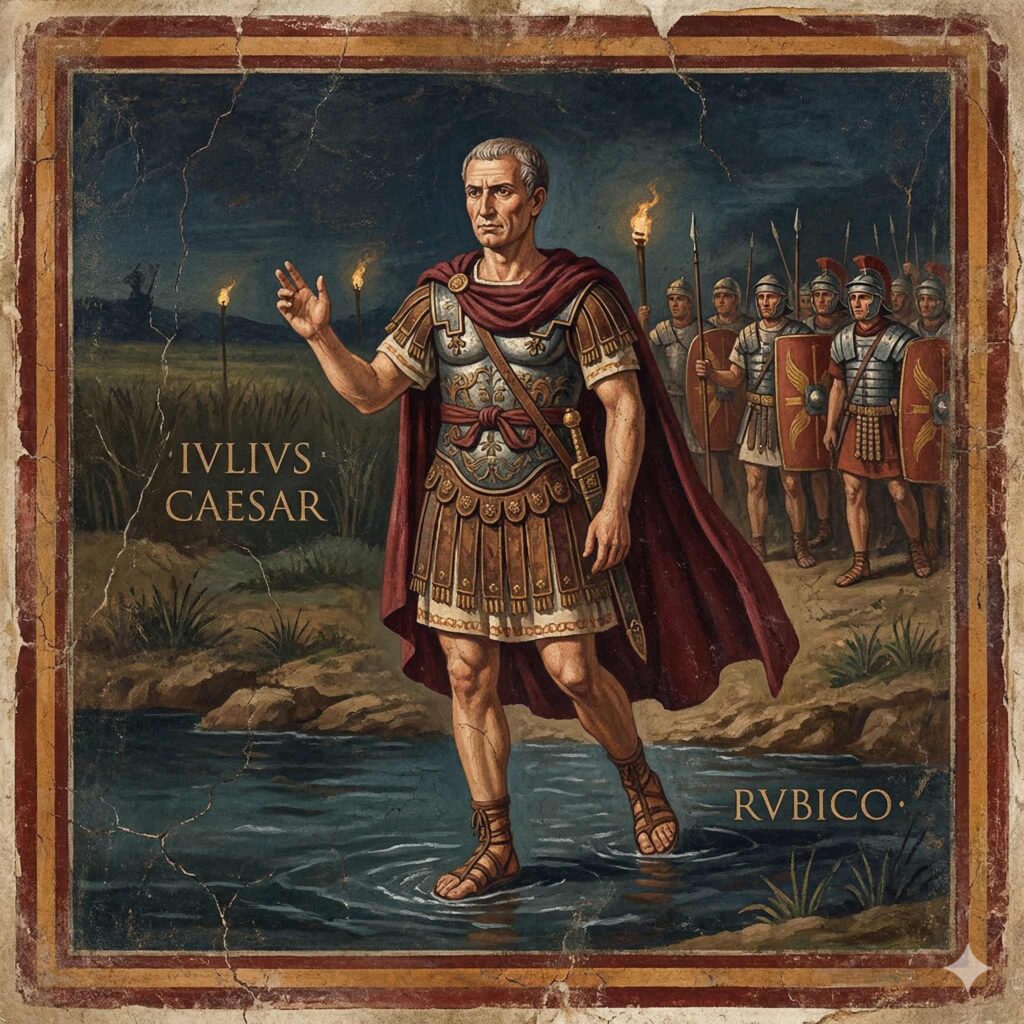
Julius Caesar stood on the northern bank in the dark of January 49 BC, water running shallow and cold at his feet. Behind him, the Thirteenth Legion — veterans of nine years in Gaul — waited in silence. Ahead: Rome, the Senate, and the men who had decided he had to be destroyed.
Roman law was unambiguous. No general could cross the Rubicon with troops. To do so was to declare war on Rome itself. The penalty, under the law of the Republic, was death.
Caesar was fifty-one years old. He had spent nine years building the greatest military reputation Rome had seen since Scipio Africanus. He had conquered eight hundred cities and brought a million Gauls into slavery. He had made himself, by any honest measure, the most powerful man in the Roman world.
He stepped into the water.
What happened next didn’t just change Rome. It changed the calendar on your wall, the names of the months you use, and the political vocabulary of every Western government that followed. Understanding that night means understanding why a man who knew the full cost still chose to pay it.
The World Before the Crisis: What Caesar Had Built
Caesar’s governorship of Gaul had begun in 59 BC as a political transaction. He needed a province. A province meant an army. An army meant military reputation. Military reputation meant political survival.
The Gallic Wars delivered all of it. The siege of Alesia in 52 BC — where Caesar’s outnumbered forces besieged a besieging army, fighting simultaneously inward and outward — is still studied in military academies. Vercingetorix, the most capable Gallic resistance leader, was captured and later executed after Caesar’s triumph in Rome. Caesar’s dispatches, the Commentarii de Bello Gallico, were read aloud in the Forum and made him famous to citizens who had never left Italy.
His soldiers were fanatically loyal. He paid them well, shared danger with them personally, and remembered their names. The Thirteenth Legion, encamped north of the Rubicon on the night of the crossing, would have followed him into the underworld.
In Rome, this success was terrifying to the right people. The conservative Senate faction — the optimates — understood with cold clarity that a general with this much money, this many loyal veterans, and this much popular support was an existential threat to everything the Senate represented.
The Political Trap: How Caesar's Options Were Closed One by One
To understand the Rubicon, you need to understand that Caesar did not cross impulsively. His options were systematically destroyed over three years. By January 49 BC, the crossing was not a choice between law and ambition. It was a choice between action and annihilation.
The First Triumvirate — the informal power-sharing arrangement between Caesar, Pompey, and Crassus — had held Roman politics in uncomfortable equilibrium for years. Caesar’s daughter Julia was Pompey’s wife, a bond that kept their rivalry manageable. In 54 BC, Julia died in childbirth. In 53 BC, Crassus died at Carrhae, killed in a disastrous campaign against Parthia. The triangle became a line, with Caesar and Pompey at opposite ends.
The Senate, led by the implacable Cato, began a systematic effort to destroy Caesar before he could return to Rome. The strategy was legally elegant: Caesar’s provincial command would expire, stripping him of immunity from prosecution. He had made enemies during his consulship in 59 BC, and those enemies had been carefully cataloguing irregularities for years. If Caesar returned to Rome as a private citizen, he would face trial before a court his enemies controlled.
Caesar’s response was entirely reasonable. He proposed, repeatedly, that he would disband his army if Pompey disbanded his. The Senate rejected every offer. He proposed keeping just two legions and two provinces until he could stand for the consulship in absentia — a compromise that Cicero later wrote most senators were prepared to accept. Cato spoke for two hours and killed it.
Then came the act that made the Rubicon inevitable. Two tribunes loyal to Caesar — Mark Antony and Quintus Cassius — had exercised their legal veto on the Senate’s ultimatum against Caesar. The Senate declared a state of emergency and physically ejected them from the chamber. They fled Rome disguised as slaves and arrived in Caesar’s camp with their clothes torn and their faces pale.
Caesar showed them to his soldiers. He understood exactly what he was doing. Every legal option had been exhausted or destroyed. The men who remained in Rome had made their intentions clear. The crossing, when it came, was less a decision than a conclusion.
The Crossing: January 49 BC
He stopped at the bank. The ancient sources — primarily Suetonius and Plutarch, writing more than a century later — agree on the fact of a pause but disagree on the details. There was no formal speech. What Suetonius records is one sentence, possibly in Greek, possibly a quote from the playwright Menander: the die is cast.
Whether Caesar said it in Latin or Greek is genuinely disputed. What is not disputed is that he said something — and then stepped forward.
Every man who followed him into that river committed treason against the Roman state. They crossed. All of them. In silence.
Caesar’s operational logic was immediately apparent. He had only the Thirteenth Legion — approximately five thousand men. He was outnumbered many times over by Pompey’s forces. But he understood something Pompey did not yet grasp: this was not primarily a military campaign. It was a political one. And in a political campaign, speed and perception were everything.
He marched south not as a conqueror but as a liberator. No looting. No violence. No reprisals. Town after town opened its gates. He released prisoners, returned property, and publicly framed his cause as the defense of the tribunes — the constitutional protectors of ordinary Roman citizens — against a corrupt Senate that had violated the law. It was masterful political theater, and it worked.
Immediate Fallout: Rome's Government in Full Flight
The news reached Rome within hours. Caesar had crossed. He was coming south.
Pompey’s response stunned his own allies. He did not march to meet Caesar. He fled — south to Brundisium, then across the Adriatic to Greece. Most of the Senate fled with him. Both consuls fled. The city that had governed the Mediterranean world for nearly five hundred years was abandoned by its own government in a matter of days.
Caesar walked into Rome without resistance. He entered the treasury — against the violent protest of the tribune Metellus, whom he physically pushed aside — and took what he needed. He was in Rome for eleven days. He left Marcus Lepidus as prefect and Marcus Antonius in command of Italy, then moved rapidly to Spain to eliminate Pompey’s legions there before Pompey could consolidate in the east.
The civil war would last five years. It consumed the Mediterranean — battles in Spain, Greece, Egypt, North Africa, and finally Spain again. An estimated three hundred thousand men died. Pompey was killed on an Egyptian beach by courtiers trying to earn Caesar’s favor. Caesar reportedly wept when the head was presented to him. Whether the weeping was genuine grief or performed restraint is a question the ancient sources raise but cannot answer.
The Long-Term Impact: What the Crossing Actually Created
Caesar was declared dictator for life in February 44 BC. One month later, he was stabbed twenty-three times on the floor of the Senate. The conspirators believed they were restoring the Republic. They destroyed it instead — triggering another decade of civil war that ended with Augustus, the first emperor, holding power so completely that the republican institutions he preserved became beautiful fictions.
The Republic Caesar crossed the Rubicon to save — or to seize, depending on which ancient source you trust — was over. It never recovered.
What survived was larger. The Julian Calendar Caesar reformed in 46 BC — correcting centuries of accumulated calendar drift — became the basis of the Gregorian calendar we use today. The month of July is named for Julius Caesar. The month of August is named for his heir. The names of the months you use every single day are a direct inheritance from the night he stepped into the Rubicon.
The Roman Empire that followed lasted in the west until 476 AD, and as the Byzantine Empire in the east until 1453 AD — fifteen centuries after that crossing. European legal traditions, political vocabulary, city planning, and the Latin roots of half the languages spoken today all trace back to the civilization Caesar’s actions both preserved and transformed.
What This Story Still Means
There is a historical marker at the presumed site of Caesar’s crossing. On a summer afternoon, tourists take photographs in front of it. The river looks ordinary. It is ordinary.
What makes the Rubicon worth understanding is not the drama of the crossing itself — though it is genuinely dramatic. It is the clarity of what Caesar knew when he crossed.
He knew the law. He had followed it for nine years. He knew what crossing it would cost. He knew that even if he won, the men who feared him would not stop. He crossed anyway — not in ignorance, and not in madness, but with the kind of cold calculation that characterizes the most consequential decisions in history.
Whether that makes him a destroyer of republics or a man who refused to accept a verdict that had been rigged against him is a question serious historians still argue. The evidence supports both readings. That ambiguity is the point. Most of history’s turning points look cleaner in retrospect than they were in the moment.
The Rubicon does not offer a simple lesson. It offers something more useful: a precise record of how power, law, personal survival, and historical consequence can collide in the space of one decision. By one man. At a river you can wade across in seconds.
Support History Republic
If this is the kind of history you’ve been looking for — detailed, honest, written from authority rather than hedged uncertainty — History Republic exists to provide exactly that.
This work is supported entirely by readers and viewers who believe serious historical storytelling deserves to survive in a digital environment that rewards the shallow and the sensational. If that belief is something you share, membership details are below.
Members of History Republic get deeper access — extended research breakdowns, member-only content, and the knowledge that they are part of keeping this mission alive.
FURTHER READING & RESOURCES
Recommended articles:
- How Hannibal Destroyed Rome’s Best Army in One Afternoon — the Battle of Cannae and its lessons for Caesar’s later campaigns
- Alexander the Great: The 3 Strategic Decisions That Built an Empire — the military mind that Caesar studied and modeled himself on
Affiliate books:
- Caesar: A Biography by Christian Meier — the definitive scholarly treatment; covers Caesar’s political calculations with the depth most popular accounts avoid.
- Rubicon: The Last Years of the Roman Republic by Tom Holland — narrative history at its best; accessible without being shallow.
FREQUENTLY ASKED QUESTIONS
What was the significance of Caesar crossing the Rubicon?
Crossing the Rubicon with his army was an act of treason under Roman law — it meant declaring war on the Roman state. The act ended the Roman Republic and triggered a five-year civil war that ultimately resulted in Caesar becoming dictator for life and the effective end of republican government in Rome.
Why was the Rubicon river so important in Roman law?
The Rubicon marked the boundary between Cisalpine Gaul (Caesar’s province) and Italy proper. Roman law forbade any general from crossing this line with troops — a rule established to prevent powerful generals from using their armies to seize political power, as Sulla had done in 88 BC. The law was specifically designed to protect the Republic from military coups.
What did Caesar say when he crossed the Rubicon?
According to Suetonius, Caesar said ‘the die is cast’ — alea iacta est in Latin. However, Suetonius quotes it in Greek and attributes it to the playwright Menander. Whether Caesar actually said these words, and in which language, is disputed by historians. What is not disputed is that the phrase has become one of history’s most enduring expressions for a point of no return.
Did Caesar have a choice when he crossed the Rubicon?
This is genuinely contested. Caesar’s supporters argued he had no choice — his enemies had rejected every compromise, expelled his tribunes from Rome, and intended to prosecute him the moment he became a private citizen. His critics argued that a less ambitious man would have accepted the legal process. The evidence suggests Caesar had exhausted his legal options by January 49 BC, but that he had also positioned himself strategically well in advance of the crossing.
What happened to Caesar after he crossed the Rubicon?
Caesar crossed the Rubicon in January 49 BC and reached Rome within weeks after Pompey and most of the Senate fled to Greece. The resulting civil war lasted five years, ending with Caesar as undisputed master of the Roman world. He was declared dictator for life in February 44 BC and assassinated on the Ides of March — March 15 — of the same year, just one month after receiving that title.
How does Caesar’s Rubicon crossing affect us today?
More directly than most people realize. The Julian Calendar Caesar reformed in 46 BC — correcting centuries of accumulated calendar drift — is the direct ancestor of the Gregorian calendar we use today. July is named for Julius Caesar; August for his heir, Augustus. The Roman Empire Caesar’s crossing helped create shaped European law, language, city planning, and political institutions for fifteen centuries.
Is there still a Rubicon river today?
Yes, though its exact historical location is disputed. A river in the Emilia-Romagna region of northern Italy is officially recognized as the Rubicon by the Italian government, and there is a historical marker at the presumed crossing site. The river itself is small and unremarkable — typically no more than twenty feet wide.
Related on History Republic
- Julius Caesar
- The Fall of Rome : Why There Was No Single Moment — And Why That Makes It More Terrifying
- The Battle of Cannae: Why Rome’s Greatest Defeat Is Still Studied Today
Go deeper in the History Republic app
Maps, timelines, and more stories from the same eras—built for readers who want the record, not the myth.
Further Reading
Product links are recommendations. Affiliate tagging is not active yet—no commission is earned on these clicks.