The emperor was certain Rome would survive.
In the summer of 408 AD, Honorius sat inside the fortified city of Ravenna — marshes on every side, walls thick enough to outlast any siege — and signed the execution order for Flavius Stilicho, his greatest living general. The charges were treason. The evidence was thin. The real offense was that Stilicho had become indispensable, and indispensable men make weak emperors nervous.
Stilicho had held the western frontier together through sheer force of will for two decades. He had pushed back Alaric’s Visigoths. Twice. He had fought at the Rhine and the Danube and in the Italian foothills. He had done the things Honorius could not do and would not do. And so the fall of Rome, in its quiet way, began not with a barbarian army but with an emperor’s signature.
Honorius executed Stilicho anyway.
Four months later, Alaric’s Visigoths sacked Rome — the first time enemy forces had entered the city in 800 years.
But here is what will disturb you if you follow the thread: Honorius was right that Rome would survive. After Alaric’s sack, Rome did not fall. The empire staggered forward for another sixty-eight years. Emperors sat on thrones. Laws were written. The machinery of civilization ground forward.
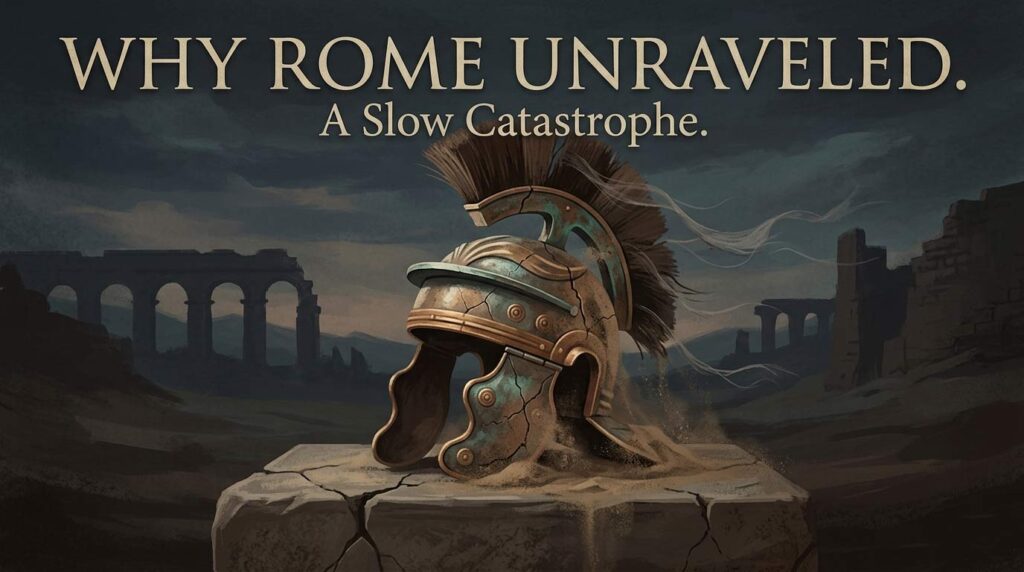
The fall of Rome was not a catastrophe. It was a slow, grinding dissolution — and the people who held power in its final century made individually rational decisions that collectively destroyed everything. That is the psychology of power. That is what makes Rome’s end more terrifying than any single battle, any single betrayal, any single moment of collapse.
There is no comfort in a slow catastrophe. There is only the creeping recognition that by the time everyone understood what was happening, the capacity to stop it had already gone.
Why the Fall of Rome Still Demands an Explanation
People want a single cause. They always do.
The fall of the Roman Empire is perhaps the most analyzed collapse in human history, and the debate about its causes has never fully resolved — not because historians are careless, but because the question itself resists a clean answer. Edward Gibbon spent six volumes and forty years on it. Modern scholars have added climate collapse, pandemic disease, and economic dysfunction to the traditional litany of military pressure and political decay. The bibliography runs to thousands of volumes.
We keep returning because the question is not merely historical. An empire that unified most of the known world, that built roads still in use two millennia later, that produced legal systems underpinning Western governance to this day — this empire did not merely fail. It demonstrated something about the nature of power that people in positions of power find deeply uncomfortable to contemplate.
The fall of Rome was not caused by any single enemy, any single emperor, any single mistake. It was caused by the systematic breakdown of the mechanisms that allow a power structure to see itself clearly. And once those mechanisms fail, the collapse becomes not inevitable — but increasingly irreversible. Not because destruction is certain, but because the capacity for self-correction is gone.
The Accumulation That Looked Like Stability
The Western Roman Empire’s final century did not look like terminal decline from the inside. This is the essential psychological fact.
The empire in the 400s AD still functioned. Collectors still extracted taxes — inefficiently, and increasingly by force, but extracted. Courts operated. Trade continued. Bishops built churches. The rich built villas. The Senate debated. The calendar advanced.
But beneath this surface, three structural failures had become self-reinforcing.
The first was military. Rome had always solved its frontier problem by incorporating the people it defeated — making them soldiers, making them citizens, binding their identity to the empire’s survival. By the fifth century, this integration had broken down. The army had become a collection of federated barbarian units fighting under Roman contracts but without Roman loyalty. Their commanders negotiated their own arrangements. When the empire failed to pay, they found other arrangements. When a stronger leader offered better terms, they followed him.
The second was fiscal. The late empire taxed its provincial populations at rates that pushed small landowners into debt and debt into dependency — converting free farmers into coloni, into something close to serfdom. The tax base shrank as the population it depended on collapsed. The state responded by taxing the remaining population harder. The remaining population shrank faster. This spiral was legible in the data. The men who ran the empire’s finances understood it. They made adjustments. None were sufficient.
The third was political. The empire had always depended on the fiction of legitimate authority — the idea that power flowed from the emperor, that the emperor’s word had weight, that the institutions of Roman governance meant something. By the 400s, generals who controlled actual armies made and unmade emperors. Honorius survived his reign not because he held power but because no general considered him worth the effort of replacing. The office retained its ceremonial weight. The authority behind it evaporated.
Each of these failures fed the others. A weaker military required more reliance on federates. More reliance on federates weakened fiscal collection. Weakened fiscal collection forced the abandonment of frontier infrastructure. Abandoned frontier infrastructure invited more military pressure. Around and around, each turn of the spiral tightening the grip.
The Turning Point Nobody Recognized
The psychological horror of Rome’s fall is not that it happened. It is that the turning point — the moment when recovery became impossible — passed without anyone marking it.
Scholars debate when that moment arrived. Some locate it at Adrianople in 378 AD, when Emperor Valens marched his army into a Visigoth ambush and died on the field, taking with him the tactical presumption of Roman military superiority. Others locate it at the Rhine crossing of 406 AD, when a coalition of Germanic tribes walked across the frozen river into Gaul in numbers Rome could not expel — the permanent loss of the western provinces beginning not with a battle but with a migration. Others point to 476 AD, when the German chieftain Odoacer sent the imperial insignia to Constantinople and declared there was no further need for a western emperor.
But if you understand how power systems actually fail, none of these events is the true turning point. The turning point is earlier, and quieter, and far more disturbing.
The turning point is the moment when Rome’s ruling class stopped believing the empire could be reformed and started believing it could only be survived.
You can trace this shift in the literature. Salvian of Marseille, writing in the 440s, describes Roman aristocrats fleeing to barbarian territories because the barbarians taxed them less and treated them with more basic dignity than their own government. He was not a radical or a pessimist. He was describing an observable migration — Roman citizens voting with their feet for the empire’s enemies.
The men who held power in this period understood intellectually that the empire was in crisis. They responded the way men who hold power always respond: by protecting what they already had. Aristocrats with large estates made deals with local barbarian commanders to ensure their land survived regardless of who nominally controlled the region. Generals carved out personal domains. Bishops extended ecclesiastical authority into the spaces civil authority vacated.
Every individual actor behaved rationally. Every individual rational decision accelerated the collective collapse.
This is what power does when it perceives existential threat. It contracts. It consolidates. It optimizes for individual survival at the expense of collective survival. The system that once rewarded loyalty to Rome began rewarding loyalty to whatever local power could guarantee your family’s safety next winter.
By the time 476 AD arrived, the Western Empire was not destroyed. It had already dissolved.
What Actually Happened When Rome Fell
Romulus Augustulus was sixteen years old when Odoacer deposed him in September of 476 AD. He had been emperor for ten months, elevated by his father — a general who had himself murdered the previous emperor and the emperor before that.
Odoacer sent him into comfortable exile on the Bay of Naples, in the villa of Lucullus, with a pension. He considered the boy harmless. He was right.
This is not the fall of Rome as people imagine it. No final battle. No Roman legions dying on the walls. No dramatic last stand. The last western emperor was a child installed by a murderer, removed by a German chieftain who saw no further use for the title, and pensioned off to live out his days in one of the most beautiful locations in the Mediterranean world.
The Eastern Empire — centered in Constantinople — did not fall at all. It continued for another thousand years, until 1453 AD, when Ottoman forces breached the walls and the last emperor died in the fighting. The Eastern Romans called themselves Romans. Their neighbors called their state the Roman Empire. The continuity was genuine.
In the West, what we call the fall of Rome was experienced by most people as a change of management. The same estates, the same coloni, the same bishops, the same tax collectors — now operating under Visigothic or Frankish or Ostrogothic authority instead of imperial Roman authority. The roads still ran. The laws still applied, modified and reinterpreted but recognizably descended from Roman originals. The Latin language survived.
What died was not Rome the civilization. What died was the political fiction that a single authority could organize the Western Mediterranean world. And Rome’s elite had maintained that fiction, increasingly artificially, for a century before Odoacer dispatched his pension to Lucullus’s villa.
The Long Shadow of a Civilization That Could Not See Its Own Ending
The fall of Rome reshaped everything that followed.
The political fragmentation of Western Europe created the conditions for the medieval world — independent kingdoms, competing feudal authorities, the rise of the papacy as a pan-European power in the absence of any secular equivalent. The modern nations of France, Spain, Italy, Portugal, and Romania are built on the substrate of Roman provincial boundaries. The legal traditions of most of Western Europe trace directly to Roman law, filtered through centuries of Germanic and ecclesiastical modification.
But the deeper shadow is psychological.
Rome fell because the people who held power within it developed an immunity to honest accounting. The empire’s institutions — the Senate, the army, the bureaucracy — had originally functioned as feedback mechanisms, ways of aggregating information from the provinces and converting it into responsive governance. By the fifth century, those mechanisms had atrophied. The Senate met. The bureaucracy filed reports. The army submitted returns. None of it translated into effective response, because effective response would have required those in power to acknowledge that their power was the problem.
Reforming the tax system meant acknowledging that the aristocracy’s land immunities were destroying the fiscal base. Reforming the military meant acknowledging that the federate system had transferred actual military capacity to men with no loyalty to Rome. Reforming political succession meant acknowledging that emperors had become figureheads whose authority depended entirely on which general currently controlled Italy.
Each of these acknowledgments was available. Salvian made them. Augustine made them, in different register. Bureaucrats who filed the fiscal returns made them implicitly every year. Nobody with the power to act on them did, because acting on them would have destroyed the positions of the people who held power.
This is not unique to Rome. It is what power systems do when they age. The mechanisms that would allow self-correction threaten the people who benefit from the current dysfunction. So the mechanisms are ignored, undermined, or captured. The dysfunction deepens. The capacity for self-correction diminishes. The spiral tightens.
Rome is simply the most documented, most studied, most elaborated example of a pattern that repeats across history with disturbing regularity.
Why the Slow Collapse Is the One That Haunts You
There is a comfort in sudden catastrophe. A battle lost, a city sacked, a dynasty destroyed — these events have a clarity. You can point to them. You can say: here is where it broke. You can mourn it cleanly.
Rome denies you that comfort.
The fall of Rome is terrifying precisely because it was so legible in hindsight and so invisible in the living. The data existed. The intellectuals saw it. Ordinary people felt it — in crushing tax burdens, in military conscription that emptied villages, in roads that stopped being repaired, in trade routes that became dangerous, in cities that shrank and then shrank again. But the people positioned to act on it were the people least willing to see it clearly.
Power, at scale, develops a specific pathology: the inability to distinguish between the health of the system and the health of the people who benefit most from it. When those two things align, great empires are built. When they diverge — when elites can prosper from a declining system long enough — the decline accelerates past the point of recovery before the elite feel the consequences themselves.
Rome did not fall because Rome was weak. Rome fell because the people who held Roman power were very good at protecting their own position within a weakening structure for just long enough that the structure could not be saved.
The barbarians did not destroy Rome. They walked into the space that Roman power had already vacated.
That is what the psychology of power looks like across centuries. Not a villain. Not a single catastrophic choice. A hundred thousand individually defensible decisions, made by individually rational people, that collectively hollowed out the most durable political structure the Western world had ever produced.
The Reader Who Wants the Honest Version
If you read history seriously — not for dates and battles, but for the patterns beneath them — you recognize Rome’s psychology. You have seen it in smaller systems and shorter timelines. You know what it looks like when a structure optimizes for the comfort of those at its center rather than the health of its base.
You also know why this kind of history matters. Not for the comfort of easy answers. For the discipline of honest ones.
Readers who support History Republic are choosing to be the kind of people who refuse the shallow version — the clean villain, the single catastrophic moment, the explanation that lets everyone off the hook. They are choosing long-form analysis, structural honesty, and the willingness to sit with uncomfortable conclusions about how power actually works.
If that is the kind of history you want to exist, support it directly.
Continue Reading
- Peter the Great and Alexei: When Empire Demands the Destruction of Family — Another case study in how power systems force their rulers toward decisions that are rational within the logic of power and monstrous by every other measure.
- Napoleon’s Hundred Days: What His Return from Elba Reveals About Power and Delusion — A shorter, faster version of the same psychological trap: a leader who could not believe the system had changed because he had been the system.
- Alexander the Great: The 3 Strategic Decisions That Built an Empire — The inverse case. What decisive, psychologically clear leadership looks like when the system is still ascending and the feedback loops still function.
Recommended Reading
The Fall of the Roman Empire by Peter Heather — The most rigorous and readable modern account of the external pressures on Rome. Heather makes the barbarian migrations comprehensible without making Rome’s internal failures invisible. Essential if you want to understand the military dimension of the collapse.
The Fate of Rome: Climate, Disease, and the End of an Empire by Kyle Harper — A necessary corrective to purely political explanations. Harper’s case that pandemic disease and climate disruption interacted with political dysfunction to accelerate the collapse is one of the most important interventions in Roman historiography of the last decade. It does not let Rome’s elite off the hook — it shows how they failed to respond to pressures that a healthier system might have absorbed.
Watch on History Republic
The psychology of Rome’s fall connects directly to the broader pattern we explore across figures from Alexander to Ivan the Terrible — leaders who built, broke, and were broken by the systems they commanded. Explore the History Republic YouTube channel for cinematic deep-dives into how power rises, consolidates, and destroys itself across civilizations.
Frequently Asked Questions
When did the Fall of Rome actually happen?
The conventional date is 476 AD, when the German chieftain Odoacer deposed the last western emperor, Romulus Augustulus. Most historians treat this as a formality — the Western Roman Empire had been functionally dissolving for a century before that date. The Eastern Roman Empire continued until 1453 AD, when Ottoman forces took Constantinople.
What caused the Fall of Rome?
No single cause. The most durable scholarly consensus identifies a combination of military pressure from migrating Germanic tribes, fiscal collapse driven by overtaxation and shrinking agricultural productivity, political instability from repeated coups and weak central authority, and — in more recent historiography — pandemic disease and climate disruption in the third and fourth centuries. These causes interacted and reinforced each other in ways that made the decline self-accelerating.
Did Rome really fall or did it just transform?
Both, depending on which part of Rome you mean. The Western political structures collapsed. The Eastern Empire survived as a genuine continuation. Roman law, Latin language, Christianity as a Roman institution, provincial boundaries, and agricultural systems all survived in modified form in the West. The civilization transformed. The political fiction of unified Mediterranean authority was destroyed.
Who was the last Roman emperor?
In the West, Romulus Augustulus, deposed in 476 AD at sixteen years old. In the East, Constantine XI Palaiologos, who died fighting in the Ottoman assault on Constantinople in 1453 AD.
Why did Rome’s military fail?
Rome’s transformation from a citizen-soldier force to a federated barbarian army was pragmatic in the short term and catastrophic in the long term. Federated units fought effectively, but their loyalty belonged to their commanders and their contracts, not to Rome as an idea. When the empire could no longer pay reliably or offer better terms than local barbarian leaders, military capacity drifted out of Roman hands without a decisive battle.
How long did the Fall of Rome actually take?
By most reckonings, the decisive decline of the Western Empire spans roughly from the Crisis of the Third Century (235–284 AD) through the formal deposition of 476 AD — approximately two hundred years, depending on where you locate the beginning of structural failure. If you include the Eastern Empire’s full trajectory, Rome in some form lasted until 1453 AD, more than a thousand years after the Western collapse.
Was the Fall of Rome inevitable?
Historians debate this vigorously. The structural argument — that the empire had grown too large to govern effectively with ancient communication and logistics — suggests some form of fragmentation was likely. But reforms proposed and not enacted, military decisions that went wrong, climate and disease pressures no one chose — counterfactuals exist. The honest answer: not necessarily inevitable, but made increasingly irreversible by the cumulative choices of people in power who protected their own position over the system’s survival.
How did the Fall of Rome affect the people who lived through it?
For most people in the Western provinces, the transition was experienced as a change of management rather than a civilizational rupture. The same estates, the same agricultural systems, the same church structures continued under new political authority. Urban life contracted sharply and trade networks simplified. The disruption was real and often severe, particularly in frontier zones, but the dramatic image of civilization collapsing overnight is a retrospective invention. Rome dissolved gradually — and most people adapted.
*Internal linking: link “Peter the Great and Alexei” reference to that blog post; link “Napoleon’s Hundred Days” reference to that blog post; link “Alexander the Great” reference to the Alexander blog post.*
Related on History Republic
- The Rubicon: What Caesar Knew, What He Risked, and Why He Did It Anyway
- Attila The Hun
- Constantinople 1453: How Mehmed II's Siege Ended a 1,000-Year Empire in a Single Night
Go deeper in the History Republic app
Maps, timelines, and more stories from the same eras—built for readers who want the record, not the myth.
Further Reading
Affiliate links coming later.
- Edward Gibbon — The History of the Decline and Fall of the Roman Empire
- Bryan Ward-Perkins — The Fall of Rome: And the End of Civilization
- Peter Heather — The Fall of the Roman Empire: A New History of Rome and the Barbarians
Books listed may earn a commission once our affiliate account is active; for now these are regular product links.