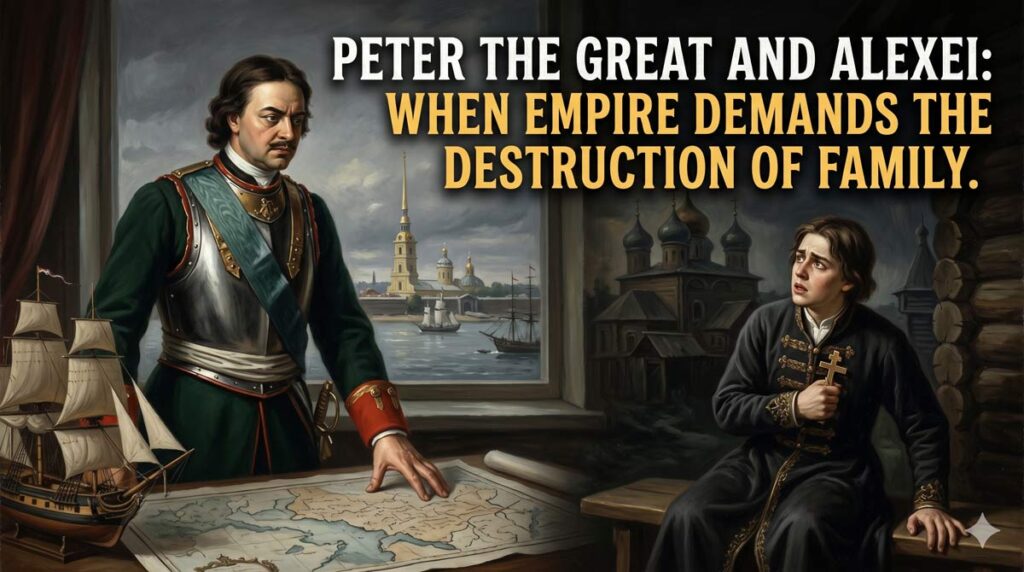
Alexei Petrovich didn’t fight his father. He ran.
On a November morning in 1716, while supposedly traveling to join Peter’s military campaign in Denmark, the heir to the Russian throne slipped away — to Vienna, into the protection of the Holy Roman Emperor, and into exile. He brought no army, no faction, no plan. He carried only the desperate hope that distance from his father might equal survival.
It didn’t.
Peter the Great spent the next year hunting his son across Europe. Not with soldiers — with something more dangerous: promises. And when Alexei finally returned to Russia in early 1718, trusting his father’s word, the full apparatus of the Russian state closed around him.
What followed wasn’t a crime of passion. It wasn’t a father striking a son in the heat of rage. Peter was methodical. He convened a tribunal of 127 ministers, nobles, and clergy. He had Alexei interrogated — repeatedly, under torture. He built a legal case. He secured a death sentence through due process.
Alexei Petrovich died in the Peter and Paul Fortress on June 26, 1718. The official cause was a stroke.
No one believed it.
The man who had built the Russian Empire systematically destroyed the one person who represented everything that empire had replaced.
The Russia Peter Broke — and the Son Who Remembered the Old One
To understand why Peter killed Alexei, you have to understand what Peter believed he was doing to Russia.
Peter came to power in a country that looked inward. Orthodox, traditional, isolated — Russia in the late seventeenth century ran on the rhythms of Byzantine Christianity and boyar politics. The elite wore long beards and long robes. The army used pikes and prayers. Western Europe had gunpowder, mathematics, and ocean-going warships. Russia had icons.
Peter intended to change all of that. Not gradually. Not diplomatically.
He cut the beards off his nobles himself. He forced Western dress on men who had worn the same robes for generations. He built an entirely new capital — St. Petersburg — from scratch on a swamp at the mouth of the Neva, at a cost of thousands of conscripted lives, specifically to give Russia a window to the West. He created a professional army on the Swedish model, a navy that shattered Swedish dominance at Poltava in 1709, a tax system designed to fund a modern state, a civil service ranked by merit rather than birth.
He also destroyed his first marriage.
In 1698, Peter had his wife Eudoxia Lopukhina forcibly tonsured — stripped of her identity and confined to a convent. Their son was eight years old. Eudoxia was everything Peter was trying to eliminate: traditionally pious, allied with the conservative boyars who resisted every reform, a living symbol of the Russia he was dismantling.
Alexei grew up in the world his mother had come from.
While Peter studied shipbuilding in Amsterdam, visited dissection theaters in Leiden, and recruited foreign engineers and officers for his new state, Alexei was raised by clergy and courtiers who prayed privately for Peter’s project to fail. He became pious where his father was secular. Cautious where Peter was volcanic. He hated the smell of gunpowder and preferred incense. He drank to get drunk rather than to celebrate. He dreamed of a Russia that still resembled the one his mother had come from.
By the time Alexei reached adulthood, father and son inhabited different countries — philosophically, psychologically, politically. They just happened to share the same throne room.
"Become My Heir or Become a Monk" — Peter's Ultimatum to Alexei
Peter did not hide what he wanted. He put it in writing.
In October 1715, shortly after a newborn son he’d had with his second wife Catherine died in infancy, Peter wrote Alexei a letter that functioned less like correspondence and more like a verdict. He told his son directly: the Russian state required a capable heir. Alexei had shown no interest in military affairs, no enthusiasm for governance, no aptitude for the work Peter had spent forty years constructing. If he could not commit himself completely to that vision of Russia, he should take monastic vows and remove himself from the succession entirely.
Alexei replied that he accepted the monastery.
Peter didn’t believe him. A monk could always leave a monastery. A discontented heir with allies in the Orthodox church and the old boyar families wasn’t neutralized by a habit and a vow — he was simply waiting. Peter wrote again, making the choice explicit: transform yourself completely, or explicitly and irrevocably renounce all claim to the throne.
Alexei answered that he would renounce.
Then, in November 1716, when Peter summoned him to join the military campaign in Denmark, Alexei vanished.
He reached Vienna before sending word to Emperor Charles VI that he needed protection from his father. Charles VI — wary of Peter’s growing power but unwilling to openly antagonize the Tsar of Russia — moved Alexei secretly to Naples, to the Castel Sant’Elmo, a Habsburg fortress overlooking the harbor. Alexei thought he had found safety.
He had found a delay.
The Promise That Wasn't — How Peter Brought Alexei Home
Peter did not send soldiers to Naples. He sent Peter Tolstoy.
Tolstoy was one of Peter’s most effective operators — a man who had survived Peter’s purges through sheer usefulness, who understood that loyalty to Peter meant getting results through whatever means necessary. He arrived in Naples with a specific mission: bring the tsarevich back. His tools were persuasion, sustained pressure, and a letter from Peter himself promising that if Alexei returned voluntarily, everything would be forgiven.
Tolstoy worked Alexei for weeks. He worked the Habsburg officials around him, making clear without stating it directly that Emperor Charles VI’s protection could not last indefinitely against a determined Russian tsar. And he presented Peter’s letter — warm, almost fatherly, full of assurances that Alexei had nothing to fear.
Alexei came home.
He arrived in Moscow in January 1718. On February 3rd, Peter confronted him in the Kremlin throne room, in front of the assembled court. He demanded that Alexei renounce the succession before witnesses — and then name everyone who had encouraged his flight, everyone who had counseled him, everyone who had hoped that Alexei would outlast Peter and reverse everything Peter had built.
Alexei named names.
That was the moment the trap closed. Alexei hadn’t returned to reconciliation. He had returned to become the primary witness in a treason investigation — an investigation that would consume his mother’s household, his closest allies, and ultimately himself.
The Trial — When the State Processes Its Own Blood
The investigation that followed was Peter’s empire working exactly as he had designed it: systematic, total, and without exception for rank or blood.
Peter had Eudoxia dragged from her convent and tried. Her supporters were arrested and tortured. Several were executed — broken on the wheel, impaled, beheaded. The network of conservative clergy and boyars who had gathered around the possibility of a different Russia was dismantled person by person, confession by confession.
Through it all, Alexei remained in custody, his own testimony evolving under the pressure of repeated questioning. By June 1718, Peter had what he needed. He put Alexei on formal trial before a tribunal of 127 members — ministers, generals, senators, clergy. The charge was treason: that he had conspired with foreign powers against his father and the Russian state.
Under torture on the rack, Alexei confessed to everything.
He confessed to hoping his father would die. He confessed to welcoming the prospect of foreign armies that might restore the old Russia. He confessed that he had spoken privately — many times, to many people — about Peter’s entire project as something that should be undone the moment he took power.
On June 24, 1718, the tribunal sentenced him to death.
Two days later, before the sentence could be carried out publicly, Alexei died in the Peter and Paul Fortress. The official record said apoplexy. The guards who had been with him said he had cried out for his father at the end, begging to see him one last time.
Whether Peter came, no one reliably recorded.
What Alexei's Death Built — and What It Left Broken
Peter survived his son by seven years, dying in January 1725. In that time, he never resolved the succession.
Alexei had left a young son — the future Peter II — but Peter the Great showed no inclination to groom him. He issued a decree in 1722 declaring that tsars could name their own successors, a radical break from hereditary tradition. Then he died without naming one. According to several accounts, he tried to write a name on a piece of paper in his final hours. The words were too weak and blurred to read.
The instability that followed was precisely what Peter had killed his son to prevent.
Russia spent the next four decades cycling through weak rulers, palace coups, and foreign influence at court — a parade of figures installed and deposed by competing aristocratic factions — until Catherine the Great arrived in 1762 and rebuilt the autocratic authority Peter had envisioned. The empire survived. The succession crisis that consumed the years after Peter’s death was the direct product of the void Alexei’s execution had created.
In trying to secure the permanence of his empire by eliminating its most dangerous internal threat, Peter had instead hollowed out the line of succession and left the throne to whoever was strong enough to take it.
The deeper question — and the one that echoes beyond Russian history — is whether Peter had any real alternative.
Alexei wasn’t simply a coward or a weakling, though Peter painted him as both. He was the living embodiment of a Russia that millions of people still wanted: Orthodox, traditional, skeptical of Western models, rooted in rhythms of civilization that had existed for centuries before Peter decided those rhythms needed to be replaced. Had Alexei taken the throne after Peter, the Westernizing reforms would almost certainly have stalled or reversed. Peter had watched that pattern play out before — in his own turbulent childhood, in the regencies that preceded his consolidation of power. He knew exactly what a hostile heir inheriting an incomplete revolution looked like.
That calculation doesn’t make what he did just. It makes it comprehensible. And comprehensible is sometimes more disturbing than monstrous.
Logic That Consumed Everything Around It
Every account of Peter the Great eventually reaches this story — not because it is the most dramatic thing he did, but because it is the most revealing.
Peter didn’t kill Alexei in a fit of fury. Ivan the Terrible killed his son in a rage — a single catastrophic blow followed by recorded grief and visible devastation. That horror is comprehensible in its humanity. Peter built a legal case. He convened judges. He obtained confessions through torture and presented them as evidence in a formal proceeding. The entire institutional machinery of the modern Russian state that he had spent forty years constructing — the senate, the ministries, the new professional class of administrators — was brought to bear on one twenty-eight-year-old man in a cell.
That is a precise portrait of a particular kind of leader: the kind who genuinely believes the mission transcends any individual, including himself, and who therefore extends that logic without hesitation to everyone around him. Peter worked himself to a premature death. He drafted legislation personally, inspected fortifications, served under assumed rank in his own navy. He asked more of himself than of anyone. He also asked more of everyone than most could give.
Alexei was the most visible casualty of that logic, but not the only one. The workers who died building St. Petersburg in impossible conditions, the strel’tsy broken on wheels after the 1698 rebellion, the boyars systematically humiliated and taxed into submission, the Orthodox clergy stripped of their institutional independence — all of them paid the cost of Peter’s vision. Alexei simply paid it with a name that history remembered.
What Peter built endured. Russia became a European power, won its major wars, expanded its empire to dimensions no previous tsar had achieved, and produced the institutions that eventually made possible Catherine the Great, Alexander I, and the full sweep of imperial Russian civilization. The vision survived.
The cost was a son who died calling for his father in a prison his father had built, and a succession so unsettled it nearly dismantled everything Peter had sacrificed to construct.
Every empire builder eventually faces this question in some form: what are you willing to destroy in order to build? Peter the Great answered it with his son’s life.
Whether that answer was necessary, or inevitable, or simply the expression of a man who had fused his identity so completely with his project that he could no longer distinguish between the two — history doesn’t settle cleanly.
It only shows you what was chosen, and what it cost.
The story of Peter the Great and Alexei isn’t a story about a cruel father. It’s a story about what happens when a man becomes so certain that he is building something larger than family, larger than loyalty, larger than love, that he can no longer see the difference between clearing obstacles and destroying people.
Peter wasn’t wrong about Russia’s future. He also wasn’t wrong about the price.
That’s not a comfortable observation. But the history that matters rarely offers comfort. It offers clarity — and the discipline to sit with what that clarity reveals.
If you’ve read this far thinking about what empire-building actually demands, about the gap between legacy and the lives consumed in building it — you’re asking the questions that serious historical thinking requires.
That’s the kind of reader History Republic is built for.
Frequently Asked Questions
Why did Peter the Great have his son Alexei killed?
Peter believed Alexei posed a direct, existential threat to the survival of Russia’s Westernizing reforms. Alexei had fled to Austria, sought protection from a foreign emperor, and — under interrogation — admitted to hoping his father would die and to welcoming foreign intervention. Peter framed this as treason and prosecuted it as such, using the legal institutions of his own state to obtain a death sentence.
What actually happened to Alexei Petrovich when he returned to Russia?
Alexei returned to Russia in January 1718 after Peter’s agent Peter Tolstoy persuaded him with promises of forgiveness. He was immediately stripped of his succession rights, placed under investigation, and compelled to name his allies under questioning. Over the following months, his entire support network was arrested, tortured, and in many cases executed. By June 1718, Alexei himself stood trial before 127 judges, was tortured on the rack multiple times, sentenced to death, and died in the Peter and Paul Fortress on June 26, 1718.
How did Alexei Petrovich actually die?
The official cause was apoplexy — a stroke. Most historians reject this. Alexei had been subjected to repeated torture in the weeks before his death, and the cumulative physical trauma is the most widely accepted cause. Some historians argue he was quietly executed — possibly strangled — before the public sentence could be carried out. Russian archives have not produced definitive evidence for either account.
Did Peter the Great show any remorse after Alexei’s death?
Nothing in the reliable historical record suggests he did. Peter went ahead with planned military celebrations — marking the anniversary of the Battle of Gangut — the day after Alexei died. He made no public statement of mourning. Whether he experienced private grief remains unknown, but his behavior in the years following Alexei’s death was consistent with a man who had closed the question before it was formally settled.
What was the relationship between Peter the Great and his son Alexei really like?
Fundamentally adversarial, and shaped by a family rupture that occurred when Alexei was eight. Peter had Alexei’s mother Eudoxia forcibly confined to a convent in 1698. Alexei was then raised by the conservative Orthodox clergy and boyars who most deeply opposed Peter’s reforms. The two men came to represent irreconcilable visions of Russia. Peter wanted an heir who would extend and complete his project; Alexei wanted a Russia that predated it.
How did Alexei’s death affect Russia’s political stability?
It created a succession crisis that persisted for four decades. With Alexei dead and his infant son Peter Petrovich dying in 1719, Peter the Great had no clear heir. His 1722 decree allowing tsars to name their own successors was the legal response — but Peter died in 1725 without naming one. Russia then experienced repeated palace coups and weak rule until Catherine the Great consolidated power in 1762.
How is the Peter and Alexei story different from Ivan the Terrible killing his son?
Both stories involve a tsar who killed his heir, but the method defines the difference. Ivan killed his son Ivan in a spontaneous rage with a staff blow to the head — a moment of uncontrolled violence that Ivan himself appears to have spent the rest of his life grieving. Peter built a case. He convened judges, extracted confessions under torture, and processed his son’s death through the full institutional machinery of the modern state he had created. One was a failure of impulse control. The other was policy.
Continue Reading
The dynamics of power, succession, and the cost of empire explored here connect directly to these pieces:
- *Ivan the Terrible and the Politics of Fear: When Terror Becomes Policy* — how Ivan built an autocracy through systematic terror, and what Peter inherited from it a century later
- *Alexander the Great: The 3 Strategic Decisions That Built an Empire* — the military and political logic behind empire-building at its most relentless and uncompromising
- *How Oda Nobunaga Used Fear to Unify a Divided Japan* — the same fear-and-succession problem in Sengoku Japan
Recommended Books
- Peter the Great: His Life and World by Robert K. Massie — the definitive English-language biography, comprehensive and deeply researched. Massie treats the Alexei affair with the full weight it deserves and places it in the context of Peter’s entire project.
- The Romanovs: 1613–1918 by Simon Sebag Montefiore — broader in scope but unflinching on the dynastic violence that defined Russian autocracy. Montefiore’s coverage of Peter and his successors is essential reading for anyone serious about this period.
Watch on History Republic
The relationship between empire-building and the destruction of everyone who threatens it — including family — runs through our entire series on rulers who changed history through sheer force of will. Our examination of Ivan the Terrible covers a tsar who faced a version of the same question as Peter, and whose answer became one of history’s most haunting moments. Find it on the History Republic YouTube channel.
Support Independent Historical Storytelling
History Republic exists because serious historical storytelling deserves serious readers.
If you’ve made it this far — thinking about the price of empire, the logic of autocratic modernization, and what it means to build something intended to outlast you — you already know what kind of reader you are.
Membership supports everything this platform produces. No algorithm shapes the editorial calendar. No advertiser edits the conclusions. Just history, told with the depth it requires.
If that’s the kind of thing you want to exist, join us.
Related on History Republic
- Peter the Great's Brutal Modernization: How Russia Was Dragged Into the 18th Century
- Ivan the Terrible and the Politics of Fear
- Peter the Great
Go deeper in the History Republic app
Maps, timelines, and more stories from the same eras—built for readers who want the record, not the myth.
Further Reading
Affiliate links coming later.
- Robert K. Massie — Peter the Great: His Life and World
- Paul Bushkovitch — Peter the Great: The Struggle for Power, 1671–1725
- Simon Sebag Montefiore — The Romanovs: 1613–1918
Books listed may earn a commission once our affiliate account is active; for now these are regular product links.