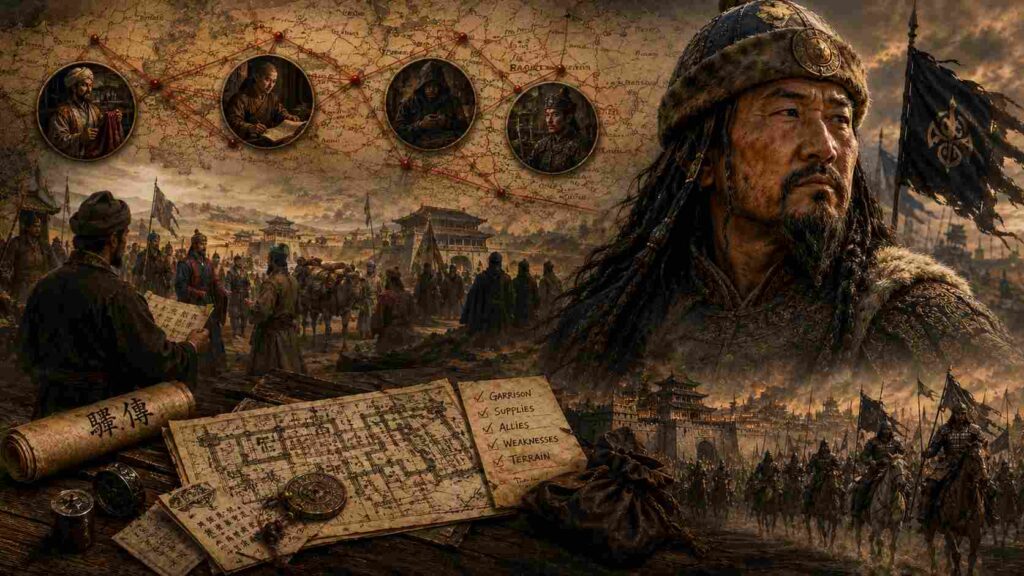
The merchant arrived in Zhongdu six months before the Mongol army did.
He carried silk. He carried dried fruit. He carried careful questions — about the city’s grain stores, the temperament of its garrison commanders, the depth of mud on the northern approaches in spring. He sat in teahouses. He listened to soldiers complain. He watched which gates opened late. He counted the wagons moving toward the palace.
When he left, he carried something far more valuable than silk.
He carried the city.
Not in any metaphorical sense. He carried the actual architecture of its defeat — the troop dispositions, the supply vulnerabilities, the political fractures inside the Jin court that a careful general could pull apart like a split seam. By the time Genghis Khan’s cavalry appeared on the horizon, Zhongdu was already half-conquered. The army was the closing act of an intelligence operation that had been running for years.
This is the story most historians skip when they talk about Mongol conquest. They talk about speed, brutality, psychological terror, the genius of the steppe cavalry system. All of that is real. None of it is the whole picture. What made the Mongol Empire the largest contiguous land empire in human history wasn’t just military brilliance. It was information. Relentless, systematic, institutionalized information — gathered by a spy network so sophisticated that it had no real parallel in the medieval world.
Genghis Khan built an intelligence empire before he built a territorial one. Understanding how he did it changes everything you think you know about how empires are actually made.
The Intelligence Problem Every Conqueror Faces
Every ruler who has ever tried to project power across distance has faced the same fundamental problem: you cannot control what you cannot see.
The Roman Empire solved this with roads — information traveled the same arteries as armies. The Byzantine Empire solved it with diplomacy and an elaborate network of tribute relationships that doubled as an early-warning system. Medieval European kingdoms largely didn’t solve it, which is why they were perpetually surprised by what happened on their own frontiers.
Genghis Khan — born Temüjin, probably around 1162, into a fractured world of steppe confederacies where betrayal was a survival strategy — understood this problem from childhood. He had grown up in a world where the wrong information, trusted at the wrong moment, could mean enslavement or death. His father had been poisoned at a feast by Tatars who knew exactly who he was. His wife had been kidnapped by raiders who knew exactly where he was camped.
Information was not an abstraction to Temüjin. It was blood and survival.
When he unified the Mongol tribes by 1206 and took the title Genghis Khan — “Universal Ruler” — he brought that obsession into governance. The result was something the medieval world had never seen: a conquering empire that treated intelligence gathering not as a luxury or a diplomatic afterthought, but as a primary military instrument, organized and funded at the highest levels of state.
The Mongol spy network wasn’t improvised. It was doctrine.
How the Network Actually Worked: Merchants, Monks, and Masterminds
The genius of Genghis Khan’s intelligence system was that it weaponized the medieval world’s existing infrastructure against itself.
Trade networks were already crisscrossing Eurasia. Merchants already moved between courts, cities, and cultures with a freedom that soldiers and diplomats could not match. They were expected to be curious. They asked questions for a living. They had natural cover — the silk, the spices, the horses they actually traded. And they had relationships: the innkeeper who talked too much, the customs official who could be bribed, the palace servant who resented his master.
Genghis Khan’s innovation was to integrate merchants systematically into his intelligence apparatus. The Mongols cultivated merchant networks across Central Asia, China, Persia, and eventually into Eastern Europe, not as occasional informants but as permanent, tasked assets. Merchants traveling under Mongol protection — and the protection was real, enforced with lethal seriousness — were expected to return with more than goods. They returned with assessments.
The *yam* system, the Mongols’ legendary postal relay network, served a dual function that most descriptions miss. Yes, it moved orders and dispatches at astonishing speed — riders covering 200 miles a day in favorable conditions. But it also moved intelligence. The same infrastructure that let Genghis Khan coordinate armies across a thousand miles let him receive reports from agents operating deep inside enemy territory months before a campaign began.
Religious figures were another channel. Buddhists, Nestorian Christians, Muslims — the Mongols maintained studied neutrality toward all of them, which gave Mongol intelligence access to religious networks that penetrated courts, monasteries, and trade cities across the known world. A Nestorian monk traveling from Persia to China was unremarkable. A Nestorian monk who was also feeding assessments back to Mongol handlers was something else entirely.
And then there were the defectors — the most valuable asset in any intelligence operation. Genghis Khan institutionalized the humane treatment of surrendered enemies who cooperated. Administrators, generals, engineers, scribes from conquered territories were absorbed into Mongol service. Many of them became invaluable sources on their own former employers: the political situation in the next city, the personality flaws of the next khan, the exact route through the next mountain pass.
The empire learned by conquering. Each conquest gave it better intelligence for the next one.
The Campaigns That Prove the System: Three Case Studies
The Khwarazmian Empire, 1219–1221
This is the most devastating example of Mongol intelligence in action, and it happened at scale.
The Khwarazmian Empire — stretching from modern Iran through Afghanistan and into Central Asia — was, on paper, a serious military power. Shah Muhammad II commanded an army that may have numbered 400,000 men. He controlled the Silk Road. He had formidable fortified cities.
He also had, for years before the Mongol invasion, a serious problem he didn’t fully appreciate: his territory was transparent to Mongol intelligence.
Merchants. Diplomats. The merchants Genghis Khan had sent to Otrar — and whom the Shah’s governor had massacred in 1218, triggering the war — were the surface of something much deeper. By the time the Mongol army crossed the Syr Darya, Genghis Khan knew that Muhammad II had a dysfunctional relationship with his mother, who commanded independent political power. He knew that the Shah had distributed his forces across his cities rather than concentrating them — a defensive posture that would prevent him from fighting a decisive engagement. He knew the administrative geography of the empire in enough detail to design a campaign that would sever its parts before they could reinforce each other.
The Shah’s empire didn’t fall to Mongol cavalry. It fell to a campaign plan built on intelligence so precise that the Mongols knew where to strike before a single arrow flew.
Muhammad II never fought a unified defensive battle. He retreated from city to city, then fled his own empire, dying as a fugitive on an island in the Caspian Sea in 1220. His empire was gone in two years.
The Jin Dynasty, North China
The Mongol campaign against the Jin Dynasty, which ruled northern China, lasted from 1211 to 1234 — longer than most Mongol campaigns, and the length itself is instructive. China presented a different intelligence problem than the steppe: dense urban civilization, enormous population, complex political structures, a military tradition that included fortification expertise the Mongols had to learn to overcome.
Genghis Khan’s response was to recruit Chinese administrators and advisors who understood Jin military and political culture from the inside. He employed Chinese engineers who knew siege warfare. He cultivated defectors from the Jin officer class. He used the friction between the Jin Jurchen ruling class and the ethnic Chinese and Khitan populations they governed — friction his intelligence network had identified and assessed — as a political weapon, framing the Mongol invasion partly as liberation.
The siege of Zhongdu in 1215 succeeded not because the Mongols out-engineered the Jin defenders, but because Genghis Khan’s intelligence gave him a clear picture of the city’s supply situation, political vulnerabilities, and the disposition of its garrison. The city fell after a siege, not an assault. The walls were never the real obstacle. The information was.
Eastern Europe, 1241
By the time the Mongols turned west under Batu Khan and Subutai, the intelligence operation was operating at its most mature. Three years before the invasion, Mongol agents were active in Poland, Hungary, and the Holy Roman Empire — assessing roads, identifying political divisions, mapping the relationships between the major powers and their capacity to coordinate.
The result was a campaign of almost terrifying precision. The Mongols struck Poland and Hungary simultaneously, preventing either kingdom from reinforcing the other. They knew the political animosity between King Béla IV of Hungary and his nobility well enough to anticipate that Béla would struggle to mobilize an effective unified defense. They knew the terrain of the Hungarian plain favored Mongol cavalry tactics.
At the Battle of Mohi in April 1241, Subutai’s forces encircled and destroyed the Hungarian army so completely that Béla barely escaped with his life. The Mongols were already deep into Hungary before Western Europe understood it was being invaded.
The campaign didn’t fail because Mongol intelligence collapsed. It halted — controversially, and still debated — for political reasons after Ögedei Khan’s death in December 1241. The intelligence system had done its job.
The Turning Point: When Institutionalized Knowledge Becomes the Empire Itself
There is a moment in the history of the Mongol intelligence apparatus that deserves close attention, because it reveals something uncomfortable about empires built on information.
Genghis Khan understood, viscerally, that his intelligence network was a system — not a collection of individual assets but an institutional capability that had to be maintained, funded, and protected. He enforced this understanding with typical ruthlessness. Killing Mongol merchants or ambassadors was one of the few offenses that guaranteed a genocidal response. The Shah of Khwarezm learned this. The assassination of Mongol envoys in several other episodes produced invasions that looked, to contemporaries, disproportionate — but were, from Genghis Khan’s perspective, rational defenses of his intelligence infrastructure.
He also understood something that many imperial strategists never grasp: intelligence is only as good as the decision-maker’s willingness to believe it. He surrounded himself with advisors from conquered peoples specifically because they gave him perspectives his Mongol commanders couldn’t. The Khitan advisor Yelü Chucai, who served under both Genghis Khan and his successor Ögedei, is the most famous example — a man who convinced the Great Khan that taxing and administering conquered Chinese cities would produce more long-term wealth than destroying them.
That was an intelligence insight, not just a moral one. It reshaped how the empire thought about the value of what it conquered.
The tragedy of the later Mongol Empire is partly a story about what happens when an institution loses its founder’s discipline. By the third and fourth generations of Mongol rulers, the intelligence system had fragmented along with the empire itself. The four successor khanates — the Golden Horde, the Ilkhanate, the Chagatai Khanate, the Yuan Dynasty — competed with each other as often as they cooperated, and the unified intelligence picture that had made conquest possible ceased to exist.
An empire built on information collapsed, in part, when the flow of that information became politicized and fractured. The instrument that built the empire couldn’t survive the empire’s own internal contradictions.
The Long Shadow: What Genghis Khan's Intelligence System Actually Changed
The Mongol Empire’s intelligence apparatus had consequences that extended far beyond the empire itself.
First, it demonstrated — for the first time at continental scale — that military force and information could be systematically integrated into a unified strategic instrument. Subsequent empires, from the Ottomans to the Ming Chinese, studied Mongol methods and adapted them. The Ottoman intelligence and diplomatic corps, one of the most sophisticated of the sixteenth century, owed a recognizable debt to Mongol practice.
Second, the Pax Mongolica — the period of relative stability across the Mongol trade network in the mid-thirteenth century — was itself a product of the intelligence system. Merchants could travel safely from China to Persia because the network that protected them was the same network that served the empire’s information needs. The famous journeys of Marco Polo were possible because Mongol infrastructure, including its intelligence-maintained security apparatus, made transcontinental travel viable for outsiders.
Third, and most overlooked: the Mongol intelligence system accelerated the transmission of information itself across Eurasia. Ideas, technologies, agricultural knowledge, disease — all of it moved faster because the Mongols had built infrastructure to move information. The Black Death traveled west along Mongol trade routes. So did the papermaking techniques that eventually reached Europe. The intelligence empire that conquered half the world also, inadvertently, wired it together.
What This Reveals About Every Empire Since
Power that cannot see itself clearly cannot sustain itself.
This is the lesson that Genghis Khan — a man who could not read, who grew up without walls, who built the largest empire the world has ever seen — understood more completely than most literate rulers who came before or after him.
Every authoritarian system that has tried to scale power across geography has faced the same problem he faced: how do you know what is actually happening? How do you prevent the information reaching you from being filtered, distorted, weaponized against you by the people whose job it is to inform you?
Genghis Khan’s answer was structural. He built redundant channels. He welcomed outsiders who had no stake in flattering him. He treated the destruction of his intelligence assets — his merchants, his envoys — as existential threats requiring maximum force. He institutionalized skepticism.
His successors, comfortable in palaces and surrounded by courtiers with interests to protect, gradually lost access to the unfiltered picture. The empire fractured. The khanates made decisions based on incomplete and politicized information. They lost wars they should have seen coming.
The intelligence empire that conquered half the world didn’t collapse because it ran out of enemies. It collapsed because it eventually ran out of accurate information about itself.
That pattern — the gap between what an empire believes and what is true, widening slowly until it becomes catastrophic — is not a Mongol story. It is the story of every imperial overreach from Rome to the present. Genghis Khan simply built the system that revealed it most clearly.
Frequently Asked Questions
How did Genghis Khan gather intelligence before his campaigns?
Genghis Khan used a layered network of merchants, religious travelers, diplomatic envoys, and absorbed defectors to collect intelligence on enemy territories. Merchants operating under Mongol protection were systematically tasked with reporting on military dispositions, political conditions, terrain, and supply vulnerabilities months or years before a campaign began.
Did Genghis Khan have a formal spy agency?
Not in the modern institutional sense, but the Mongol intelligence apparatus was systematic and doctrine-driven. The *yam* postal relay system, the merchant protection networks, and the deliberate absorption of administrative expertise from conquered peoples all served intelligence functions. It was the most organized information-gathering system in the medieval world.
How did Mongol intelligence contribute to the fall of the Khwarazmian Empire?
Mongol intelligence identified that Shah Muhammad II had distributed his forces across fortified cities rather than concentrating them, had dysfunctional political relationships within his own court, and could be separated from potential allies. The 1219–1221 campaign was designed around these assessments — the Shah’s empire was strategically isolated before the armies crossed the border.
Why did the Mongol Empire’s intelligence system eventually fail?
As the empire fractured into competing successor khanates after Genghis Khan’s death and the death of Ögedei Khan, the unified intelligence network fragmented. The khanates competed with each other, politicizing information flows. Without the centralized discipline Genghis Khan had imposed, the system that had made conquest possible ceased to function as a coherent instrument.
How did the Mongol trade network affect the spread of information and disease?
The Pax Mongolica created relatively secure transcontinental trade routes, accelerating the movement of goods, people, ideas, and pathogens across Eurasia. The Black Death traveled west along these routes in the 1340s. So did papermaking technology, agricultural techniques, and the commercial contacts that eventually enabled the explosion of trade that preceded the Renaissance.
What made Mongol intelligence superior to other medieval powers?
Most medieval powers used intelligence opportunistically — capturing defectors, receiving diplomatic reports, interrogating prisoners. The Mongols institutionalized it. They funded it, protected it by force, built redundant channels, and integrated it systematically into campaign planning. The difference was not capability but doctrine.
How does Genghis Khan’s intelligence empire compare to the Roman intelligence system?
Rome relied primarily on its road network, provincial administration, and diplomatic relationships for information. It had nothing comparable to the Mongols’ systematic use of merchant networks as intelligence assets, or the degree of integration between commercial infrastructure and military intelligence. The Mongol system was more sophisticated as a dedicated intelligence apparatus, though Rome’s administrative intelligence — knowing its own provinces — was more developed.
Further Reading
The Secret History of the Mongol Queens by Jack Weatherford — Weatherford’s research into Mongol primary sources, including the *Secret History of the Mongols*, reveals the political and intelligence dimensions of the early empire that most Western accounts flatten. Genuinely essential for understanding how the empire actually functioned.
Genghis Khan and the Making of the Modern World by Jack Weatherford — still the best single-volume account of the Mongol Empire in English, with strong coverage of the administrative and intelligence systems that made conquest sustainable.
Watch Next on History Republic
This piece connects directly to our examination of how fear and information control shaped authoritarian rule — covered in depth in our YouTube episode on Ivan the Terrible’s reign of terror and the Oprichnina, Russia’s first secret police force. The parallels between Genghis Khan’s intelligence institutionalization and Ivan’s paranoid surveillance state reveal something consistent about how power tries to make itself permanent.
A Note on Why This Matters
History Republic exists because serious historical storytelling — the kind that actually changes how you understand power, human nature, and the present — is harder to find than it should be.
If you found this piece genuinely useful — if it shifted something in how you think about intelligence, empire, or the relationship between information and power — consider supporting what we’re building. Members make it possible to go deeper, stay longer, and resist the pressure to simplify for the algorithm.
You’re not just supporting a history channel. You’re helping preserve serious historical storytelling in a shallow digital age.