The Day Rome's Largest Army Ceased to Exist
The Roman consul Lucius Aemilius Paullus knew, by midday on August 2nd, 216 BC, that something had gone terribly wrong. He had ridden into battle that morning commanding the largest army Rome had ever assembled — roughly seventy thousand legionnaires on the flat Apulian plain near the village of Cannae. By afternoon, Paullus was dead. So were somewhere between forty-five thousand and seventy thousand of his men.
It was not a defeat. It was an annihilation — executed in a single afternoon by a Carthaginian general who was outnumbered nearly two to one.
The Battle of Cannae is the most studied tactical engagement in military history. Not because Rome lost, but because of how Hannibal won. The encirclement he designed that day — what military theorists call a double envelopment — became a blueprint that generals have attempted to replicate for more than two thousand years. It is still taught at West Point, Sandhurst, and Saint-Cyr today. Understanding what happened at Cannae, and why it worked, is understanding something fundamental about how armies fight, and how empires fall.
Three Years of Catastrophe Before Cannae
By the summer of 216 BC, Rome had already lost two major armies to Hannibal Barca and was beginning to understand that it was fighting a different kind of enemy. Hannibal had crossed the Alps in 218 BC — a feat most Romans considered impossible — and immediately demonstrated why he had made the crossing: he crushed a Roman force at the Trebia River within months of arriving. The following summer, he ambushed and destroyed another army at Lake Trasimene in one of the most complete surprise victories in ancient warfare.
Rome’s response was characteristic: raise a larger army. For 216 BC, the Senate voted to field a consular force of unprecedented size — ancient sources, including Polybius and Livy, give figures ranging from seventy to eighty-six thousand men, though modern historians debate the exact numbers. Two consuls shared command, rotating on alternate days by Roman convention: Lucius Aemilius Paullus, experienced and cautious, and Gaius Terentius Varro, a populist who had campaigned on the promise of finally defeating Hannibal decisively.
On the day of the battle, command rotated to Varro. He chose to engage.
Hannibal had approximately fifty thousand soldiers — Iberians, Gauls, Numidians, and the heavy African infantry called Libyans. He had chosen the battlefield himself, deliberately, over the preceding weeks. The flat Apulian plain near Cannae offered Roman infantry the ideal ground for their preferred tactic: mass, compress, push through the center. Hannibal wanted them to believe it was exactly the terrain advantage they needed.
The Trap Hannibal Built Before the Battle Began
Understanding what happened at Cannae requires understanding what Rome was trying to do — because the Roman plan was not stupid. It was the plan that had worked against every enemy Rome had faced for a century.
Roman tactical doctrine in the third century BC was built around the legionary system: disciplined infantry formations arranged in three lines, disciplined enough to rotate fresh troops forward, and capable of sustaining enormous pressure while maintaining cohesion. Against an enemy in open ground, a Roman army simply put more weight behind a narrower front and drove through. The Romans had been doing this successfully across Italy and beyond for generations. Against Hannibal’s mixed force, with its greater cavalry strength but infantry inferiority, it was a reasonable approach.
Hannibal’s deployment exploited the logic of that plan. He arrayed his weakest troops — the Spanish and Gallic infantry — at the very center of his line, but in a convex formation: the center bowed forward, toward the Roman mass, rather than holding a straight line. On both flanks, beyond the Spanish and Gauls, he positioned his strongest soldiers — the Libyan heavy infantry, equipped with captured Roman armor — and held them back, waiting. On the far flanks, his cavalry: the heavier Iberian and Gallic horse on his left against the Roman cavalry, the lighter, faster Numidians on his right against Rome’s allied cavalry.
The Roman infantry outnumbered his significantly. The Roman cavalry was outnumbered and outmatched.
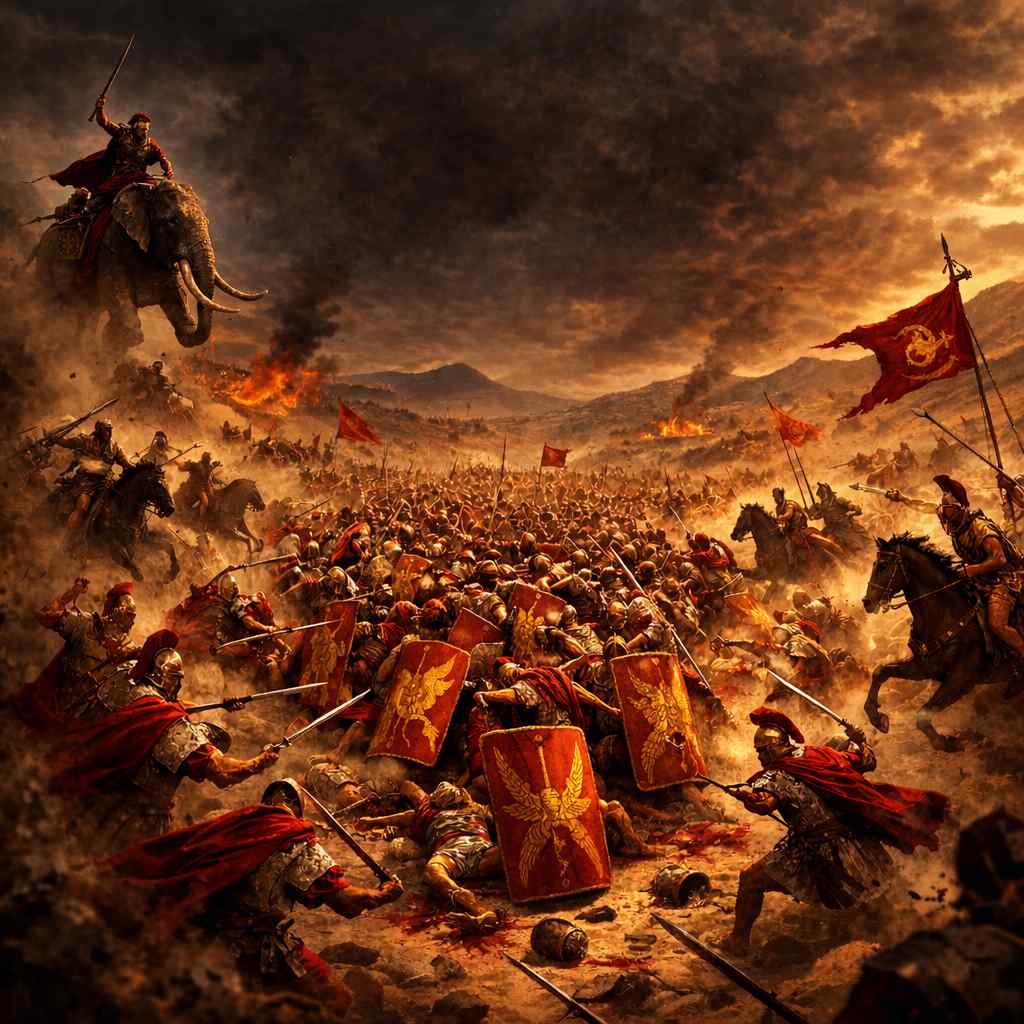
When the battle began, the Romans did exactly what the terrain invited them to do. They pushed into the Carthaginian center. The center gave ground — deliberately, absorbing the Roman thrust while bending backward. From the Roman perspective, the enemy line was breaking. Varro pressed harder. The legions compressed, packing tighter and tighter as they pushed into the narrowing space created by the concave formation. Men who had room to swing their swords when the battle began increasingly found they didn’t.
On the flanks, the cavalry action unfolded with decisive speed. On the Roman right, the Iberian and Gallic heavy cavalry crashed into the Roman horse and shattered it. On the Roman left, the Numidians tied up the allied cavalry — not pursuing aggressively, but keeping them occupied, buying time. The critical move was what happened next: the victorious Iberian cavalry on the right did not pursue the fleeing Romans. Instead, they wheeled across the rear of the entire battlefield toward the Roman left flank.
In the center, the Romans believed they were winning. The enemy center had retreated so far that the formation had inverted: what had been a convex arc pointing toward them was now a concave cup surrounding them on three sides. The legions were so tightly packed that senior officers were struggling to exercise any control at all.
The Encirclement Closes: Cannae's Defining Moment
The moment that defines Cannae — the moment that military academies reconstruct in detail two millennia later — is the pivot of the Libyan infantry.
Hannibal’s Libyans had been waiting on both flanks, watching the Roman mass compress itself into the concave trap of the Carthaginian center. When the moment came, they turned inward simultaneously from both sides. At the same moment, the Iberian cavalry swept around from the rear. The encirclement was complete in minutes.
Seventy thousand Roman soldiers — the ancient sources disagree on exact figures, and modern historians note the uncertainty — stood surrounded on all sides. In front, the Carthaginian center. On both flanks, fresh Libyan heavy infantry. Behind them, cavalry. They had no room to maneuver. Many were packed so tightly they could not raise their arms to use their weapons.
What followed was not a battle in any meaningful sense. It was systematic killing. The Carthaginian forces worked inward from every direction. Ancient accounts by Polybius — writing roughly a century after the battle, though with access to earlier sources — describe Roman officers dying alongside their men, the scale of the slaughter incomprehensible even to those carrying it out.
By evening, the field was still. Modern historians place Roman dead between forty-five thousand and seventy thousand, depending on how the ancient sources are weighted. Carthaginian losses: approximately five thousand five hundred. In a single afternoon.
Rome's Response: The System That Would Not Break
News reached Rome the following day. Ancient writers describe a city in a state that had no precedent — not the measured grief of a military setback, but genuine panic, senators debating whether to abandon Italy entirely.
Hannibal reportedly collected the gold finger-rings of dead Roman knights and shipped them to Carthage as tangible proof of what had happened. Ancient sources claim he sent three bushels of rings. The exact figure is impossible to verify, and Roman sources may have embellished — but the symbolic act was clearly deliberate. He was announcing not just a victory but the destruction of Rome’s equestrian class in a single afternoon.
The political consequences in Italy were immediate and severe. Capua — the second city of the peninsula — defected to Hannibal within weeks. Several other allied communities followed. For the first time in the war, it looked as though Rome’s grip on Italy was genuinely loosening.
Hannibal’s cavalry commander Maharbal reportedly urged him to march immediately on Rome while the city was in shock. The account, preserved by Livy, has Maharbal famously saying that Hannibal knew how to win a victory but not how to use one. Whether this exchange happened in exactly these words, we cannot verify — Livy was writing more than two centuries after the battle. But the underlying question it raises is real and historically significant: why didn’t Hannibal march on Rome?
The answer remains genuinely contested among historians. Hannibal had no siege equipment capable of reducing Rome’s walls. His army needed time to resupply and reorganize after the exertion of the battle. He may have calculated — reasonably, if incorrectly — that sufficient Italian allied defections would force Rome to negotiate a settlement without requiring a siege. We cannot know with certainty which consideration dominated his thinking.
What is documented is that he didn’t march. And Rome used the time.
What Cannae Changed, and What It Didn't
Rome’s response to Cannae is, in some ways, as remarkable as the defeat itself. The Senate restricted public mourning to prevent collective panic from becoming institutional collapse. Rome refused to ransom its prisoners — a deliberate signal to Carthage that Rome would not negotiate from weakness under any circumstances. New legions were raised. The war continued.
For the next thirteen years, Rome fought Hannibal on Italian soil without attempting another open pitched battle against him directly. They adopted a strategy of attrition — denying him supplies, retaking defected allies, and slowly strangling his position in Italy while fighting Carthage’s allies in Spain. When Rome finally struck decisively, it was not at Hannibal in Italy but at Carthage’s home territory in North Africa, under Scipio Africanus — who had studied Hannibal’s methods carefully and used them against him at the Battle of Zama in 202 BC.
The long-term military legacy of Cannae is specific and traceable. The double envelopment — encircling an enemy force by letting them advance into a concave center while closing both flanks — entered military doctrine as a theoretical ideal for decisive battle. It influenced Hellenistic military theory and was studied by Roman commanders in the following generations.
Two thousand years later, it explicitly shaped German military planning. Count Alfred von Schlieffen, whose strategic plan dominated German thinking before the First World War, framed his entire Western Front concept in terms of achieving a Cannae-style encirclement of France. At the Battle of Tannenberg in 1914, German forces did achieve a genuine double envelopment, encircling and destroying an entire Russian army. Schlieffen had studied Hannibal’s blueprint and built modern staff-college doctrine around it.
Today, the Battle of Cannae appears in the curriculum of virtually every major military academy in the Western world. Military historians study it not only as a tactical achievement but as a test case for the relationship between battlefield success and strategic outcome — Hannibal won the battle and lost the war.
The Question Cannae Actually Asks
The tactical mechanics of Cannae are worth understanding. But the deeper question the battle poses is about systems rather than tactics.
Hannibal was, by almost any measure, the most brilliant tactical commander of the ancient world. He fought on Italian soil for fifteen years and never lost a major engagement. At Cannae, he engineered one of the most complete battlefield victories in recorded history against an enemy that outnumbered him nearly two to one. And none of it was enough. Rome had a system — political, military, social — capable of absorbing losses that would have collapsed any other Mediterranean power. Every army Hannibal destroyed, Rome replaced. Every ally that defected, Rome eventually recovered or isolated. The system held.
What Cannae reveals, then, is a distinction that military strategists have been arguing about ever since: the difference between winning battles and winning wars. Tactical brilliance, deployed repeatedly and brilliantly, inside a strategic system you cannot break, will not produce victory. Rome learned this, imperfectly and at enormous cost. The Romans who rebuilt after Cannae produced the strategy — attrition, pressure on Carthage’s allies, the eventual invasion of North Africa — that finally won the Second Punic War.
Hannibal died in exile in 183 BC, surrounded by Roman agents, rather than surrender. He took poison. He had never returned to Italy after being recalled to face Scipio at Zama. His campaign — fifteen years, no major defeats, three of the most brilliant victories in ancient warfare — ended in a foreign court, hunted.
Built for Those Who Take History Seriously
If this is the kind of historical storytelling you’ve been looking for — grounded, accurate, without the distortion — History Republic publishes more of it regularly. The Battle of Cannae is one piece of a larger story: the Second Punic War, Scipio Africanus, the nature of Roman resilience, and the question of what actually wins wars.
History Republic is supported entirely by readers who believe this work matters. If that’s you, you’re welcome here.
RELATED ARTICLE SUGGESTIONS (INTERNAL LINKS)
- Hannibal’s Crossing of the Alps: What It Actually Cost Him (companion piece — how the campaign began)
- Scipio Africanus: The Roman Who Studied Hannibal and Destroyed Him (logical next read — the war’s resolution)
- The Battle of Zama: When Hannibal’s Tactics Were Used Against Him (direct follow-up — Cannae’s mirror)
AFFILIATE BOOK RECOMMENDATIONS
- Cannae: The Experience of Battle in the Second Punic War — Gregory Daly
The definitive modern scholarly treatment of the battle. Rigorous, readable, and built for serious history enthusiasts who want to go deeper than surface-level accounts.
- Hannibal: Enemy of Rome — Leonard Cottrell
Cinematic and grounded — excellent for understanding the full context of Hannibal’s Italian campaign without sacrificing accuracy for accessibility.
FAQ SECTION (5–8 QUESTIONS FOR FEATURED SNIPPET TARGETING)
What happened at the Battle of Cannae?
The Battle of Cannae (August 2, 216 BC) was a devastating defeat for Rome during the Second Punic War. Carthaginian general Hannibal Barca used a double envelopment tactic — encircling a larger Roman force — resulting in the death of between 45,000 and 70,000 Roman soldiers in a single afternoon.
How many soldiers died at the Battle of Cannae?
Ancient sources estimate Roman dead between 45,000 and 70,000. Modern historians treat these figures as approximate, given the uncertainties of ancient record-keeping. Carthaginian losses are estimated at approximately 5,500. The battle remains one of the bloodiest single-day engagements in ancient warfare.
Why is the Battle of Cannae still studied today?
Cannae is studied because Hannibal’s double envelopment — surrounding and destroying a numerically superior force — became the theoretical model for decisive battle in Western military doctrine. Military academies including West Point, Sandhurst, and Saint-Cyr still include it in their curricula. Count von Schlieffen explicitly modeled his World War I strategy on Cannae’s encirclement principle.
What was Hannibal's strategy at the Battle of Cannae?
Hannibal deployed his weakest infantry at the center in a convex arc that invited the Romans to push into it. As the Romans advanced, the center deliberately gave ground, inverting into a concave formation that wrapped around the Roman mass. Simultaneously, his cavalry destroyed the Roman horse on both flanks, and his Libyan heavy infantry pivoted inward from both sides. The result was a complete encirclement.
Why didn't Hannibal march on Rome after Cannae?
Historians debate this question. Hannibal lacked siege equipment capable of attacking Rome’s walls. His army needed resupply. He may also have calculated that Italian allied defections would force Rome to negotiate. Whatever his reasoning, the decision not to march is widely considered the strategic error that ultimately cost Carthage the war.
What is a double envelopment?
A double envelopment is a military maneuver in which an attacking force simultaneously encircles an enemy on both flanks, completely surrounding them. Cannae is history’s most famous example. The tactic requires the attacking force to fix the enemy’s attention at the center while closing both flanks — typically with cavalry.
Who commanded the Roman forces at the Battle of Cannae?
Two consuls shared command, rotating on alternate days per Roman convention: Lucius Aemilius Paullus, an experienced general who was cautious about the terrain, and Gaius Terentius Varro, a populist who chose to engage Hannibal. On the day of the battle, command rotated to Varro. Paullus was killed in the fighting.
Who won the Second Punic War?
Rome ultimately won the Second Punic War in 202 BC at the Battle of Zama, where Roman general Scipio Africanus defeated Hannibal using tactics modeled on Hannibal’s own methods. Carthage was forced to surrender its navy, pay massive reparations, and surrender control of Spain. Hannibal was later exiled and died in 183 BC.
Related on History Republic
- Hannibal
- The Rubicon: What Caesar Knew, What He Risked, and Why He Did It Anyway
- Alexander the Great: The 3 Strategic Decisions That Built an Empire
Go deeper in the History Republic app
Maps, timelines, and more stories from the same eras—built for readers who want the record, not the myth.
Further Reading
Product links are recommendations. Affiliate tagging is not active yet—no commission is earned on these clicks.