Who Was Khalid ibn al-Walid?
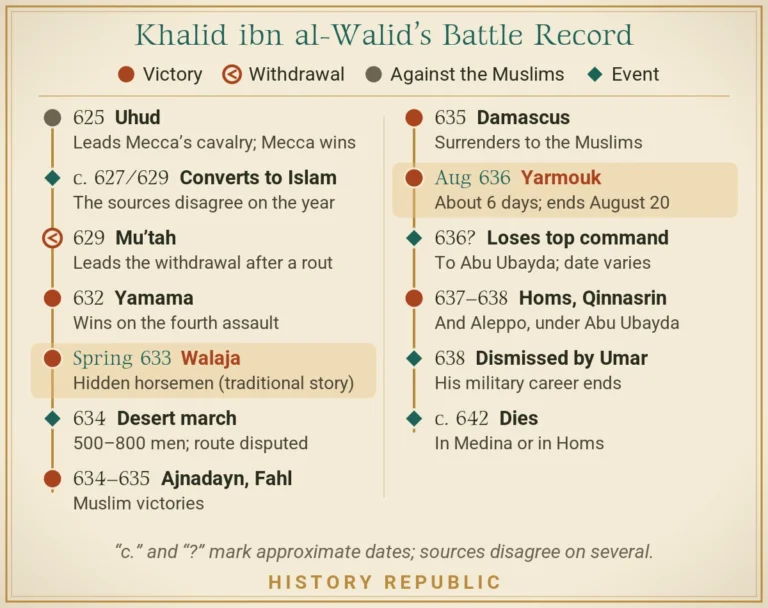
Khalid was born in Mecca into the Banu Makhzum, one of the leading clans of the Quraysh tribe, and his clan opposed the Prophet Muhammad. At the Battle of Uhud in 625, Khalid commanded cavalry for Mecca. When Muslim archers left their post to join in looting the Meccan camp, he charged through the gap. Uhud was a Muslim defeat, and historians credit Khalid’s timing for it.
Then he switched sides. Around 627 or 629 (the sources disagree) he converted to Islam and went on to serve Muhammad and the first two caliphs, Abu Bakr and Umar. The title Sayf Allah, “Sword of God,” is usually said to have come from Muhammad, though some early historians say Abu Bakr gave it later.
After Muhammad’s death in 632, Khalid fought the Arabian tribes that broke away from Medina in the Ridda wars. In 633 he campaigned in Iraq against the Sasanian Persian Empire, and in 634 he moved to Syria to fight the Byzantine Empire. Around 638 he was dismissed. He died in 642, in Medina or in Homs, Syria.
"Never Lost a Battle": What the Khalid ibn al-Walid Battle Record Really Says
The claim that he never lost a battle comes from the Islamic historical tradition. It fairly sums up how the sources tell his story, but it is not a verified scorecard.
Almost everything we know about him comes from Arabic histories written long after his death, above all the Conquests of the Lands by the 9th-century historian al-Baladhuri and the vast History of al-Tabari, who died in 923, nearly three centuries after Khalid. These writers collected older oral reports that often disagree about dates, places, numbers and even who was in command. The historian Patricia Crone went as far as doubting that Khalid fought in Iraq at all; others, such as Khalid Yahya Blankinship, think that goes too far.
The record also depends on what you count:
- Uhud (625): Khalid won, but he was fighting against the Muslims.
- Mu’tah (629): a Muslim force was routed by a Byzantine-led army and its appointed commanders were killed. Khalid took over and led a hard but safe withdrawal. Tradition treats it as a rescue, not a defeat.
- Yamama (632): his first three assaults on the rebel leader Musaylima were thrown back before the fourth succeeded.
So “never lost a battle” is best read as: in the battles he led as a Muslim commander, the tradition records no defeat. That is still a remarkable reputation, and it is why he is often set beside Hannibal, who fought in Italy for fifteen years without losing a major battle. Almost every number below, from army sizes to casualties, is debated, so this article gives ranges where historians disagree.
Walaja, 633: The Trap Behind the Ridge
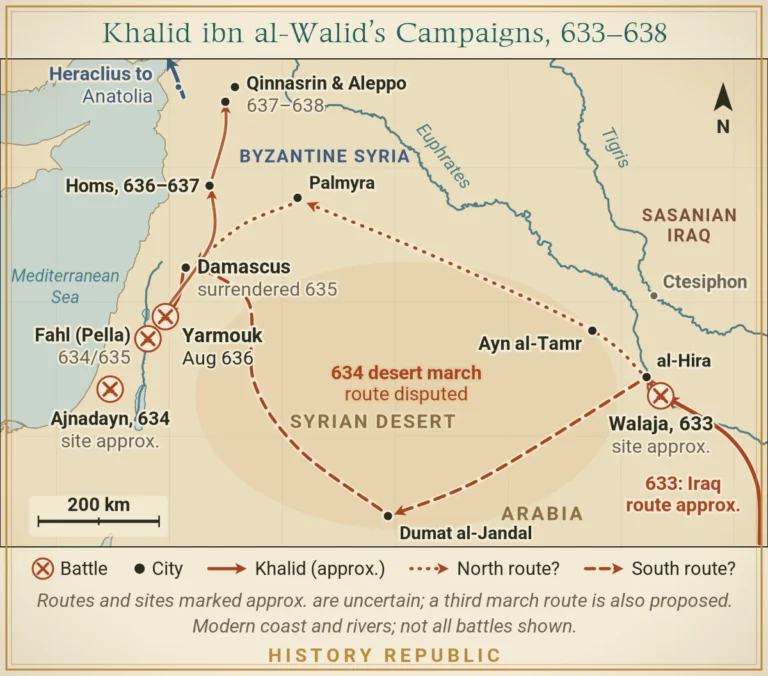
By spring 633 Khalid was in southern Iraq, raiding along the Euphrates and picking off Persian frontier garrisons. Even the size of his army is unclear. The historian Hugh Kennedy puts the force that reached the frontier at about 1,000 men. A modern reconstruction by Agha Ibrahim Akram gives him about 15,000 at Walaja, after tribesmen had joined him.
Beating One Army Before the Second Arrived
In the traditional account, the Persian court answered its early losses by sending two new armies. One, under a commander named Andarzaghar, camped at Walaja near the Euphrates to wait for a second under Bahman. Together they would have outnumbered Khalid badly.
Khalid’s answer was speed. He marched hard to reach Walaja before the second army arrived, so that he would fight one army instead of two. It is the first lesson of his career: he treated time as a weapon. An enemy waiting for reinforcements does not want to fight yet, and Khalid made sure he had to.
A Double Envelopment Like Cannae
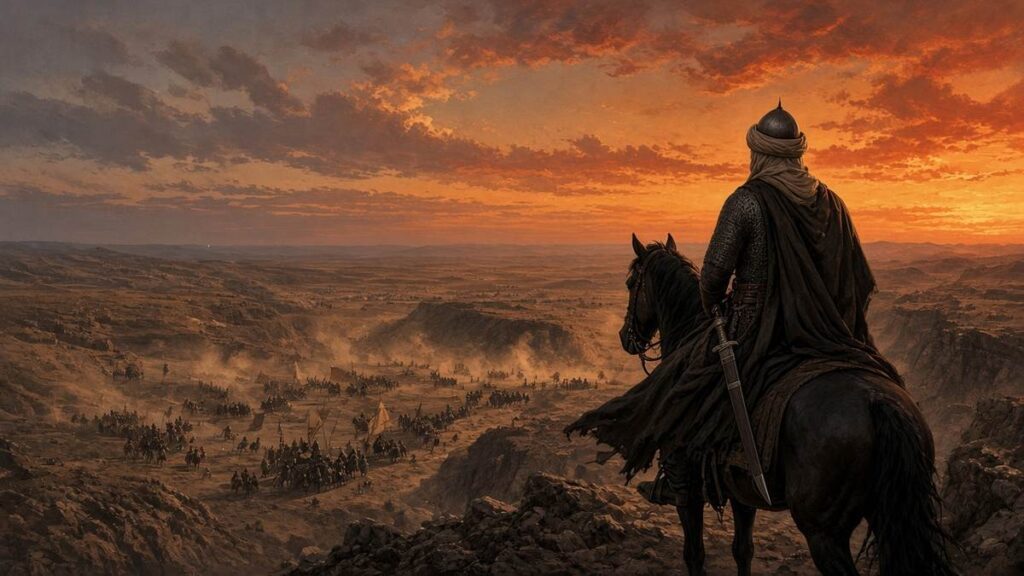
Al-Tabari’s account, which here relies on the 8th-century storyteller Sayf ibn Umar, says that before the battle Khalid hid two groups of horsemen out of sight. When the armies clashed, the Persians pushed hard and the Muslim line gave ground. Then, on Khalid’s signal, the hidden riders fell on the Persian rear. Caught between front and back, the Persian army broke. According to the tradition, Andarzaghar escaped the field but died of thirst in the desert.
Modern writers describe Walaja as a double envelopment, the same idea of closing on an enemy from both sides that Hannibal used at Cannae in 216 BC. There is one difference in the reconstruction. Hannibal’s cavalry swept around the flanks; Khalid’s, the story goes, waited behind a low ridge, so the Persians never saw them coming.
The fine details, such as the ridge, the numbers and the size of the hidden units, come from later sources and modern reconstructions. What the sources agree on is the shape of the idea, and it is psychological. Khalid let the Persians believe they were winning. An army that thinks it is winning pushes forward, stops watching its back, and is at its most fragile at exactly that moment.
From Iraq to Syria: The Desert March
In 634 Caliph Abu Bakr sent Khalid to support the Muslim armies in Syria. The tradition says he led between 500 and 800 men across a waterless desert for six days and five nights. Short of waterskins, he had camels drink heavily and slaughtered some each day so his men could drink the water in their stomachs. The route is disputed, but Kennedy calls the crossing certain and a remarkable feat of endurance.
Khalid reached the area near Damascus in April 634. The Muslim armies then won at Ajnadayn and Fahl, and Damascus surrendered in 635. Then Emperor Heraclius sent the army that was supposed to end it all.
Yarmouk, 636: Retreat as a Weapon
Giving Up Damascus
In spring 636 a large Byzantine army entered Syria, led by Vahan and Theodore Trithyrius, with Christian Arab cavalry under the Ghassanid ruler Jabala ibn al-Ayham and Armenian contingents.
How large was it? No one knows. Fred Donner thinks the Byzantines outnumbered the Muslims about four to one. Walter Kaegi suggests 15,000 to 20,000 or more Byzantines, probably with an edge in numbers. John Jandora argues the sides were close to even, about 40,000 against 36,000. Medieval figures run far higher.
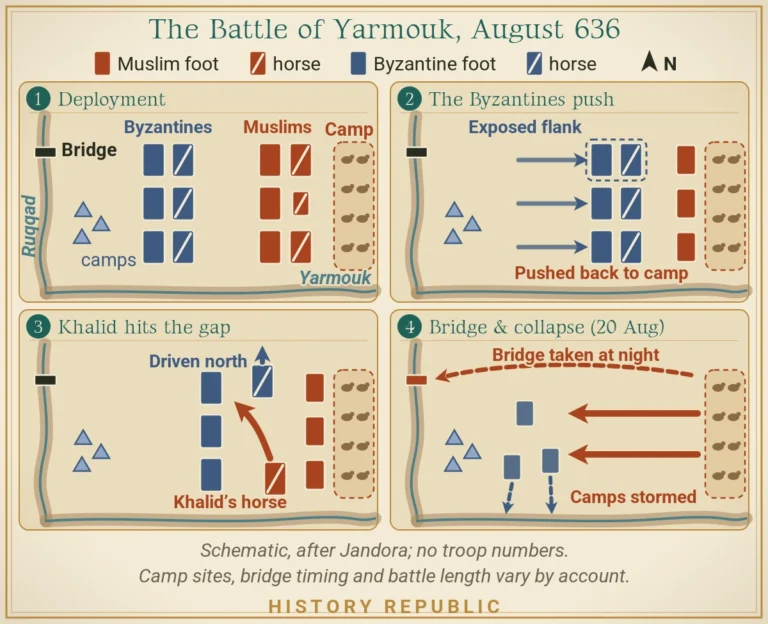
Khalid did not try to hold Damascus. He pulled back south to high ground near where the Ruqqad stream meets the Yarmouk, close to today’s border between Syria and Jordan, and gathered the scattered Muslim forces into one army. On a map it looked like a retreat. In practice he was choosing his battlefield: water, high ground, and the roads the Byzantines would need. For weeks the armies skirmished, and some of the Byzantines’ Arab and Armenian allies reportedly deserted.
Khalid attacked when retreat seemed logical, and he retreated when attack seemed obvious. He did not care how a move looked. He cared what it did to the enemy.
Camels, Archers and a Closed Bridge
Why Caliph Umar Removed Khalid ibn al-Walid
The general no enemy could beat was removed by his own side.
The First Demotion
When Abu Bakr died in 634, Umar became caliph. Within six months to two years, depending on the source, Umar took the supreme command in Syria from Khalid and gave it to Abu Ubayda ibn al-Jarrah, one of Muhammad’s earliest companions. Most modern historians place the change after Yarmouk. Britannica notes that, even after he was formally relieved, Khalid remained the effective leader against the Byzantines.
Khalid did not rebel. He served as Abu Ubayda’s chief lieutenant at Homs and in the campaign around Qinnasrin and Aleppo in 637–638, and became deputy governor of Qinnasrin.
The Final Dismissal, 638
In 638, according to Sayf ibn Umar’s account preserved by al-Tabari, Umar heard that Khalid had handed out lavish gifts from the spoils of northern Syria, including a large sum to the nobleman al-Ash’ath ibn Qays. Umar ordered Abu Ubayda to question Khalid in public and remove him whatever the answer. Khalid said farewell to his troops and went to Medina. His military career was over.
Fear of a Man Who Seemed Unbeatable
The early sources give several reasons for Umar’s decision, and historians still argue over them:
- Independence: Khalid often acted on his own, with little contact with Medina.
- Old scandals: in the Ridda wars he had executed the chieftain Malik ibn Nuwayra and married his widow. Umar wanted him punished then; Abu Bakr refused.
- Money: he was accused of giving spoils to nobles and poets rather than needier Muslims.
- Politics: Khalil Athamina argues Umar needed the support of Syria’s established Arab tribes, who saw Khalid’s large army of newcomers as a threat.
- Fame: in Sayf’s account, Umar told the garrisons Khalid was removed not for wrongdoing but because the soldiers had begun to trust in him rather than in God.
That last reason is the heart of this story. Umar’s authority rested on the idea that victory came from God and that the caliph in Medina, not a general in the field, led the community. A commander who seemed unbeatable threatened that idea, even if he was completely loyal. Umar did not need Khalid to be guilty. He needed the army to see that no single man was the reason it won.
The Psychology of Power: What Khalid's Career Teaches
He fought the enemy’s mind first. At Walaja he let the Persians think they were winning. At Yarmouk he let the Byzantines think he was retreating. Both times the enemy’s confidence became the trap.
He used time and ground as weapons. He raced to fight one Persian army before the second came, and he gave up a city to get the battlefield he wanted.
His independence cut both ways. The habit of deciding for himself won battles, but it also made him hard to control. The quality that made him dangerous to Persia and Byzantium made him uncomfortable for Medina.
Success creates its own danger. Khalid was never beaten in the field, but he could not beat the political logic of his own success. A ruler who depends on one brilliant general also fears him, and Umar’s choice made a point: the state is bigger than its best soldier.
The comparison with Hannibal shows this from the other side. Hannibal’s run of victories in Italy ended when he was recalled to defend Carthage and lost at Zama in 202 BC; his state needed him and still lost the war. Khalid’s state was strong enough to remove its greatest general and keep winning. Battlefield genius alone does not decide who holds power.
Quick Answers (FAQ)
Did Khalid ibn al-Walid really never lose a battle? That is the traditional record, which credits him with no defeats as a Muslim commander. It depends on how you count: at Mu’tah in 629 he led a retreat after a Muslim defeat, and at Yamama his first assaults failed. The sources were written two to three centuries later and disagree on many details.
Why was he called the Sword of God? Sayf Allah was an honorary title. Most traditions say Muhammad gave it to him after he saved the army at Mu’tah; some early historians credit Abu Bakr, for the Ridda wars.
Why did Caliph Umar remove Khalid ibn al-Walid? The sources point to his independence, past controversies, generous gifts of spoils, tension with Umar, and politics in Syria. In one account Umar said the army had come to trust Khalid more than God.
When and where did he die? Around 642, in Medina or in Homs, Syria. Since at least the 12th century his tomb has been placed in the Khalid ibn al-Walid Mosque in Homs.
Sources
- Encyclopaedia Britannica, “Khālid ibn al-Walīd.”
- al-Ṭabarī, The History of al-Ṭabarī, Vol. 11, trans. Khalid Yahya Blankinship (SUNY Press): publisher page.
- P. Crone, “Khālid b. al-Walīd,” Encyclopaedia of Islam, 2nd ed. (Brill).
- K. Athamina, “The Appointment and Dismissal of Khālid b. al-Walīd from the Supreme Command,” Arabica 41(2), 1994, pp. 253–272.
- W. E. Kaegi, Byzantium and the Early Islamic Conquests (Cambridge University Press).
- C. Avcı, “A Turning Point in the Islamic-Byzantine Struggle: The Battle of Yarmūk (15/636),” Marmara Türkiyat Araştırmaları Dergisi 11(1), 2024.
Related on History Republic
- Alexander the Great: The 3 Strategic Decisions That Built an Empire
- Saladin: The Sultan Who Reclaimed Jerusalem
- Mehmed The Conqueror
Go deeper in the History Republic app
Maps, timelines, and more stories from the same eras—built for readers who want the record, not the myth.
Further Reading
Product links are recommendations. Affiliate tagging is not active yet—no commission is earned on these clicks.