
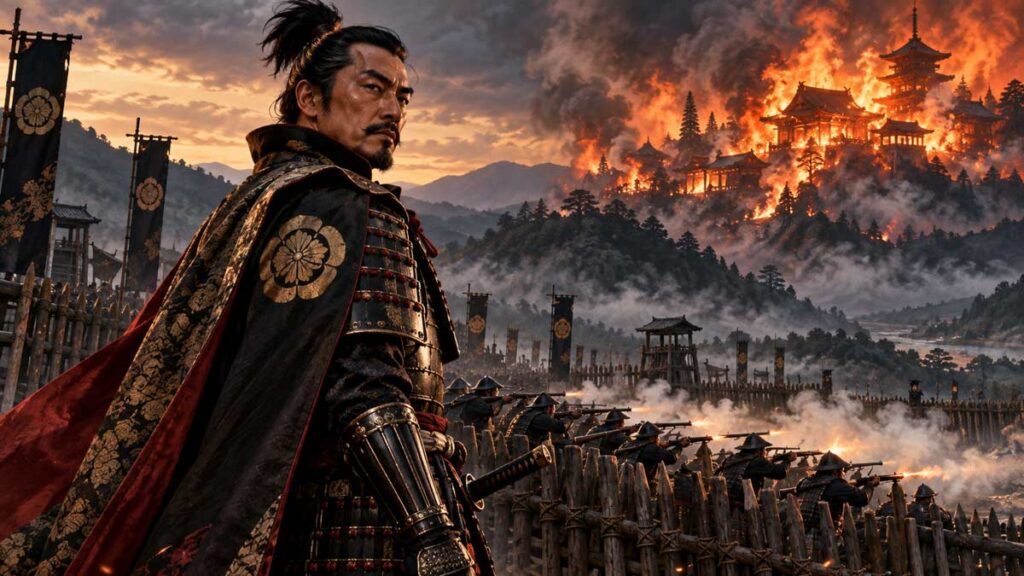
A Psychology of Power field guide: how a provincial warlord turned public terror into a unification strategy, and why fear took him most of the way but could not finish the job.
In the autumn of 1571, an army surrounded Mount Hiei, above Kyoto, and set its monasteries on fire. Enryaku-ji had been Japan’s most important Buddhist center for nearly eight hundred years, a place whose armed monks had bullied the imperial court for centuries and which no sensible warlord had dared to strike. Oda Nobunaga’s soldiers burned its main halls and killed monks, lay people, women, and children. His chronicle says the heads were brought to him.
Four years later, at Nagashino, his musketeers stood behind wooden palisades and shot apart the attacks of the Takeda clan, the most feared army in eastern Japan.
Put those two days side by side and you have the core of how Oda Nobunaga used fear. It was not a temper. It was a policy. He made examples so brutal that other enemies did the math and surrendered, and he backed the threat with an army that could carry it out. The message went out to every castle in the country: resist me, and this is what happens to you.
It worked. It also had limits, and one of them killed him.
This is a field guide for amateur enthusiasts who want the spine of the argument, not a museum of footnotes.
Japan Before Nobunaga: A Country With No Center
By the mid-1500s, the Ashikaga shoguns in Kyoto ruled in name only. The Ōnin War (1467–1477) had wrecked the capital and the shogunate’s authority with it. What followed is known as the Sengoku period, the “Warring States” era: more than a century in which regional lords, the daimyo, fought each other for land, rice, and survival.
Power was split among players who answered to no one:
- Daimyo families held provinces or pieces of them and spent much of their time trying to take their neighbors’.
- Their own retainers could switch sides or overthrow their lords. The era had a word for it: gekokujō, “the low overturning the high.”
- Buddhist institutions were military powers in their own right. Enryaku-ji had armed monks and wide estates. The Ikkō-ikki, leagues of True Pure Land believers, ruled whole provinces.
- The emperor and the shogun still conferred legitimacy, but neither could command obedience.
Anyone who wanted to unify this country faced a basic problem: he could not fight every rival, vassal, and armed temple one at a time. He needed most of them to give up without a fight.
The "Fool of Owari" Learns the Price of Mercy
Oda Nobunaga was born in 1534 into a minor branch of the Oda family in Owari province, near modern Nagoya. As a young man he was known for odd clothes, rough company, and bad manners; locals reportedly called him “the great fool of Owari.” When his father died around 1551–1552, few would have bet on him.
His younger brother, Oda Nobuyuki, was backed by senior retainers who preferred him as clan head. They rebelled in 1556. Nobunaga beat them and, at their mother’s urging, pardoned his brother. Nobuyuki plotted again. This time Nobunaga lured him to Kiyosu Castle by pretending to be ill and had him killed.
Mercy once, death the second time. That pattern followed him through his career, and it captures a theme of the whole era: mercy shown too often was read as weakness, and weakness invited the next knife.
Then came the battle that made his name. In 1560, Imagawa Yoshimoto, one of the strongest lords in eastern Japan, marched through Owari with an army many times larger than Nobunaga’s. Estimates vary widely, but think a few thousand men against perhaps 20,000 or more. At Okehazama, in a sudden storm, Nobunaga’s troops struck the Imagawa headquarters and killed Yoshimoto.
He moved fast after that. He allied with Tokugawa Ieyasu to secure his eastern flank. In 1567 he took Inabayama Castle, renamed it Gifu, and began using a seal reading Tenka fubu, usually translated as “rule the realm by military force.” In 1568 he marched into Kyoto and installed Ashikaga Yoshiaki as shogun. On paper, Nobunaga was the shogun’s protector. In practice, he was the strongest man in central Japan.
Mount Hiei, 1571: Terror as Public Policy
Between 1570 and 1573, Nobunaga faced a coalition that could have destroyed him. The Asakura of Echizen and the Azai of northern Ōmi turned on him; Azai Nagamasa was married to Nobunaga’s own sister. The Ikkō-ikki rose against him. The shogun he had installed began plotting with his enemies. And Enryaku-ji sheltered Azai and Asakura troops during a dangerous campaign in late 1570, after Nobunaga had demanded that it stay neutral.
In September 1571 his army surrounded Mount Hiei and the town of Sakamoto at its foot. Over a day or two, the troops burned buildings and killed the people they found. Nobunaga’s chronicle, the Shinchō kōki, describes monks, lay people, children, scholars, and senior clerics beheaded one by one. How many died is uncertain. Contemporary figures run from a few hundred to 3,000–4,000, and somewhere between roughly 1,500 and a few thousand is a reasonable middle range. Modern archaeology suggests the destruction was smaller than the most dramatic accounts claim, since many buildings had already fallen into ruin before 1571.
The exact numbers matter less than the message. Mount Hiei was chosen because of what it was, and burning it told every lord, temple, and village three things:
- Nothing is too holy to be destroyed. If Nobunaga would burn Enryaku-ji, he would burn anything.
- Neutrality is a choice, and the wrong choice is punished. Helping his enemies, even passively, counted as war.
- The old rules of restraint are gone. Custom, religion, and reputation would no longer protect his rivals.
This is terror as policy: violence meant to be seen, so the next enemy surrenders before the fighting starts. Other rulers used the same logic in very different places, from Ivan the Terrible’s politics of fear to Robespierre’s Reign of Terror. The difference is that Nobunaga aimed it outward at rivals for the realm, not inward at a court or a revolution.
Hiei was only the start. In 1573 he drove Yoshiaki out of Kyoto, effectively ending the Ashikaga shogunate, and destroyed the Asakura and the Azai. At a New Year’s gathering in 1574, according to his chronicle, the lacquered and gilded skulls of their leaders were set out before his inner circle. At the Ikkō-ikki strongholds of Nagashima in 1574, defenders trapped behind stockades were burned; the chronicle claims as many as 20,000 died. In Echizen in 1575, his own letters boast of the dead in the tens of thousands. Those figures may be inflated, but inflating them served the same purpose: making the message louder.
Nagashino, 1575: Fear Backed by Firepower
Terror only works if people believe you can carry it out. Mount Hiei proved Nobunaga’s will. Nagashino proved his power.
Under Takeda Shingen, the Takeda clan of Kai had been the great military power of eastern Japan, and in 1573 they crushed Tokugawa Ieyasu at Mikatagahara. Shingen died that year, but his son Takeda Katsuyori kept pushing west, and in 1575 he besieged Nagashino Castle, held for the Tokugawa.
Nobunaga and Ieyasu marched to relieve it with an army that probably outnumbered the Takeda by around two to one. At Shitaragahara, near the castle, Nobunaga built a line of wooden palisades along a stream and placed large numbers of arquebusiers behind them. Matchlock guns had reached Japan with Portuguese traders only about thirty years earlier, and Nobunaga had worked hard to acquire them in quantity.
The Takeda attacked across open ground, a stream, and the fence line under fire. By the end of the day their army was broken and many of their most experienced commanders were dead.
Two myths are worth clearing up:
- “3,000 guns firing in three rotating volleys.” This version became popular much later. Nobunaga’s chronicle mentions about 1,000 gunners in one passage, and many historians doubt the neat three-rank system. The safe version: he massed a large number of guns behind field fortifications and used them with discipline.
- “Guns beat samurai.” The Takeda attacked a prepared position held by a larger army. Palisades, numbers, and ground mattered as much as muskets.
Every lord in Japan saw the strongest army in the east break itself against his lines in a single day. The threat behind his terror was not a bluff.
How Oda Nobunaga Used Fear as a System
Telling this as one long massacre misses why it worked. Fear was one part of a system.
- Make examples, not just conquests. Hiei, Nagashima, and Echizen were meant to be talked about. Each lowered the price of the next conquest, because the next castle had a reason to surrender early.
- Make surrender worth it. Lords who submitted in time often kept their lands or received new ones. Nobunaga promoted on ability over birth; Toyotomi Hideyoshi, born a commoner, became one of his top generals. Fear pushed enemies toward the door. Rewards made walking through it attractive.
- Back terror with a working state. He abolished many internal toll barriers, encouraged free markets in his towns, and controlled rich trade cities like Sakai. That wealth paid for guns, armies, and the great castle at Azuchi, begun in 1576 and built to impress as much as to defend.
- Use mercy as a tool, not a habit. Matsunaga Hisahide, a notorious schemer, was pardoned after turning on Nobunaga in the early 1570s. When he rebelled again in 1577, there was no second pardon, and he died in his besieged castle. Mercy existed, but it ran out.
- Break rival sources of loyalty. He went after armed Buddhist institutions less from hatred of religion than because they commanded loyalty that competed with his. He tolerated Jesuit missionaries, who posed no political threat and brought trade with them.
Fear was the hammer, not the whole toolbox. But the hammer made the rest work faster.
Where Fear Stopped Working
Fear has a built-in flaw. Once people believe surrender means death, they stop surrendering.
Ishiyama Hongan-ji would not break. The Ikkō-ikki’s fortified headquarters in Osaka held out for about ten years, from 1570 to 1580. Nagashima and Echizen did not frighten its defenders into giving up; they showed what giving up might cost. The siege ended in a negotiated settlement, brokered with imperial help, not through terror.
Terror made rebels fight to the end. Several of Nobunaga’s allies and vassals turned on him: Azai Nagamasa in 1570, Matsunaga twice, Araki Murashige in 1578. When Araki’s revolt collapsed in 1579, Nobunaga had several hundred of the family members and retainers left behind executed. That kept the message consistent, but it also taught anyone considering betrayal that once they started, there was no way back.
Fear does not create loyalty. It creates obedience while the threat is in view. On 21 June 1582, Nobunaga was staying at Honnō-ji, a temple in Kyoto, with a small guard. His senior general Akechi Mitsuhide turned his army around and attacked. Nobunaga died in the burning temple, most likely by his own hand; his body was never identified. His heir, Nobutada, was killed in Kyoto the same day.
Mitsuhide’s motive is still debated, and no single answer is proven. But the shape of the event fits. A man who ruled by fear had trained those around him to think hard about what happened if they ended up on the wrong side of him. One of them decided not to wait.
What His Successors Inherited
Nobunaga died controlling roughly a third of Japan’s provinces. He did not finish unification, but he made it possible.
Mitsuhide’s moment lasted about two weeks before Hideyoshi rushed back from the western front and beat him at Yamazaki. Hideyoshi took over Nobunaga’s network and by 1590 had brought the whole country under his authority. After Hideyoshi’s death, Tokugawa Ieyasu won at Sekigahara in 1600 and became shogun in 1603, founding a shogunate that kept the peace for more than 250 years.
An old Japanese verse sums it up: Nobunaga pounded the rice, Hideyoshi kneaded the dough, and Ieyasu ate the cake. Another saying imagines a cuckoo that will not sing: Nobunaga kills it, Hideyoshi coaxes it, Ieyasu waits. Both come from later centuries, not from the men themselves, but they capture how Japan remembers the three.
The successors kept what he broke loose: armed temples never again threatened the state the way Enryaku-ji and the Ikkō-ikki had. They kept and refined his tools, from castle towns to control of trade. But they used terror more selectively, leaning harder on alliances, marriages, hostages, and patience. Ieyasu built a system designed to make rebellion pointless, not merely frightening.
That is a familiar arc. A brutal founder breaks the old order, and someone more patient builds the lasting one on top of it. Readers of our pieces on Peter the Great’s brutal modernization and Napoleon’s genius and overconfidence will recognize the shape.
The Psychology of Power Lesson
Fear worked for Nobunaga because it was not random. It was aimed at people who had made a choice, it was public, it was backed by a real army, and it came with a clear way out. In a country where promises were cheap, a reputation for doing exactly what he threatened was worth more than a reputation for kindness.
It failed because fear gets more expensive the longer you use it. It shrinks the circle of people willing to tell a ruler the truth, raises the stakes of every betrayal, and teaches those closest to power that safety lies in striking first. Compare Alexander the Great’s three strategic decisions, where terror at Thebes and Tyre sat alongside a serious effort to win over the conquered. The rulers whose work lasted usually learned when to stop being feared and start being needed.
Quick Answers
How did Oda Nobunaga use fear to unify Japan?
He made public examples of enemies who resisted, most famously by burning the monasteries of Mount Hiei in 1571, so other lords would surrender early. He backed the threat with a strong army and rewarded those who submitted.
What happened at Mount Hiei in 1571?
After Enryaku-ji sheltered his enemies, Nobunaga’s army surrounded the mountain, burned its main halls, and killed monks, lay people, women, and children. Estimates of the dead range from a few hundred to a few thousand.
Why was the Battle of Nagashino important?
In 1575, Oda and Tokugawa forces used massed arquebuses behind wooden palisades to break the Takeda army, proving Nobunaga could back his threats with real power.
How did Oda Nobunaga die?
His general Akechi Mitsuhide attacked him at Honnō-ji in Kyoto in June 1582. Nobunaga died in the burning temple, most likely by suicide. Toyotomi Hideyoshi and then Tokugawa Ieyasu finished the unification he started.