
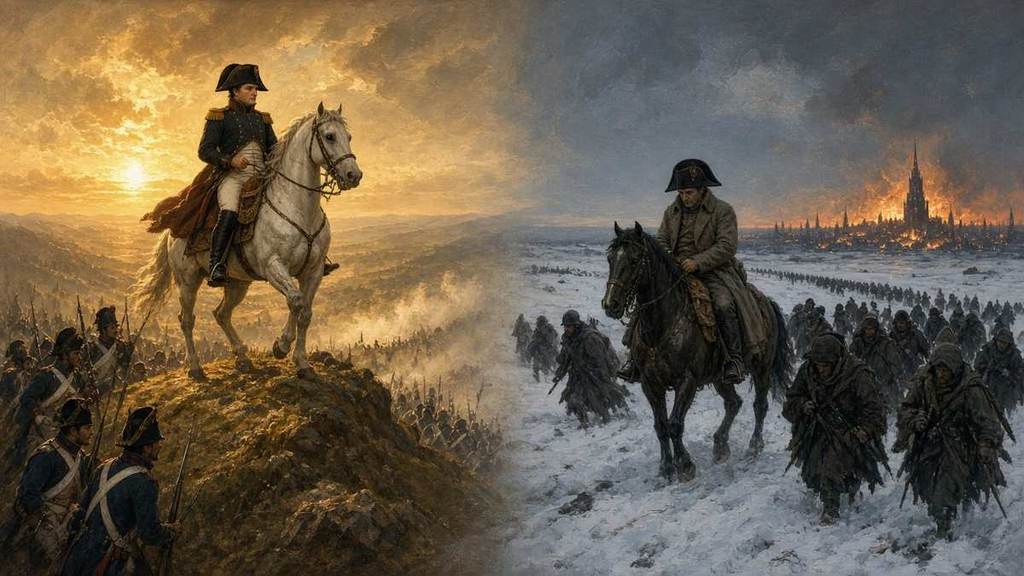
A Psychology of Power field guide: how the same habits that won Austerlitz in 1805 marched an army to ruin in Russia in 1812.
On the morning of 2 December 1805, fog lay in the low ground below the Pratzen Heights in Moravia. When it burned off, Russian and Austrian commanders discovered that the French army they thought was weak, retreating, and ripe for a flanking blow was instead driving straight into the center of their line. By nightfall the allied army was broken. Within weeks, Austria had made peace and Russia had marched home.
Seven years later, the same commander led the largest army Europe had ever assembled into Russia. By December 1812 it barely existed.
Popular history likes to split Napoleon into two men: the genius of Austerlitz and the gambler of Moscow. That split is too tidy. The habits that produced the masterpiece and the habits that produced the catastrophe were largely the same habits. What changed was the scale of the stage, the kind of enemy he faced, and how much he had come to believe his own record. That growing self-belief, Napoleon’s overconfidence, is the thread that runs from Austerlitz to Moscow.
This is a field guide for amateur enthusiasts who want the spine of the argument, not a museum of footnotes.
What Made Napoleon Dangerous in 1805
By 1805, Napoleon had been First Consul and then, from December 1804, Emperor of the French. He had inherited a revolutionary army full of energy and promotion by merit, and he had spent the quiet years of 1803–1805 drilling it in camps along the English Channel for an invasion of Britain that never came.
What he built there, the Grande Armée, had several advantages that rival armies struggled to match:
- The corps system. The army was divided into self-contained corps, each with its own infantry, cavalry, and artillery. Each could march on its own road and fight alone for a day until others arrived. Spread out, they moved fast and fed themselves; concentrated, they hit hard.
- Speed. French columns lived largely off the countryside instead of waiting on slow supply convoys. In the densely farmed lands of Central Europe, that worked.
- A single mind at the center. Napoleon was head of state and commander-in-chief at once. No council of war, no coalition partners, no political masters to consult. Decisions moved as fast as couriers could ride.
- A theory of victory. Find the enemy’s main army, destroy it in one decisive battle, then dictate peace while the enemy government is still in shock.
In late August 1805, when Austria and Russia joined Britain against France, Napoleon swung the army from the Channel coast toward the Danube. In October, his corps wheeled around the Austrian army of General Karl Mack at Ulm and trapped it. Mack surrendered around 25,000 men on 20 October. The next day, far away off Cape Trafalgar, the Royal Navy destroyed the combined French and Spanish fleets. Britain was now out of reach by sea, but on land Napoleon looked unstoppable.
Austerlitz: A Trap Built on the Enemy’s Hopes
After Ulm, Napoleon took Vienna and pushed north into Moravia. He was now far from home, outnumbered, and facing the combined Russian and Austrian armies under the eyes of Tsar Alexander I and Emperor Francis I. On paper, his position was dangerous. He chose to make it look even worse.
He made a show of seeking negotiations. He gave up the Pratzen Heights, the commanding high ground in the middle of the field. And he left his southern flank thinly held, as if inviting the allies to cut his line of retreat toward Vienna.
The allies took the bait. Roughly 85,000 to 90,000 allied troops faced around 70,000 to 75,000 French (figures vary by source), and the allied plan sent a heavy share of that force down off the Pratzen to crush the weak French right.
Two things made the trap work.
First, the weak right flank did not stay weak. Marshal Louis-Nicolas Davout’s III Corps had force-marched from the Vienna area, covering roughly 110 kilometers (about 70 miles) in around two days, and arrived in time to hold the southern villages against attacks far larger than itself.
Second, once the allied columns had committed to the south, the center was thin. Napoleon sent Marshal Soult’s IV Corps up the slopes of the Pratzen as the fog cleared, the moment later celebrated as the “sun of Austerlitz.” The French seized the heights, split the allied army in two, and then turned south to trap the forces that had been attacking Davout.
Allied losses ran to roughly 25,000 or more killed, wounded, and captured. French losses were around 9,000. Austria signed an armistice two days later and the Treaty of Pressburg on 26 December. Within a year, the thousand-year-old Holy Roman Empire was gone.
Austerlitz is still taught for the same reason Cannae is: the winning commander shaped what his enemy wanted to do, then punished them for doing it.
The Lessons Napoleon Took From Winning
Victories are data. The trouble is what a commander concludes from them.
After Austerlitz came Jena and Auerstedt against Prussia in October 1806, then Friedland against Russia in June 1807 and the Treaties of Tilsit, where Napoleon and Alexander I met on a raft on the Niemen River and divided Europe into spheres. The pattern held each time: move fast, force a big battle, win it, and the enemy sues for peace.
From a run like that, several beliefs follow naturally:
- The decisive battle decides the war. Enemies who lose their main army negotiate.
- Speed beats logistics. The army can outrun its supply problems by winning quickly.
- My judgment is the army’s greatest asset. Marshals execute; the emperor sees what others miss.
- Rulers think like me. A beaten monarch makes the rational deal to save his throne.
Each of these was more or less true in Central Europe between 1805 and 1807. Each would prove false in Russia. That is the core of the “genius or overconfidence” question. Napoleon did not abandon his method in 1812. He applied it faithfully to a problem it did not fit.
The Warning Signs Between Tilsit and 1812
The cracks showed before Russia.
Britain could not be beaten in battle. After Trafalgar, Napoleon tried economic war instead. The Continental System, launched by the Berlin Decree in November 1806, barred British goods from European ports. It only worked if every major port obeyed, which meant every rival ruler had to keep obeying. It turned trade into a loyalty test.
Spain would not stay beaten. In 1808 Napoleon pushed his brother Joseph onto the Spanish throne. The result was a long war of regular battles, guerrilla raids, and British intervention in Portugal and Spain. Hundreds of thousands of French and allied troops ended up tied down there for years. There was no single battle that could end it, because there was no single enemy army whose defeat would make the country give up.
Alexander I would not stay obedient. The Continental System hurt Russian trade. On 31 December 1810, Russia opened its ports to neutral shipping and put tariffs on French goods. Both sides began preparing for war. Napoleon’s answer to a political and economic problem was the one his record recommended: invade, find the Russian army, beat it, and bring the Tsar back to the table.
1812: The Same Method on the Wrong Map
On 24 June 1812, the Grande Armée began crossing the Niemen River into the Russian Empire. The first wave numbered roughly 450,000, and with later reinforcements more than 600,000 men served in the campaign. Many of them were not French at all: Poles, Germans from a dozen states, Italians, Swiss, Dutch, and Austrian and Prussian corps on the flanks.
Napoleon expected a short war. He had prepared supply depots on a scale he had never attempted before, which is worth remembering: he was not simply careless about logistics. But the plan still assumed what Austerlitz had taught him to assume, that the Russians would stand and fight near the frontier and that one big victory would end it in weeks.
The Russians did not cooperate. Their armies, first under Michael Barclay de Tolly and later under Mikhail Kutuzov, fell back. The Grande Armée marched deeper into a vast, thinly farmed land that could not feed it. Living off the country, the trick that had worked in Bavaria and Moravia, failed on bad roads and in empty fields. Summer heat, bad water, dysentery, and typhus killed and disabled huge numbers of men, and tens of thousands of horses died in the first weeks. The army was bleeding badly before it fought a major battle.
Three decisions that turned a hard campaign into a disaster
- Pushing past Vitebsk and Smolensk. In late July Napoleon paused at Vitebsk and reportedly considered halting for the year. In mid-August he took a burning Smolensk. Both were natural stopping points where he could have wintered, resupplied, and organized Poland and Lithuania as a base. Each time, the hope of the decisive battle pulled him on.
- Fighting Borodino the way he did. On 7 September 1812, he finally got his big battle at Borodino, about 110 kilometers west of Moscow. It was one of the bloodiest single days of the Napoleonic Wars, with combined casualties commonly estimated at more than 70,000. The French held the field, but Napoleon refused to commit his Imperial Guard to finish the Russian army, and Kutuzov withdrew in order. Napoleon had won the kind of battle that used to end wars. This one did not.
- Waiting in Moscow. The French entered Moscow on 14 September. Within hours fires broke out across the city, very likely set on the orders of the Russian governor, Fyodor Rostopchin, and much of Moscow burned. Napoleon then waited about five weeks for a peace offer from Alexander. It never came. The Tsar understood something Napoleon’s record had trained him to miss: as long as Russia refused to negotiate, taking Moscow won nothing.
Napoleon left Moscow on 19 October. After a fierce fight at Maloyaroslavets on 24 October blocked a southern route through untouched country, the army retreated along the same stripped road it had come in on. Hunger, Cossack raids, and the first hard frosts of November finished what summer had started. At the Berezina River in late November, French engineers working in freezing water built the bridges that saved part of the army, at terrible cost.
On 5 December, Napoleon left the army and raced back to Paris. In Warsaw on the way, according to the Abbé de Pradt, he remarked that there is only one step from the sublime to the ridiculous.
Only a small fraction of the men who crossed the Niemen came back in fighting shape. Charles Joseph Minard’s famous 1869 chart of the campaign shows the main force shrinking from about 422,000 at the crossing, to about 100,000 at Moscow, to about 10,000 on the return. Exact totals vary by source and by what is counted, but the scale is not in dispute.
Myth vs. Record: Did Winter Beat Napoleon?
The popular version says “General Winter” destroyed the Grande Armée. It is a satisfying story, for the same reason the “Protestant wind” story is satisfying about the Spanish Armada: it puts the blame on the weather instead of on decisions.
The record is less flattering. The army lost a huge share of its strength in the summer and early autumn to disease, hunger, exhaustion, desertion, and battle, long before the deep cold. Winter was brutal and it killed many thousands, but it struck an army that strategy and logistics had already ruined. The cold finished the defeat. It did not cause it.
Was It Genius or Napoleon’s Overconfidence?
Both, and that is the point.
Look at the traits that won Austerlitz:
- Boldness: he accepted a dangerous position and made it the bait.
- Speed: Davout’s march turned a weak flank into a strong one.
- Total control: one man saw the whole field and made every key call.
- Faith in the decisive battle: one day ended a coalition.
Now look at Russia:
- Boldness became pressing on past Vitebsk and Smolensk when stopping was the sound move.
- Speed became an army outrunning its food on roads that could not carry it.
- Total control meant no one close to him could make him stop, and his personal command could not reach across a front hundreds of kilometers wide.
- Faith in the decisive battle met an enemy who refused to let any battle, or even the loss of Moscow, decide the war.
The difference between 1805 and 1812 was not that Napoleon got stupid. In 1805 his methods matched the problem: a compact theater, rich farmland, enemies who fought the kind of war he expected, and rulers who negotiated when beaten. In 1812 every one of those conditions was missing, and seven years of victories had made it harder for him, and for anyone around him, to say so.
That is the psychology of power at work. Success does not just reward a leader’s methods. It hardens them into certainty. The more often a strategy works, the less the leader looks at whether this situation is the kind where it works.
What Came After
Russia’s disaster broke the spell. Prussia changed sides in 1813, Austria followed, and at Leipzig in October 1813 the allies beat Napoleon in the largest battle Europe had seen. He abdicated in April 1814 and went into exile on Elba. Even then, he believed one more bold stroke could undo it all, a story we cover in Napoleon’s Hundred Days.
If you want to compare him with another commander who knew when to push and when to consolidate, read our guide to Alexander the Great’s three strategic decisions.
Quick Answers
What was Napoleon’s greatest victory?
Most historians point to Austerlitz, 2 December 1805, where he lured a larger Russian and Austrian army into attacking his deliberately weakened flank, then split their center from the Pratzen Heights.
Why did Napoleon invade Russia in 1812?
Mainly because Tsar Alexander I broke with the Continental System, Napoleon’s trade blockade of Britain. Napoleon expected a short campaign and a decisive battle that would force Alexander back into line.
Was Napoleon defeated by the Russian winter?
Not mainly. Disease, hunger, and battle had already destroyed most of the army before the worst cold arrived. Winter finished a defeat that earlier decisions had set up.
Was Napoleon’s real flaw overconfidence?
His real flaw was applying a method that had worked brilliantly in Central Europe to a war where its core assumptions no longer held, and having no one around him able to stop him.