Charles XII of Sweden was eighteen when he smashed a much larger Russian army in a snowstorm at Narva. He had already forced Denmark out of the war. In the years that followed he drove his Saxon-Polish rival off the throne, then set out for Moscow itself. He never got there. At Poltava in 1709 the invasion broke, and with it Sweden’s status as a great power.
The thing to explore is not only the defeat. It is the habit that made both the early victories and the collapse: Charles would not retreat, would not make peace, and would not accept that a campaign was over while he was still alive.
His story sits on the other side of the same war we have already followed through Peter the Great’s brutal modernization. This is Charles’s side: the ambition, and the refusal to lose.
Eighteen Years Old at Narva
Prince Charles was born in Stockholm on June 17, 1682, the only surviving son of Charles XI and Ulrika Eleonora of Denmark. When his father died in April 1697, the boy was barely fifteen. Charles XI had wanted a regency, but the Riksdag declared the new king of age that November. He was, as Britannica puts it, the first and only Swedish king born into absolutism.
Three neighbors decided the moment was theirs. In 1700 Denmark, Saxony-Poland under Augustus II, and Russia under Peter I attacked Swedish territory and began the Great Northern War. They expected a short campaign against a teenage king. They did not get one.
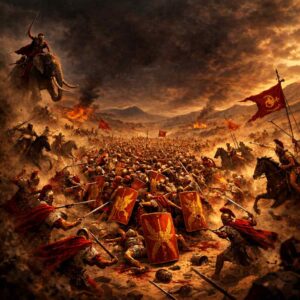
Charles struck the nearest enemy first. In August 1700 he landed on Zealand and forced Denmark out of the war in a matter of weeks. Then he moved east. On November 30, 1700, he attacked the Russian army that was besieging Narva, in Swedish Estonia. Britannica says the Swedes came in during a snowstorm that blew into the Russians’ faces, and that the Russian force was more than four times the size of Charles’s army. Peter had already left the camp. By nightfall the siege was broken, a large part of the Russian army was in flight or had surrendered, and Sweden’s Baltic provinces were, for the moment, safe.
The numbers are less tidy than the legend. Britannica’s Narva article gives the Swedish army at 8,000 to 11,000 men, with about 2,000 lost, and the Russian army at 24,000 to 35,000, with 8,000 to 10,000 lost. Other counts sit at different points in those ranges. What is not in dispute is the result: a smaller, better-led Swedish army wrecked a much larger Russian one, and Charles was not yet nineteen.
He did not march on Moscow then. He turned instead to Poland, and he stayed on that front for years.
Charles XII of Sweden and the Invasion of Russia
The Polish war was a victory that cost him time. Charles spent 1702 to 1706 fighting Augustus II, elector of Saxony and king of Poland, and had him replaced with a king of his own choosing, Stanisław Leszczyński. In 1706 the Swedish army entered Saxony and forced the issue. Augustus was out of the war. Sweden looked unbeatable.
Peter used the interval. While Charles was in Poland, Russian forces trained, took Swedish posts in the eastern Baltic, and began the city that would become St. Petersburg. Britannica is blunt about the trade: Charles’s first necessity by 1706 was to deal with Russia, which had made good use of those years.
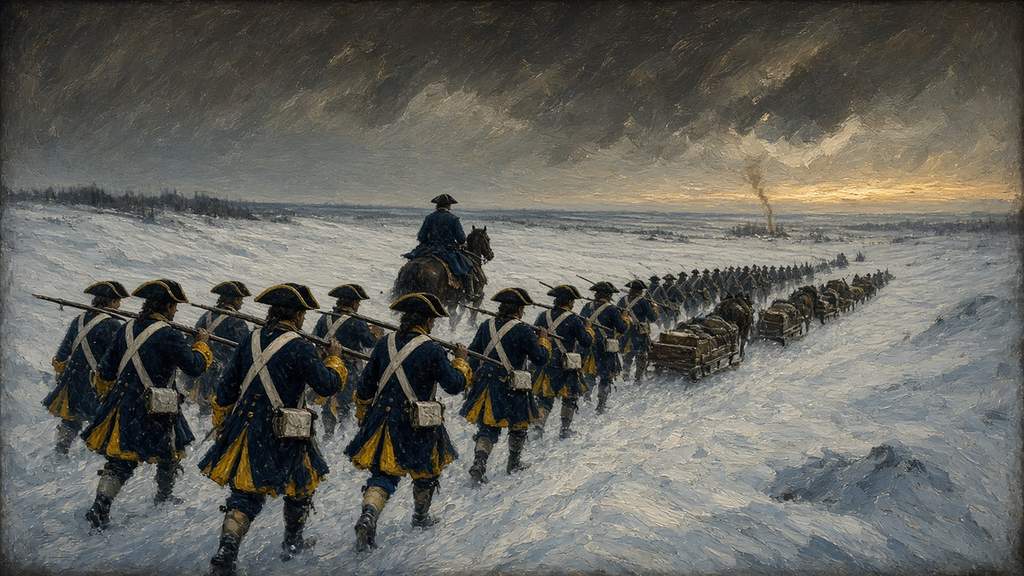
In the late autumn of 1707, Charles’s troops left Saxony and set out to invade Russia, aiming for Moscow. In July 1708 they won at Hołowczyn. Then the campaign slipped out of his hands. Russian scorched-earth tactics stripped the country ahead of the army. A major Swedish supply column was lost. The winter of 1708 to 1709 was brutal. Charles abandoned the road to Moscow and turned south into Ukraine.
He never reached the city he had come for. By the summer of 1709, Britannica says, he faced a hard choice: accept battle with the Russians, or fall back once more into Poland. He chose battle.
The Battle of Poltava, 1709
Who won the Battle of Poltava? Peter I of Russia, on July 8, 1709 (June 27 in the Old Style calendar then used in Russia; June 28 in the Swedish style). The fight was fought north and west of Poltava, west of the Vorskla River, in what is now Ukraine. It ended Sweden’s run as a major power in the east.
The Swedish invasion had already failed the winter before. Charles was short of men, artillery, and powder, but he would not break off. He besieged Poltava in May 1709. The Russians closed in, dug in near the Swedish lines, and forced him to attack their fortified camp.
Charles had been wounded in the foot and could not lead the army in person. His plan, as Britannica describes it, was to push past a line of Russian redoubts and strike the main position without stopping to take the forts. The attack faltered. The Russian counterattack wrecked what was left of the Swedish field army.
Here the numbers part company again. Britannica’s Poltava article gives about 80,000 Russian troops and 17,000 Swedes, and says the Russian counterattack involved some 40,000 men. Other historians count only the soldiers who actually joined the assault, or the whole camp including men still on the siege lines, and they arrive at different totals. The outcome is not in doubt. Three days later, on the Dnieper at Perevolochna, the bulk of the Swedish army surrendered. Charles was already gone. He escaped south into Ottoman territory with about 1,500 followers.
Bender, the Kalabalik, and the Road Home
A king who had refused to retreat now had to ask for shelter. Charles spent years at Bender, then under Ottoman rule (today Bender, or Bendery, in Moldova), trying to bring the Ottoman Empire into the war against Russia. He governed Sweden from exile as best he could, and he would not accept a peace that locked in the losses.
The Ottomans tired of their guest. In 1713, after he refused to leave, Ottoman troops moved to force him out of his camp at Bender. The chaotic fight is remembered as the kalabalik. Later accounts say Charles defended the house for hours with a small group of men until it was set on fire and he was overpowered. He was held elsewhere in Ottoman territory after that.
In 1714 he made his way back to Swedish-held Stralsund, on the Baltic. He held the town into 1715, then escaped across the sea to Sweden itself. He had been gone since 1700. The Baltic provinces, Finland, and Sweden’s German lands were already under heavy pressure or in enemy hands. Charles still would not make peace. He raised new forces and looked for a way to break the coalition from the west, by attacking Norway, then part of the Danish monarchy.
Shot Dead at Fredriksten
In 1718 Charles was back in the field, laying siege to the fortress of Fredriksten, which overlooked Fredrikshald (now Halden) in Norway. On November 30, 1718, while he was in the trenches, he was shot in the head and killed. He was thirty-six.
Who fired the shot has never been settled. Britannica’s history of Sweden says the bullet was of either Norwegian or Swedish origin. The fortress was being defended, so an enemy shot is possible. A shot from his own side has been argued for just as long, and never proved. The sources allow us to say that he was killed in the trenches at Fredriksten. They do not allow us to name the shooter.
With him died Sweden’s so-called Age of Greatness. His sister Ulrika Eleonora succeeded him, and the Diet soon clipped the crown’s power. The Great Northern War dragged on until the Peace of Nystad in 1721, when Sweden formally gave up the Baltic provinces, part of Karelia, and Vyborg to Russia.
The King Who Would Not Lose
Charles’s gift was real. At Narva, and in the early years of the war, a smaller Swedish army under a king who would not flinch beat enemies who had expected an easy win. That same refusal, once the road to Moscow was gone and the army was worn down, took him into a battle he could not win at Poltava, into years of exile, and at last into a Norwegian trench.
The contrast with Napoleon is close, and not exact. Both were brilliant field commanders who pushed an army toward Moscow and would not accept a smaller war. Napoleon reached the city and still could not hold what he had taken. Charles never arrived. In both cases, the refusal to stop did as much as the enemy to wreck the army.
The time Charles spent finishing the war in Poland is part of the same story. It gave Peter the years he needed to rebuild, and to drag Russia into the contest that Charles had started by winning. The tsar who beat him at Poltava would later destroy his own son, Alexei, to protect the empire that victory had made possible.
Charles XII is easy to admire at a distance and hard to defend at the end. He would not lose, until he had almost nothing left to lose with.
Support History Republic
Charles XII of Sweden: Frequently Asked Questions
Who was Charles XII of Sweden?
Charles XII (1682–1718) was king of Sweden from 1697 until his death. He came to the throne at fifteen and spent almost his entire adult life fighting the Great Northern War against Denmark, Saxony-Poland, and Russia. He won famously at Narva in 1700, lost decisively at Poltava in 1709, and was killed at the siege of Fredriksten in Norway in 1718.
Who won the Battle of Poltava?
Peter I of Russia, known as Peter the Great, won the Battle of Poltava on July 8, 1709 (June 27 Old Style). The Swedish attack on the Russian fortified camp failed, and three days later most of the remaining Swedish army surrendered at Perevolochna. Charles XII escaped into Ottoman territory with about 1,500 followers.
Why did Charles XII invade Russia?
After forcing Denmark out of the war and defeating Augustus II of Saxony-Poland, Charles turned on his remaining great enemy, Peter I. In the late autumn of 1707 his army left Saxony and set out for Moscow. Russian scorched-earth tactics and the winter of 1708–09 forced him off that road and south into Ukraine. He never reached Moscow, and in 1709 he chose to fight at Poltava rather than withdraw.
How did Charles XII die?
He was shot in the head and killed on November 30, 1718, while inspecting the trenches during the siege of Fredriksten, at Fredrikshald in Norway. He was thirty-six. Whether the shot came from the Norwegian defenders or from someone on the Swedish side has never been settled.
Did Charles XII reach Moscow?
No. He set out to invade Russia in 1707 with Moscow as the aim, but scorched earth, lost supplies, and the winter of 1708–09 forced him to abandon that route and turn into Ukraine. The campaign ended at Poltava, hundreds of miles short of the city.
Related on History Republic
- Peter the Great’s Brutal Modernization: How Russia Was Dragged Into the 18th Century
- Peter the Great and Alexei: When Empire Demands the Destruction of Family
- Napoleon Bonaparte: Genius Strategy or Fatal Overconfidence?
Keep exploring in the History Republic app.
An interactive map of where history happened, short biographies of history’s heroes, and quizzes. Free to download.
Sources & further reading
As an Amazon Associate I earn from qualifying purchases.
Books
- Ragnhild Marie Hatton, Charles XII of Sweden (Weidenfeld & Nicolson, 1968)
- Peter Englund, The Battle That Shook Europe: Poltava and the Birth of the Russian Empire (I.B. Tauris, 2003)
- Robert I. Frost, The Northern Wars: War, State and Society in Northeastern Europe, 1558–1721 (Longman / Routledge, 2000)
Reference
Older histories
- Voltaire, History of Charles XII, King of Sweden (1731; trans. Winifred Todhunter) (via Project Gutenberg). An early literary history, written more than a decade after Charles’s death, not a witness account.
- R. Nisbet Bain, Charles XII and the Collapse of the Swedish Empire, 1682–1719 (1895) (via Internet Archive)
Where this story comes from: the historians who have studied Charles XII and the Great Northern War, and the reference articles that set out the dates, places, and points of disagreement. Book links are Amazon product pages.