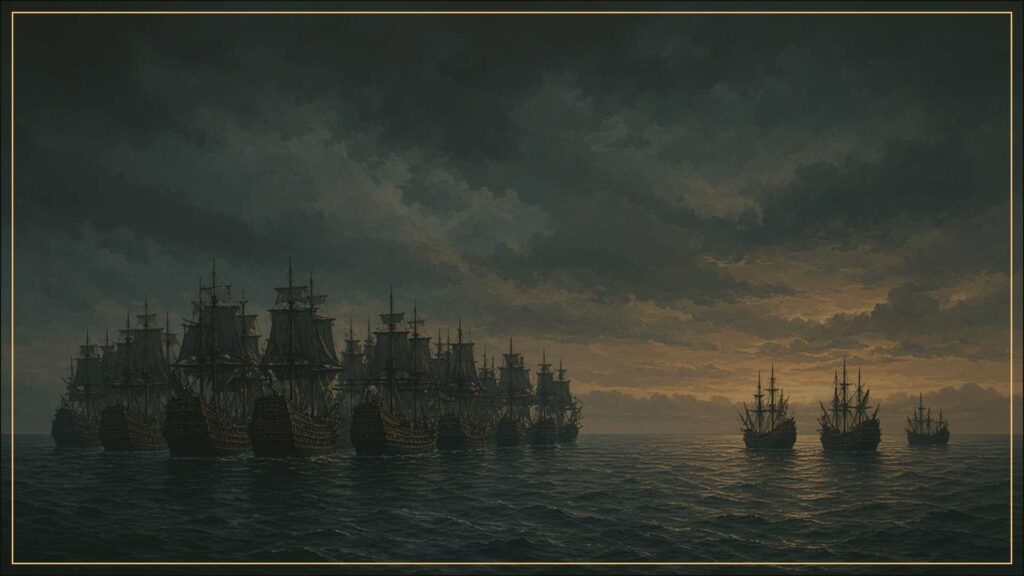
A Turning Points field guide to 1588: strategy, logistics, and the rendezvous that never happened—before the storms finished the job.
In Protestant memory, the Spanish Armada of 1588 ends with a tidy miracle. God sent a wind. The Catholic fleet scattered. England was delivered. Medals were struck. Sermons were preached. The story traveled well because it was short, pious, and flattering.
It was also incomplete.
Weather did wreck ships on the long way home—especially ships already damaged, short of food and water, and forced into the wrong ocean at the wrong time of year. But the invasion plan had already failed before those Atlantic and Irish storms did their worst. The Armada was undone by a dual strategy with a fragile hinge, by English fighting methods that Spanish boarding doctrine struggled to answer, by command and supply constraints, and by a rendezvous with the Duke of Parma’s army in Flanders that never quite became possible. The wind mattered. It was not the whole verdict.
This is a field guide for amateur enthusiasts who want the campaign’s spine, not a museum of footnotes.
What Philip II Was Trying to Do
By the late 1580s, Philip II of Spain ruled a global monarchy: Iberia, much of Italy, the Americas, the Philippines, and—by inheritance and claim—the Low Countries. England looked, from Madrid, like a nuisance that had become a strategic threat.
Elizabeth I’s government sheltered English privateers who preyed on Spanish shipping. English help stiffened Dutch rebels fighting Philip’s rule in the Netherlands. After Mary, Queen of Scots, was executed in 1587, Catholic hopes of a smooth dynastic replacement in England narrowed. Philip’s goals layered together: invade England, remove or break Elizabeth’s regime, restore Catholic worship, and cut English interference in the Dutch war. Piety and power politics were not separate files in his cabinet.
The Enterprise of England was not a vague crusade. It was a joint operation with a timetable and a critical dependency.
The Dual Plan—and Why the Rendezvous Was the Fragile Hinge
Philip’s plan had two halves that only worked if they met.
First, a great fleet—the Armada—would sail from Spain, fight its way up the English Channel if needed, and take station off the Flanders coast. Second, Alexander Farnese, Duke of Parma, commanding the Army of Flanders, would embark troops on barges and small craft and cross under the Armada’s protection. The deep-water navy and the shallow-water army would lock together long enough to put a veteran invasion force ashore in southeastern England.
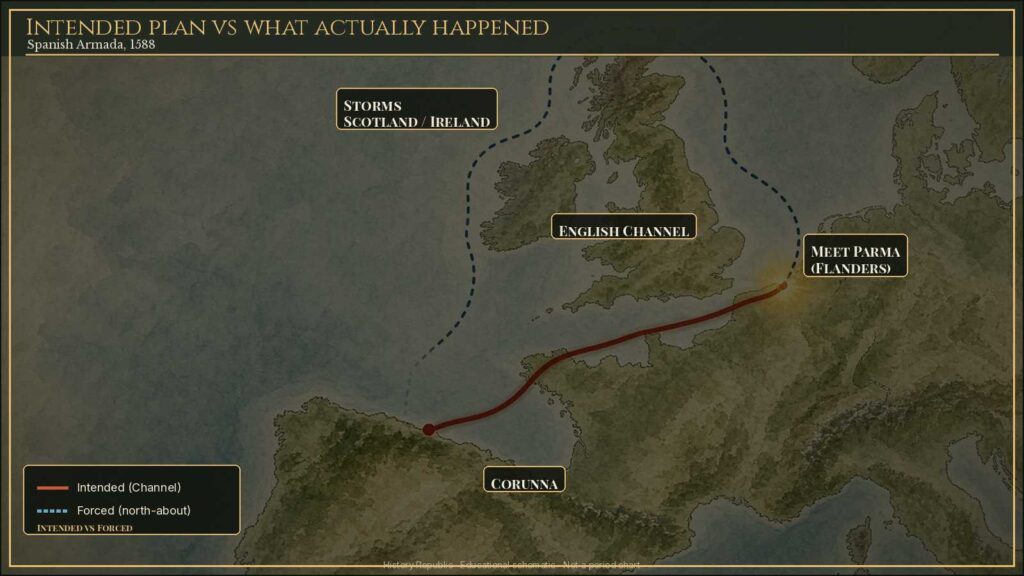
Educational schematic: intended Spanish route to the Flanders rendezvous, English Channel theater, and the forced north-about return after Gravelines. Not a navigational chart.
That rendezvous was the hinge. Everything else—ship lists, powder inventories, noble captains—hung from it.
The hinge had structural problems. Parma’s embarkation points were shallow and vulnerable. Dutch “flyboats” and rebel control of coastal waters made a clean departure hard even when the Spanish army was ready. The Armada’s big ships needed deeper water than Parma’s barges could offer. There was no secure deep-water Spanish-held port where a grand fleet could sit indefinitely while an army loaded. Communication across the Channel was slow and brittle. Philip’s instructions assumed coordination that geography and the Dutch made difficult.
Most modern historians treat this mismatch—not a single English broadside—as the plan’s deepest vulnerability. The Armada could win skirmishes in the Channel and still fail if it could not deliver Parma.
Medina Sidonia: Appointment, Orders, and Constraints
The Armada’s first designated commander, the experienced Álvaro de Bazán, Marquis of Santa Cruz, died in February 1588. Philip appointed Alonso Pérez de Guzmán, Duke of Medina Sidonia, a great noble with administrative talent and limited deep-water combat command experience. Medina Sidonia himself protested the appointment. Philip insisted.
That detail matters for how we judge what followed. Medina Sidonia was not a comic-opera coward invented by English pamphlets. He was a loyal executor under tight royal instructions, leading a multinational fleet with uneven ships, mixed crews, and a mission that required precise cooperation with an army he did not control. He kept the fleet together through most of the Channel running fight—no small feat. What he could not invent was a deep-water harbor for Parma or English cooperation with Spanish boarding tactics.
After storms delayed the first departure from Lisbon, the Armada regrouped at Corunna and sailed again in late July 1588 (by the calendar then used in England). Roughly 130 vessels of all types put to sea, carrying on the order of 20,000–30,000 men when soldiers and mariners are counted together. Exact totals vary by list and by what historians include; treat round numbers as ranges, not ledger entries.
What the English Brought to the Fight
England did not win because of a Hollywood genius alone—though Francis Drake’s name still eats oxygen in popular tellings. The English advantage was systemic.
Elizabeth’s navy had invested in “race-built” galleons: lower castles, longer lines, better sailing qualities. English doctrine leaned toward longer-range gunnery—culverins and similar pieces—fighting at a distance, then standing off to reload. Spanish doctrine still prized closing, grappling, and boarding, methods that had worked in Mediterranean and Atlantic fights against less nimble opponents. In a Channel chase, English ships could often keep the weather gauge and refuse the kind of mêlée Spanish captains wanted.
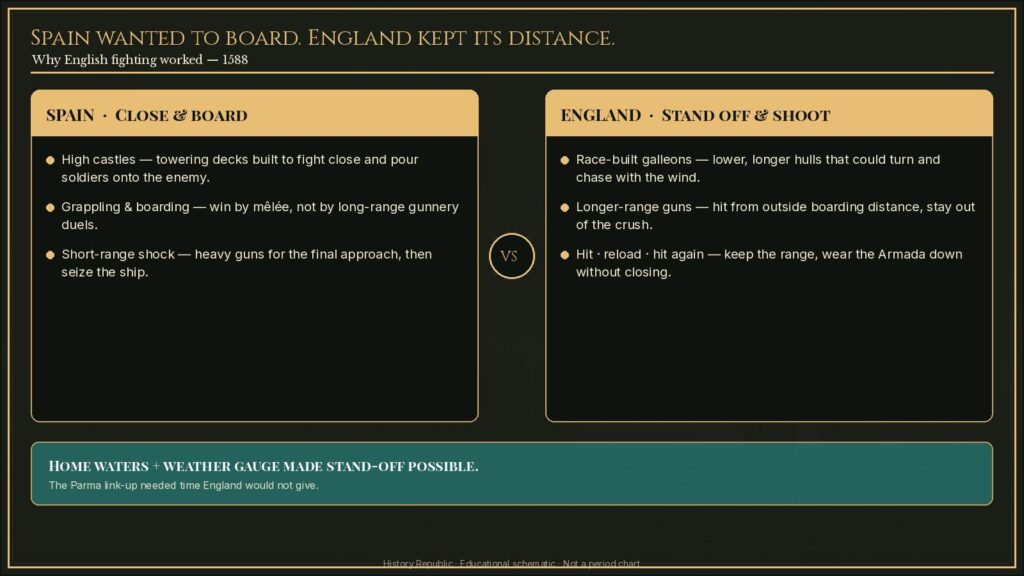
Schematic comparison: composition, doctrine, operational qualities, and why the Parma rendezvous was hard. Ratings are illustrative teaching aids, not measured data.
Home waters mattered. English captains knew the tides, the anchorages, and the resupply network. Powder and shot could be replenished more readily than Medina Sidonia’s crews could hope for. English numbers are as contested as Spanish ones—royal ships plus armed merchantmen making a flexible total that swelled and shrank—but the qualitative edge in sailing and stand-off fire is not seriously disputed among mainstream historians.
None of that made English victory automatic. It meant that if the Spanish could not force a close action or complete the Flanders link-up quickly, time worked against the invaders.
The Channel Sequence: From Running Fight to Gravelines
Late July into early August 1588, the Armada entered the Channel and fought a running series of actions rather than a single Trafalgar-style set piece. English ships harried the Spanish formation from Plymouth eastward. Spanish discipline held better than legend claims; the crescent or defensive cluster did not simply dissolve on contact. But English guns bit, Spanish ships took damage, and Medina Sidonia still needed to reach the Flanders coast with a fleet fit to cover Parma.
Off Calais, the Armada anchored—waiting for the rendezvous that was supposed to unlock the invasion. Parma was not ready to embark on Spanish terms. The Dutch threat and the shallow-port problem had not vanished because a grand fleet had appeared on the horizon. The Armada sat in a roadstead that was a waiting room, not a secure base.
On the night of 7–8 August, the English sent fire ships—perhaps eight vessels packed with combustibles—downwind toward the Spanish anchorage. Fire ships were a known terror weapon. The point was less to burn half the Armada than to force it to break formation. Spanish ships cut cables to escape. Anchors and order were lost. The tidy waiting room became a scramble.
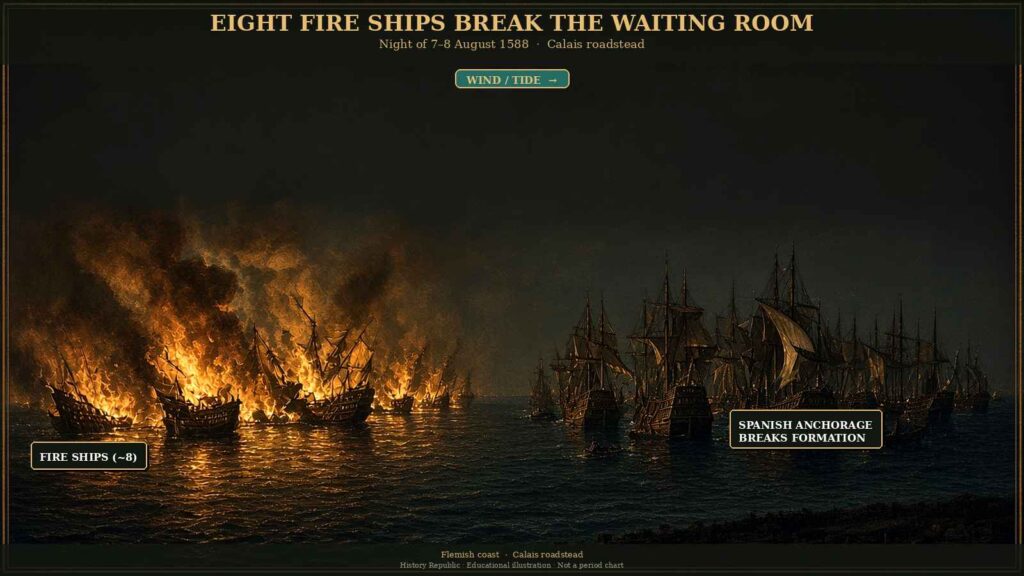
Tactical schematic: fire ships at the Calais anchorage. Positions are illustrative; this is not a period chart.
The next day, off Gravelines, the English pressed the disordered fleet hard. This was the campaign’s sharpest naval clash. Spanish ships suffered serious damage. English stand-off tactics worked better than Spanish attempts to close. Ammunition shortages—especially on the Spanish side after days of fighting—shaped what either fleet could still do. The Armada was driven toward the shoals of the Flanders banks and then, with the wind, into the North Sea.
At that point the strategic story was already written. There would be no embarkation of Parma under Armada cover. The invasion hinge had broken. What remained was survival: get the fleet home.
Logistics: Water, Food, Powder, and Shallow Ports
Popular histories love cannon smoke. Campaigns die of barrels and cables.
Spanish provisions spoiled; water went bad; disease rode with crowded ships. Powder and shot consumption in a multi-day Channel fight exceeded what optimistic planners had assumed for a short, decisive boarding war. Once the fleet was forced north, resupply from Spain or Flanders was fantasy. Dutch control of the shallow approaches meant Parma’s barges could not simply “sail out” into the Armada’s protection as if the Flanders coast were a Spanish lake.
Logistics did not replace strategy as the cause of failure; it enforced strategy’s verdict. A plan that required perfect timing between a deep-draft navy and a shallow-draft army, in hostile coastal waters, left no margin for spoiled casks, spent magazines, or a night of cut cables.
Myth vs. Record: “Just the Weather”
English and Dutch Protestant culture celebrated deliverance—“God blew and they were scattered” is the compressed slogan later ages remember. Storms on the north-about route around Scotland and Ireland did destroy many ships already weakened by battle damage, exhaustion, and empty stores. Wrecks along the Irish coast still mark that catastrophe. Weather was a real killer.
But weather was late to the argument. By the time Atlantic gales finished Spanish hulls, the dual plan had already failed at its hinge. The Armada had not landed Parma’s army. English gunnery and sailing had prevented the close battle Spain preferred. Command constraints and geography had blocked a leisurely wait off Flanders. Storms punished a fleet that was already strategically defeated and physically compromised.
Serious accounts—Colin Martin and Geoffrey Parker’s work is the current gold standard for many readers—stress multi-cause failure: strategy, logistics, tactics, and environment stacked together. Reducing 1588 to meteorology alone is propaganda with a barometer.
Why It Mattered (and What It Did Not Instantly Do)
England remained Protestant and independent. Elizabeth’s regime survived its greatest invasion scare. Spanish prestige took a public hit across Europe; the aura of invincibility cracked. English and Dutch confidence rose. The Channel looked less like a Spanish highway.
What did not happen is equally important. Spain did not collapse in 1588. Philip’s monarchy remained the richest and most formidable power in Western Europe for years afterward. There would be later Armadas and later scares. The Dutch war ground on. Treating Gravelines as the overnight end of Spanish greatness is another tidy myth.
Still, as a turning point, 1588 counts. A successful landing under Parma might have rewritten English religion, Dutch fortunes, and the Atlantic balance. The failure preserved a Protestant England that would matter enormously in the next two centuries—not because destiny required it, but because a complex plan met a stubborn set of constraints and broke.
Field Notes: How to Read 1588 Without the Sermon
If you keep only a handful of points, keep these:
- Philip’s aim was invasion plus regime change, not a symbolic cruise past Dover.
- The Parma rendezvous was the plan’s load-bearing joint—and the weakest.
- English race-built ships and stand-off gunnery punched above pamphlet heroics.
- Fire ships at Calais and fighting at Gravelines broke order and hope of link-up.
- Storms finished damaged ships on the way home; they did not invent the strategic defeat.
Weather belongs in the story. It does not get to own the title.
Related on History Republic
- Edward the Black Prince — Channel power, Sluys, and why control of the narrow seas shaped English strategy long before 1588. (URL verified.)
- Napoleon’s Hundred Days: What His Return from Exile Reveals About Power and Delusion — Another Turning Points study of an overdetermined failure where legend outruns logistics. (URL verified.)
- The Battle of Cannae: Why Rome’s Greatest Defeat Is Still Studied Today — Tactical brilliance versus strategic systems; useful contrast when reading “miracle” battles. (URL verified.)
Go deeper in the History Republic app
Maps, timelines, and more stories from the same eras—built for readers who want the record, not the myth.
Further Reading
- Felipe Fernández-Armesto, The Spanish Armada
- Colin Martin, The Spanish Armada
- Neil Hanson, The Confident Hope of a Miracle
Product links are recommendations. Affiliate tagging is not active yet—no commission is earned on these clicks.