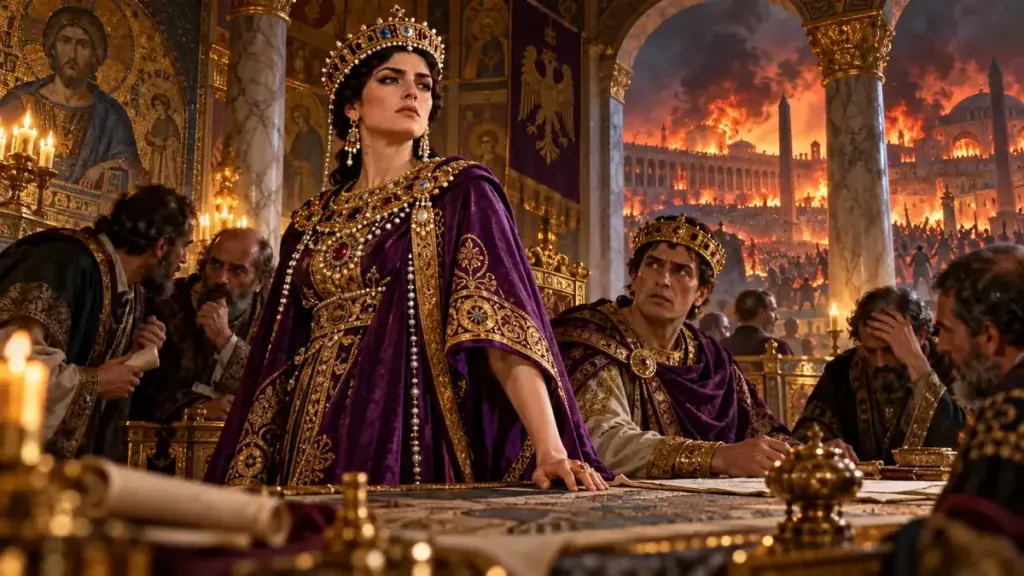
The ships were ready. Constantinople was burning, the mob had a new emperor, and the men around Justinian were weighing whether to run. Then Empress Theodora spoke. According to the historian Procopius, she told the room that flight might bring safety, but that “for one who has been an emperor it is unendurable to be a fugitive.” She would stay. “Royalty,” she said, quoting an old saying, “is a good burial-shroud.”
That was January 532, during the Nika riots. Within days Justinian’s throne was safe, and tens of thousands of his subjects were dead.
Empress Theodora’s rise, from the floor of the Hippodrome to the council of an empire, is one of the strangest in history. It is also told mostly by one man, who praised her in public and attacked her in private. Here is what happened, and how much of it we can trust.
Who Was Empress Theodora?
Theodora was born around 495 to 497, probably in Constantinople. About half a century before her birth, the same city had been paying tribute to Attila and his Huns. Her father, Acacius, kept the bears for the Green faction at the Hippodrome, the city’s great chariot-racing stadium. He died when she was a small child.
What happened next comes from Procopius’ Secret History, so treat it with care. He says her mother remarried, but the Greens gave the bear-keeper’s job to someone else. So their mother sent the three little girls into the arena wearing garlands, to sit on the ground as suppliants before the crowd. The Greens ignored them. The rival Blues took pity and gave the family a post.
From actress to empress (a disputed early life)
Procopius goes on to say that Theodora went on the stage as a girl, and that she lived as a performer and a prostitute. That account is disputed. Most historians accept her stage career, a profession at the bottom of the social ladder and widely linked with sex work. But the lurid scandals come from a writer who hated her. David Potter, one of her modern biographers, calls Procopius’ description of her sex life an exaggerated diatribe.
Later she followed an official named Hecebolus to North Africa. When he dropped her, she made her way back through Alexandria and Antioch to Constantinople, where she met Justinian, nephew and heir of the emperor Justin.
Roman law barred men of senatorial rank from marrying actresses. Justin changed the law, and Justinian married Theodora in the early 520s, usually dated to 525. When Justinian became emperor in 527, Theodora was crowned augusta beside him.
Theodora and Justinian: A Partnership of Power
She was no ceremonial consort. She received foreign envoys, wrote to foreign rulers and built her own network at court. Encyclopaedia Britannica calls her probably the most powerful woman in Byzantine history. In a law of 535, Justinian said he had consulted his wife on it.
They did not always agree: Justinian backed the imperial church’s Chalcedonian creed, while Theodora sheltered the leaders of the Miaphysites, who rejected it.
But nothing showed her power like one week in January 532.
The Nika Riots: A City on Fire
The Blues and the Greens were the supporters’ clubs of the chariot teams, but they were far more than fans. They chanted political demands at the races and fought each other in the streets. Procopius called their rivalry “a disease of the soul.”
Two men who survived the gallows
In January 532, city officials hanged members of both factions for murder after an earlier riot. The scaffold failed, and two men, a Blue and a Green, survived. Monks carried them to sanctuary in a church. When Justinian refused to pardon them, the two factions did something they almost never did. They joined forces.
At the races, the chants of “Blue!” and “Green!” became a single cry: Nika! It means “Win!” or “Conquer!”, the shout fans used for their charioteers. Now it was aimed at the emperor.
Fire, demands and a rival emperor
The rioters broke open the prison and released the prisoners. Then they set fire to the city. Procopius lists what burned: the great church of Hagia Sophia, the Baths of Zeuxippus, part of the imperial palace and the colonnades leading to the Forum of Constantine. This was the second Hagia Sophia, built under Theodosius II in 415.
Justinian gave in to the crowd’s demand to dismiss his hated officials, the prefect John the Cappadocian and the legal minister Tribonian. It did not help.
On the fifth day, Justinian sent Hypatius and Pompeius, nephews of the former emperor Anastasius, home from the palace. The next morning the crowd found Hypatius and proclaimed him emperor. Procopius writes that his wife, Mary, clung to him and begged the crowd to let him go. They took him anyway, and seated him on the imperial throne in the Hippodrome.
Inside the palace, Justinian and his council argued about escaping by sea.
"Royalty Is a Fine Burial Shroud": Theodora's Speech
This is the moment the story turns on, and it comes from one source: Procopius, History of the Wars, Book I, chapter 24.
In his account, Theodora brushes aside the idea that a woman should keep quiet among men in a crisis. Everyone who is born must die, she says, but for a ruler, life as a fugitive is unbearable. “May I never be separated from this purple,” she says, “and may I not live that day on which those who meet me shall not address me as mistress.”
Then comes the knife. “If, now, it is your wish to save yourself, O Emperor, there is no difficulty. For we have much money, and there is the sea, here the boats.” But would he not, once safe, wish he had chosen death instead? “For as for myself, I approve a certain ancient saying that royalty is a good burial-shroud.”
That is H. B. Dewing’s 1914 translation. Today the line is usually quoted as “royalty is a fine burial shroud” or “purple makes a fine winding sheet.” Procopius says the room took heart and began planning a defense.
Did Theodora really say it?
This is disputed, and the doubts are serious.
- One source. Only Procopius records the speech. He was secretary to Belisarius, who led the counterattack, so he may have heard about the meeting firsthand. But he was not writing a transcript.
- Ancient historians wrote speeches. Greek and Roman historians routinely composed speeches for their characters. Many historians read this one as Procopius’ version of the debate, not her exact words.
- A borrowed line with a sting. The “ancient saying” was known in a darker form: “tyranny is a good winding-sheet,” advice that ancient tradition linked to Dionysius I, the tyrant of Syracuse. By swapping “tyranny” for “royalty,” Procopius may have been hinting that the imperial couple were tyrants. Historians including J.A.S. Evans see a double edge in the scene.
So the speech may be literary. But few historians doubt its core: Theodora argued for staying, and Justinian stayed.
The Massacre in the Hippodrome
Justinian’s hopes rested on two generals. Belisarius had just returned from the Persian war with his veteran guards. Mundus happened to be in the city with a force of Herul soldiers. The palace guard was waiting to see who would win.
Belisarius could not reach Hypatius directly; the guards would not open the doors. So he picked his way through ruins and half-burned buildings into the Hippodrome, where a vast crowd stood packed in disorder. He drew his sword and charged. Mundus came in from the other side through a gate called the Gate of Death. Trapped between the two forces, the crowd was cut down.
“There perished among the populace on that day,” Procopius writes, “more than thirty thousand.”
How many died? (a disputed figure)
That is Procopius’ estimate, not a count. Ancient casualty figures are notoriously hard to check, and many of the dead may have been crushed in the panic rather than killed by soldiers.
Hypatius and Pompeius were dragged from the throne. Justinian had them killed the next day and their bodies thrown into the sea. He seized the property of the senators who had backed them, though he later restored titles to their children.
What Happened After the Nika Riots
Justinian came out of the riots stronger than he went in. Soon afterward he began building a new Hagia Sophia, the vast domed church that still stands in Istanbul. It was dedicated in December 537. His law code, his building program and his wars to retake Italy and North Africa all came from a ruler who had nearly fled his own capital.
Theodora remained at the center of power for another sixteen years. She died on 28 June 548, probably of cancer. Justinian ruled until 565 and never remarried.
The Secret History: a hostile source (disputed reliability)
Almost everything we know about Theodora’s character comes from Procopius, and he gives us two Theodoras. In the Wars and his book on Justinian’s buildings, she is a capable empress. In the Secret History, written around 550 and kept hidden, she is cruel, greedy and depraved.
Historians are divided on how far to trust it. It survived in only a single manuscript copy, suggesting it was rarely copied in Byzantium. World History Encyclopedia sums up a common view: a gossip piece with a few facts mixed in. When you read about Theodora’s early life, you are usually reading her enemy.
The Woman Who Outplayed an Empire
Empress Theodora joins a small group of women who held real power in a world built to deny it to them, like Cleopatra in Egypt and Zenobia of Palmyra, who defied Rome. Olga of Kyiv, who ruled the Rus as regent and was baptized in Constantinople some four centuries after Theodora, belongs on the same list.
The empire Theodora helped save did not last forever. Less than a century after Justinian’s death, Byzantine Syria fell to the armies of the caliphate, led by commanders like Khalid ibn al-Walid, the general who never lost a battle. And Constantinople itself, the city Theodora refused to leave, held out until Mehmed II’s siege in 1453.
The Nika riots also leave an uncomfortable question. Theodora’s courage saved a throne, and the price was a massacre. Rulers who survive by terror often learn to rule by it, as Ivan the Terrible’s politics of fear showed a thousand years later. Was Theodora a heroine who refused to run, or the voice that sent soldiers into a crowd? The honest answer may be both.
If you believe stories like this deserve to be told carefully, with the sources on the table, History Republic is supported by readers who feel the same way. You’re welcome here.
Empress Theodora: Frequently Asked Questions
Who was Empress Theodora?
Theodora (c. 495–548) was Byzantine empress from 527 until her death, as the wife of Justinian I. A bear-keeper’s daughter and former actress, she became one of Justinian’s closest advisers and is often called the most powerful woman in Byzantine history.
What did Theodora do during the Nika riots?
In January 532, when rioters burned Constantinople and proclaimed a rival emperor, Justinian’s council debated fleeing by sea. According to Procopius, Theodora argued that a ruler should never live as a fugitive and urged them to stay. Justinian stayed, and his generals crushed the revolt in the Hippodrome.
Did Theodora really say "royalty is a fine burial shroud"?
We cannot be sure. The speech survives only in Procopius’ History of the Wars, and ancient historians often composed speeches for their characters. The line adapts an older saying about tyranny linked to Dionysius I of Syracuse. Most historians accept that Theodora argued for staying, but not that these were her exact words.
How many people died in the Nika riots?
Procopius says more than 30,000 people were killed in the Hippodrome on the final day. That is his figure, not a verified count, and many victims may have died in the crush.
Was Theodora really an actress?
Most historians accept that Theodora worked on the stage before her marriage, since a special law was needed for Justinian to marry her. The lurid details of her early life, however, come from Procopius’ hostile Secret History and are widely treated as exaggerated.
Sources
- Procopius, History of the Wars I.24 (The Persian War), trans. H. B. Dewing, Loeb Classical Library (1914), via Project Gutenberg: www.gutenberg.org
- Procopius, Secret History (Anecdota), ch. 9, trans. Richard Atwater (1927), via Fordham University Internet History Sourcebooks: sourcebooks.fordham.edu
- J.A.S. Evans, The Empress Theodora: Partner of Justinian (University of Texas Press, 2002): utpress.utexas.edu
- David Potter, Theodora: Actress, Empress, Saint (Oxford University Press, 2015): Google Books
- Encyclopaedia Britannica, “Theodora (Byzantine empress, died 548)”: www.britannica.com
- Mark Cartwright, “Empress Theodora,” World History Encyclopedia (2018): www.worldhistory.org
- J. B. Bury, History of the Later Roman Empire, Vol. 2, ch. XV (1923), via Internet Archive: archive.org
- The Metropolitan Museum of Art, “Hagia Sophia, 532–37”: www.metmuseum.org
Related on History Republic
- Constantinople 1453: How Mehmed II's Siege Ended a 1,000-Year Empire in a Single Night
- The Fall of Rome: Why There Was No Single Moment — And Why That Makes It More Terrifying
- Zenobia of Palmyra
Go deeper in the History Republic app
Maps, timelines, and more stories from the same eras—built for readers who want the record, not the myth.
Further Reading
Product links are recommendations. Affiliate tagging is not active yet—no commission is earned on these clicks.