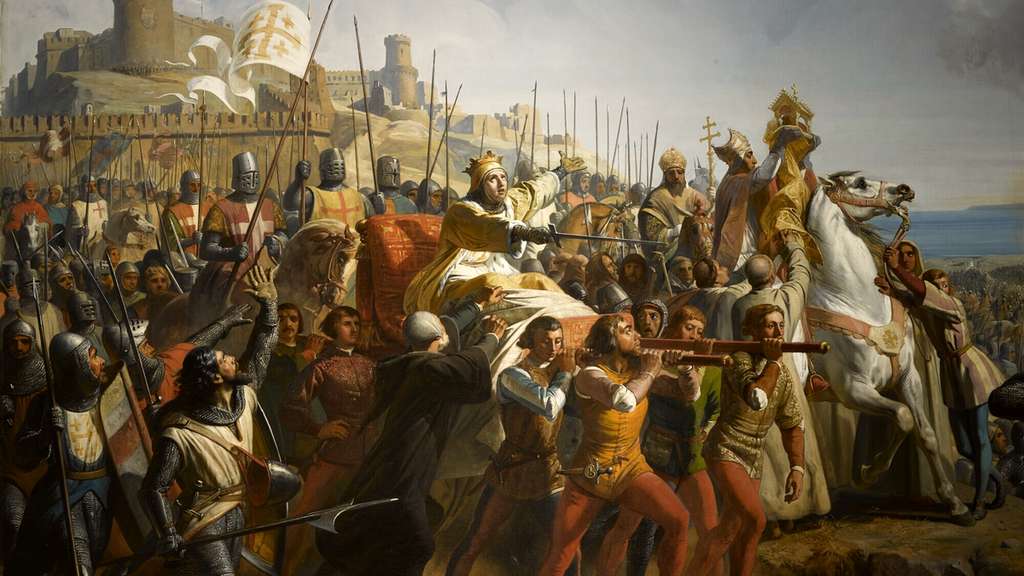
In November 1177, Saladin marched out of Egypt with a large army aimed at the crusader Kingdom of Jerusalem. Standing in his way was a 16-year-old king with leprosy and a few hundred knights. A week later Saladin was fleeing back across the Sinai, and his army was scattered across the coastal plain. The Battle of Montgisard is one of the great upsets of the crusading era, and it is worth exploring how it happened, what the chroniclers claim, and why the victory did not change the long game.
If you want the full story of the king himself, start with our profile of Baldwin IV of Jerusalem, the Leper King. Here the focus is the campaign.
Who Fought at Montgisard?
On one side was Saladin, sultan of Egypt and, since 1174, master of Damascus. He was building a state that wrapped around the crusader kingdom from the south and east. (Our post on Saladin covers the man in more depth.)
On the other side was Baldwin IV. He was born in the early summer of 1161, according to the historian Bernard Hamilton, which makes him 16 at the time of the battle. He had been king since 1174 and was already ill with leprosy.
The timing mattered. In 1177 a large part of the kingdom’s strength was away in the north. Philip, count of Flanders, had arrived on crusade, and he went off with Raymond of Tripoli and many of the Hospitallers to campaign around Hama and Harim in Syria. Saladin saw the opening and took it.
Before Philip’s arrival, Baldwin had named Raynald of Châtillon, the former prince of Antioch, regent and commander of the army, to act whenever the king could not lead in person. William of Tyre, our main chronicler, says so directly. Raynald was at Baldwin’s side for the whole campaign, and modern scholars say the young king leaned heavily on his military experience.
Saladin's Invasion From Egypt
Saladin crossed the Sinai in November 1177. William of Tyre says he left part of his heavy baggage at al-Arish, passed the frontier forts of Darum and Gaza, and appeared before Ascalon. The modern reconstruction puts the invasion around 18 November and Saladin’s arrival at Ascalon around 22 November.
Baldwin at Ascalon, the Templars at Gaza
Baldwin had moved fast. When Saladin arrived, the king and his troops were already inside Ascalon. Meanwhile Odo of St Amand, master of the Knights Templar, had taken a body of knights (Hamilton says 80) to hold Gaza, further south.
There was a skirmish outside Ascalon that lasted until evening, and then the Christians pulled back inside the walls. From Saladin’s point of view, the king was bottled up in a coastal city with a small force. The road north was open.
Saladin's Army Breaks Up to Raid
This is where the campaign turned. William of Tyre says Saladin’s men grew arrogant and spread out across the country in raiding bands. One commander burned Ramla and attacked Lydda. Panic reached Jerusalem, where, William writes, people fled into the Tower of David for safety.
A dispersed army is a vulnerable army. Saladin was confident enough to let his troops plunder, and that left his own command group without most of its strength around it.
The Battle of Montgisard, 25 November 1177
Baldwin did not stay in Ascalon. He marched out along the coast, and the Templars from Gaza joined him. According to William of Tyre, they caught sight of the enemy around the eighth hour of the day, in the afternoon.
William lists who was with the king: Odo of St Amand and 80 Templar brothers, Raynald of Châtillon, Baldwin of Ramla and his brother Balian, Reynald of Sidon, and the king’s uncle Joscelin. The True Cross, the kingdom’s most sacred relic, was carried by Albert, bishop of Bethlehem.
Then the Christians charged. Saladin’s forces were caught out of formation and broke. William describes a pursuit that ran from Mont Gisard to a marsh he calls the Cannaie des Etourneaux, “twelve miles and more”, until nightfall. Modern accounts say a Templar charge came close to reaching Saladin himself.
William dates the battle to 25 November, the feast of St Catherine of Alexandria. Grateful for the win, Baldwin later founded a monastery dedicated to St Catherine on the battlefield.
Where Exactly Was Mont Gisard?
Nobody is completely sure. William places it near Ramla, and the name has been linked to Tell Jezer (ancient Gezer). Other scholars point to Tell es-Safi, further south. “Montgisard” is the traditional label, but the precise ground is still debated.
How Big Were the Armies?
This is where you have to read the sources carefully, because the numbers are claims, not counts.
- The Franks. William of Tyre says the king’s force, “including all ranks and conditions”, was “barely three hundred and seventy-five”, plus the 80 Templars. That figure seems to count only the mounted fighting men. Modern historians generally assume a body of infantry was there too, and one other contemporary estimate puts the Christians in the thousands.
- Saladin’s army. William says he investigated carefully and arrived at 26,000 light cavalry, plus a bodyguard of about 1,000 in yellow silk. The historian W. B. Stevenson called the Latin estimates exaggerated. A review of Saladin’s Egyptian army in 1181 lists about 8,500 regular cavalry, which suggests the real field army was much smaller than 26,000.
So the honest version: Baldwin was badly outnumbered, but the gap was probably less extreme than “375 against 26,000” makes it sound.
Was William of Tyre There?
William writes this part in the first person (“we lost four or five knights”), and his 1943 translators thought he probably rode with the king. Others argue he never went on campaign. Either way, he was writing close to the events and knew the people involved.
Saladin's Escape
The defeat turned into a disaster on the way home. William says ten days of rain and cold wore down the survivors, and the men guarding the baggage at al-Arish ran off. Many stragglers were killed or captured.
Saladin himself got back, but barely. William says he returned “attended by barely a hundred followers” and was “said to have been mounted on a camel”. Modern accounts have him reaching Cairo in early December with only a fraction of the army he had marched out with. The losses on the Christian side were real too: the Hospitaller master later reported about 1,100 dead and 750 wounded.
Why the Victory Did Not Last
Montgisard was a stunning tactical win, and it gave Baldwin enormous prestige. But it did not break Saladin, whose resources were much deeper than the kingdom’s.
- Jacob’s Ford, 1179. Baldwin went on the offensive, building a new Templar castle at Jacob’s Ford on the upper Jordan. In June 1179 Saladin defeated the Franks at Marj Ayyun, where Odo of St Amand was captured (he died in captivity). In late August Saladin besieged the unfinished castle, broke in and destroyed it.
- Hattin, 1187. Baldwin died in 1185. Two years later, on 4 July 1187, Saladin destroyed the army of King Guy at the Horns of Hattin and captured the True Cross. Raynald of Châtillon, Baldwin’s commander at Montgisard, was killed by Saladin after the battle. Jerusalem fell that October.
That chain of events set up the Third Crusade and the clash between Saladin and Richard the Lionheart.
Battle of Montgisard: Frequently Asked Questions
Who won the Battle of Montgisard?
The Kingdom of Jerusalem under Baldwin IV. Saladin’s army was routed and the sultan barely escaped back to Egypt.
When was the Battle of Montgisard?
On 25 November 1177, the feast of St Catherine, near Ramla in what is now central Israel.
How old was Baldwin IV at Montgisard?
He was 16. Bernard Hamilton dates his birth to the early summer of 1161.
How many soldiers fought at Montgisard?
William of Tyre claims about 375 Frankish fighters plus 80 Templars, against 26,000 of Saladin’s cavalry. Modern historians think both figures are distorted: the Franks probably had infantry as well, and Saladin’s army was likely much smaller than William claims.
What role did the Templars play?
Odo of St Amand led about 80 Templar knights from Gaza to join the king before the battle. They fought in the charge that broke Saladin’s army.
Did Saladin ever lose another big battle?
Thomas Asbridge calls Montgisard the only defeat in pitched battle Saladin suffered before Richard the Lionheart arrived with the Third Crusade. Richard then beat him at Arsuf in 1191.
Sources
- William of Tyre, A History of Deeds Done Beyond the Sea, Book XXI, chapters 14 and 20–24, translated by E. A. Babcock and A. C. Krey (1943): https://archive.org/details/williamoftyrehistory
- Bernard Hamilton, The Leper King and His Heirs (Cambridge University Press, 2000), chapter “The victor of Mont Gisard”: https://doi.org/10.1017/cbo9781107050662.011
- “Battle of Montgisard”, Wikipedia (summary of modern scholarship, including Stevenson and the 1181 army review): https://en.wikipedia.org/wiki/Battle_of_Montgisard
- “Battle of Hattin”, Encyclopaedia Britannica: https://www.britannica.com/event/Battle-of-Hattin
- Medievalists.net, “The Failed Hit at Mont Gisard: The Templars against Saladin”: https://www.medievalists.net/2026/01/templars-saladin-mont-gisard/
Related on History Republic
- Baldwin IV of Jerusalem: The Leper King
- Saladin: Why the Sultan Took Jerusalem Without a Massacre
- Richard the Lionheart
- Frederick Barbarossa
Keep exploring in the History Republic app.
An interactive map of where history happened, short biographies of history’s heroes, and quizzes. Free to download.

Sources & further reading
Where this story comes from: the medieval chronicler first, then the historians who have studied him. Links open free texts where we could find a reliable one.
Primary sources
- William of Tyre, A History of Deeds Done Beyond the Sea, Book XXI, chapters 14 and 20–24 (trans. E. A. Babcock and A. C. Krey, 1943) (via Internet Archive)
Modern scholarship
- Bernard Hamilton, The Leper King and His Heirs (Cambridge University Press, 2000), chapter “The victor of Mont Gisard”
- “The Failed Hit at Mont Gisard: The Templars against Saladin,” Medievalists.net
Reference
- “Battle of Montgisard,” Wikipedia (summary of modern scholarship, including Stevenson and the 1181 army review)
- “Battle of Hattin,” Encyclopaedia Britannica