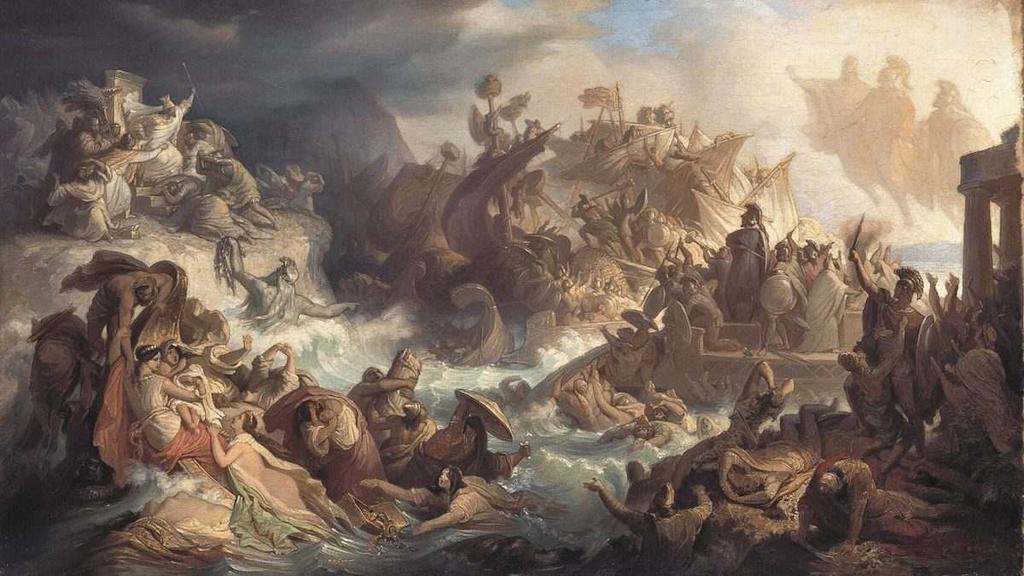
On a September day in 480 BC, the king of Persia sat at the foot of a mountain above the sea and waited to watch his navy win the war. Herodotus says Xerxes had scribes beside him, ready to write down the name of every captain who fought well for him. By nightfall the Battle of Salamis was lost, and an invasion Herodotus calls “by far the greatest of all expeditions that we know of” was starting to come apart.
Almost everything we know about that day comes from two Greeks. Herodotus wrote his Histories a generation or so later. Aeschylus staged his play The Persians in Athens in 472 BC, only eight years after the battle. Both tell it as a story about pride, and both had reasons to tell it that way.
So here is the story as they tell it: the bridges, the whip, the trick that pulled a fleet into a trap, and the long march home. Along the way we’ll flag where the ancient numbers stop being believable, and why the fall of Xerxes at Salamis still reads like a warning to anyone who thinks they can’t lose.
Who Was Xerxes I?
Xerxes I was the son of Darius I and Atossa, a daughter of Cyrus the Great, the man who built the Persian Empire. According to Encyclopaedia Britannica, Xerxes took the throne in 486 BC at about 35 years old, after governing Babylonia for roughly a dozen years. He inherited a vast empire and a grudge. His father’s army had been beaten by the Athenians at Marathon in 490 BC.
Britannica says his cousin Mardonius pushed hard for revenge, and that preparations for a new invasion took about three years, from 484 to 481 BC. Not everyone at court was keen. Herodotus says Xerxes’ uncle Artabanus spoke his mind freely and advised him not to march against Greece at all. Xerxes went anyway.
The Xerxes Invasion of Greece
Herodotus treats the march into Greece as a long display of power, and some of the most famous stories about Xerxes come from these months.
Whipping the Hellespont
To get his army from Asia into Europe, Xerxes had bridges of boats built across the Hellespont, the narrow strait between the two continents. A storm wrecked them. Herodotus says Xerxes was so angry that he ordered the Hellespont to be given three hundred lashes and had a pair of fetters thrown into the water. In A. D. Godley’s translation, the men with the whips were told to say: “Bitter water, our master thus punishes you, because you did him wrong though he had done you none.” Then the overseers of the bridge were beheaded.
Herodotus also describes a canal dug through the isthmus at Mount Athos, so the fleet wouldn’t have to sail around the headland where an earlier Persian fleet had been wrecked. He says the work took about three years, and that men were driven to dig with whips.
A King Who Wept at His Own Army
One of the strangest moments in Herodotus comes at Abydos, on the Asian shore. Xerxes looked out at the Hellespont covered with ships and the plains full of men, called himself blessed, and then wept. When Artabanus asked why, Xerxes said he had been thinking about how short human life is, since “of all this multitude of men not one will be alive a hundred years from now.”
How Big Was Xerxes' Army?
This is where you have to read Herodotus with care. He says Xerxes brought 1,207 triremes and calculates the fighting men at 2,641,610. Then he adds the servants and supply crews and arrives at a grand total of 5,283,220 people. Aeschylus gives Xerxes a thousand ships and singles out 207 of them, or perhaps 207 more, as especially fast.
Modern historians dispute these numbers and think the real forces were much smaller. Britannica’s article on Xerxes I, written by the archaeologist Jean-Louis Huot, gives a modern estimate of about 360,000 soldiers and 700 to 800 ships. That’s still an enormous force for the ancient world.
Thermopylae and the Fall of Athens
In mid-August 480 BC, by Britannica’s dating, the Persians forced the pass at Thermopylae after the famous stand of the Spartan king Leonidas and his men. We cover that story in full in our post on Leonidas of Sparta. For this story, what matters is what came next. The road to Athens was open.
The Athenians had already made a hard choice. Herodotus says they asked the oracle at Delphi for advice and were told that “a wood-built wall” would save them, and that “divine Salamis” would “bring death to women’s sons.” The Athenian politician Themistocles argued that the wooden wall meant ships, and that the oracle’s doom fell on the enemy, not on Athens. Years earlier he had also persuaded the Athenians to spend a windfall from their silver mines at Laurium on two hundred warships instead of sharing it out. Now those ships were the city’s best hope.
Most Athenians left their homes. Herodotus says families were sent to Troezen, Aegina and Salamis. The Persians reached an almost empty city, climbed the Acropolis, killed the few defenders who had stayed, and set the whole Acropolis on fire.
Themistocles and the Trap at Salamis
The allied Greek fleet gathered at Salamis, an island just off the coast of Attica, under the Spartan admiral Eurybiades. Herodotus puts the fleet at 378 ships, rising to 380 when two deserting ships came over. Aeschylus says three hundred, plus a picked squadron of ten. Britannica’s summary says about 370 triremes.
The allies couldn’t agree on what to do. Many of the Peloponnesian commanders wanted to pull back and defend the Isthmus of Corinth. Themistocles wanted to fight where they were, in the narrow waters between Salamis and the mainland. Herodotus says he warned Eurybiades that if the fleet sailed away, the Athenians would load up their families and leave for Siris in Italy.
Artemisia's Warning
On the Persian side, there was a voice of caution too. Herodotus says Artemisia, the queen of Halicarnassus who commanded her own ships in Xerxes’ fleet, advised against fighting at sea. Xerxes liked her answer and praised her, but he ordered that the majority be obeyed. Herodotus gives a telling reason. Xerxes believed his men had fought badly earlier at Euboea because he wasn’t there to watch, so this time he planned to see the battle in person.
The Message From Sicinnus
Then came the trick. When the Peloponnesians were outvoting him, Herodotus says, Themistocles secretly sent his servant Sicinnus by boat to the Persian commanders. Sicinnus told them that Themistocles was on the king’s side, that the Greeks were terrified and planning to run, and that the Persians could “perform the finest deed of all” if they didn’t let them escape.
The Persians took the bait and moved to close the exits from the strait. The Athenian Aristides, whom Athens had exiled, slipped through from Aegina and told the Greek commanders they were surrounded. When a ship of deserters from Tenos arrived with the same news, the argument was over. The Greeks had to fight, and they would fight in the narrows.
The Battle of Salamis, 480 BC
Britannica describes the battle site as the straits between the island of Salamis and the Athenian port of Piraeus. In those cramped waters, the size of the Persian fleet became a problem instead of an advantage. Herodotus says the Greeks fought in an orderly line, while the Persians “were no longer in position and did nothing with forethought.”
Herodotus adds a detail that fits the whole story. The Persian crews were brave that day, he says, because each one thought the king was watching him. When the front ships turned to flee, the ships behind them were pushing forward to show off for Xerxes, and they crashed into their own side. Many Persians drowned because they couldn’t swim, while Greeks whose ships sank swam to Salamis. Among the dead was Ariabignes, a son of Darius and Xerxes’ own brother.
Xerxes Watches From Mount Aegaleos
Herodotus says Xerxes sat beneath the mountain opposite Salamis called Aegaleos, and whenever he saw one of his men do something brave, his scribes wrote down the captain’s name, father and city. Herodotus also says the king was watching when Artemisia, chased by an Athenian ship with no room to escape, rammed and sank a ship on her own side. The watchers around Xerxes thought she had sunk an enemy, and Xerxes is said to have replied: “My men have become women, and my women men.”
Psyttaleia and the End of the Day
Before the battle, the Persians had landed troops on Psyttaleia, a small island in the strait. Herodotus says they were there to rescue their own men and kill any Greeks who washed ashore, and Aeschylus calls them Xerxes’ choicest troops. Herodotus says Aristides led armed men across and killed every Persian on the islet. Aeschylus makes this the worst moment of all. In his play, a messenger tells the Persian court that Xerxes, seated on a high headland with a view of the whole army, groaned aloud, tore his robes and ordered his land forces to fall back.
Britannica’s summary puts the losses at about 300 Persian ships sunk against about 40 Greek ships. Like every number from this war, that’s an estimate, not a count.
Why Did Xerxes Lose at Salamis?
Strategy and geography did a lot of the work. But Herodotus and Aeschylus both tell the defeat as a story about a man who couldn’t imagine losing. Their account points to a few choices that line up uncomfortably well.
- He fought where his numbers didn’t count. A huge fleet needs open water. Xerxes sent his into a narrow strait where only part of it could fight at once.
- He ignored the people who told him no. Herodotus gives him two warnings, from Artabanus before the war and from Artemisia before the battle. He praised Artemisia and overruled her anyway.
- He believed the message he wanted to hear. The note from Sicinnus told Xerxes the Greeks were scared and divided. It was exactly what a confident king expected, so it worked.
- He made the battle about being seen. By Herodotus’ telling, the king wanted to watch, and his captains wanted to be watched. That’s how rear ships ended up crashing into their own front line.
Aeschylus goes further. His messenger says it wasn’t numbers that beat Persia but “some divine power that tipped the scale.” Britannica notes that the play blames the defeat partly on the gods punishing Persian folly for reaching beyond Asia. That’s the Greek idea of hubris, pride that invites its own punishment.
It’s worth keeping some balance here. These are Greek writers telling a Greek victory. Huot argues in Britannica that Xerxes’ character “was later distorted in Greek legend,” and that he was neither foolish nor overly optimistic. The arrogance story may be partly a story the winners liked to tell. It has lasted because the pattern feels so human.
Aftermath and Legacy: From Salamis to Alexander
Herodotus says Xerxes feared the Greeks would sail north and break his bridges, trapping him in Europe, so he decided to go home. Mardonius stayed behind in Greece with a picked army that Herodotus numbers at three hundred thousand. Xerxes took 45 days to reach the Hellespont, and Herodotus describes starving men eating grass and tree bark, with disease spreading through the ranks. When they got there, the bridges had been broken by a storm, and the army crossed by ship.
The next year, 479 BC, the Greeks beat Mardonius at Plataea, and Mardonius was killed. Herodotus says a Greek fleet won at Mycale, on the coast of Asia Minor, on the very same day. The invasion of Greece was over. Britannica says Xerxes turned to building at Persepolis and was assassinated by his courtiers in 465 BC. It also calls his defeat the beginning of the decline of the Achaemenid Empire.
That decline took a long time. A century and a half after Salamis, Alexander the Great crossed the same Hellespont in 334 BC, beat Darius III at Gaugamela in 331 BC, and took Persepolis. Darius III, the last Achaemenid king, was killed by one of his own governors in 330 BC.
Salamis wasn’t the last time a great power trusted its size at sea and paid for it. If you want a later parallel, the story of why the Spanish Armada failed is a good place to keep exploring. And if you want to see the same kind of confidence play out on land, Napoleon’s overconfidence is another case worth a look.
Support History Republic
Battle of Salamis: Frequently Asked Questions
When was the Battle of Salamis?
It was fought in September 480 BC. Britannica dates it to September 29, though other modern reconstructions place it a few days earlier. Herodotus doesn’t give a calendar date.
How many ships fought at Salamis?
Nobody knows for sure. Herodotus says the Greeks had 378 to 380 ships and Xerxes started the campaign with 1,207. Aeschylus gives 310 Greek ships against about 1,000 Persian ones. Britannica’s modern summary says about 370 Greek triremes against about 800 Persian galleys.
Did Xerxes really whip the sea?
Herodotus says he did, with three hundred lashes, after a storm broke his bridges over the Hellespont. He even says he’d heard Xerxes sent men to brand the water. There’s no way to confirm it, and it may be a story told to make the king look arrogant, but it’s one of the most famous scenes in Herodotus.
Why was the Battle of Salamis important?
It destroyed much of the Persian fleet and sent Xerxes back to Asia. Britannica notes that the defeat forced him to delay his land campaign for a year, which gave the Greek city-states time to unite. They won at Plataea and Mycale in 479 BC, and Britannica says Xerxes played only a small part in the war after that.
Related on History Republic
- Leonidas of Sparta
- Cyrus the Great
- Alexander the Great: The 3 Strategic Decisions That Built an Empire
- Why the Spanish Armada Failed (It Wasn’t Just the Weather)
Keep exploring in the History Republic app.
An interactive map of where history happened, short biographies of history’s heroes, and quizzes. Free to download.
Sources & further reading
As an Amazon Associate I earn from qualifying purchases.